World Economic Forum – Deep Shift

A must read on six mega-trends, their tipping points and societal impacts. I recommend this for anyone with interest in where the world is heading, and/or tasked with future thinking in the context of strategy. I commend the World Economic Forum for their efforts here, as education is likely to spur action. The six mega-trends are:

  1. People and the internet
  2. Computing, communications and storage everywhere
  3. The Internet of Things
  4. Artificial intelligence (AI) and big data
  5. The sharing economy and distributed trust
  6. The digitization of matter

Here is a tipping point timeline from the report:

Many leaders are struggling with the sheer number of future scenarios and some indication of when the tipping point may arrive. This material provides critical input into the scenario and response analysis process. Enjoy the read.

IDC Predicts a DX Economy

IDC today announced its worldwide information technology (IT) industry predictions for 2016 and beyond. The predictions were published in a new IDC FutureScape report. As we embrace the notion of Future Thinking

This forward looking guidance is critical. Here is a snippet from the report:

“The disruptive impact of digital transformation is about to be felt in every industry as enterprises ‘flip the switch’ and massively scale up their DX initiatives to secure a leadership role in the DX economy,” said Frank Gens, Senior Vice President and Chief Analyst at IDC. “In the next two years, two-thirds of Global 2000 CEOs will put DX at the center of their growth and profitability strategies. By the end of this decade, IDC predicts that the percentage of enterprises with advanced DX strategies and implementations will more than double.”

IDC predicts that the scale-up of digital business strategies will drive more than half of enterprise IT spending within the next 24 months, rising to 60% by 2020. Mastery of 3rd Platform technologies will be table stakes for successfully executing DX business initiatives and “Cloud First” will become the new mantra for enterprise IT. Virtually none of the other 3rd Platform technologies or major DX initiatives is possible in scaled-up implementations without the Cloud as the foundation. By 2020, IDC predicts that enterprise spending on cloud services, the hardware and software to support cloud services, and the services for implementing and managing cloud services will exceed $500 billion, more than three times what it is today.

Source: FutureScape

Additional predictions were provided:

  1. By the End of 2017, Two-Thirds of the CEOs of the G2000 Will Have Digital Transformation at the Center of Their Corporate Strategy
  2. By 2017, 60% Companies with a DX Strategy Will Deem It Too Critical for Any One Functional Area and Create an Independent Corporate Executive Position to Oversee the Implementation
  3. By 2018, 80% of B2C Companies Will Have Created Immersive, Authentic Omni-Experiences for Customers, Partners, and Employees; 60% of B2B-Centric Companies Will Have Done the Same
  4. The Top New Investment Areas Through 2017 Will Be Contextual Understanding and Automated Next Best Action Capabilities
  5. In 2016, 65% of Large Enterprises Will Have Committed to Become Information-Based Companies, Shifting the Organizational Focus to Relationships, People, and Intangible Capital
  6. By 2018, 75% of the G2000 Will Have Deployed Full, Information-Based, and Economic Models or “Digital Twins” of Their Products/Services, Supply Network, Sales Channels, and Operations
  7. By 2020, 60% of the G2000 Will Have Doubled Their Productivity by Digitally Transforming Many Processes from Human-Based to Software-Based Delivery
  8. In 2016, the Level of Connectivity Related to Products, Assets, and Processes Will Increase 50% for All Industry Value Chains
  9. The Sharing Economy Will Give Rise to the Networked Free Agent and Skill-Based Marketplaces, Resulting in More than 10% of Work Being Sourced in this Fashion in Mature Economies by 2019
  10. By 2018, at Least 20% of All Workers Will Use Automated Assistance Technologies to Make Decisions and Get Work Done

No Ordinary Disruption

In my last future of business series post, I focused on a recent book titled No Ordinary disruption. That post explored the author’s belief that our intuitions must be reset. In that same book, the authors explore what they call “trend breaks”, or shifts away from the trends of the recent past. This post will look at these breaks and their impact on 21st century organizations – and it starts with value. In the rapidly growing world of ecosystems, the way value is created and captured is changing. But, more fundamentally, even our traditional views of value are being challenged. The authors use GDP as a way to underscore this point. They estimate that digital capital is now the source of roughly one-third of total global GDP growth, with value delivered via intangible assets like Google’s search algorithm or Amazon’s recommendation engine. Even our long standing view of capital itself is shifting, as human creative capital becomes a critical source of value.

Additionally, future value increasingly accrues to consumers. In a recent article titled Why Every Aspect of Your Business is about to Change, the author talks about the destruction of value for incumbents and the creation of value for consumers in the form of consumer surplus. They use a powerful example to make their point: Skype brought in $2 billion in 2013, but McKinsey calculates that at the same time, they transferred $37 billion away from telecom firms to consumers via free or low-cost calls. Even the innovative new company only gets a fraction of the value created (Skype: $2 Billion, Consumers $37 Billion). So back to value and GDP: consumer surplus is not accounted for in the way we measure GDP. This creates two challenges: First, do we need to change the way we measure value? Second, how do companies monetize the newly created consumer surplus?

So what does this mean for the future of business? Let’s start with something right from the aforementioned book: On the first day of classes at Ivy League colleges, it was common for the dean to warn students: “Look to the left, look to the right. One of you won’t be here next year.” That seems very appropriate when looking through the lens of company viability. This real phenomenon unfolds over the next decade, driven in part by several trend breaks as identified by the authors:

Continue reading

Your business is about to change – Fortune

Source: Why every aspect of your business is about to change – Fortune

Great piece. This is very timely given the future of business series that I am currently focused on. The major themes:

  1. Asset heavy to asset-light
  2. Employees are the business – but you likely need less of them
  3. Winners win big, the rest fight very hard
  4. Corporate life expectancy shrinks
  5. The continued move towards a frictionless economy
  6. Speed equals survival
  7. Low capital companies out performing heavy capital competitors
  8. Growth before profits
  9. The 21st Century Corporation
  10. Competition gets tougher

Enjoy the read!

A version of this Fortune article appears in the November 1, 2015 issue of Fortune with the headline “Every aspect of your business is about to change.”

Intuition Resets

Will our fundamental beliefs be challenged in the coming decade? In a recent book titled No Ordinary Disruption, the authors talk about the need for an intuition reset, where everything we thought we knew about the world seems to be wrong. They see our world changing radically from the one in which those intuitions that drive our decision making were formed. Skeptics abound, but I for one see the writing on the wall. In the future-of-business series kick-off, I focused on Future Scenarios as a major force in altering the future of business. Let’s continue the series by focusing on other forces.

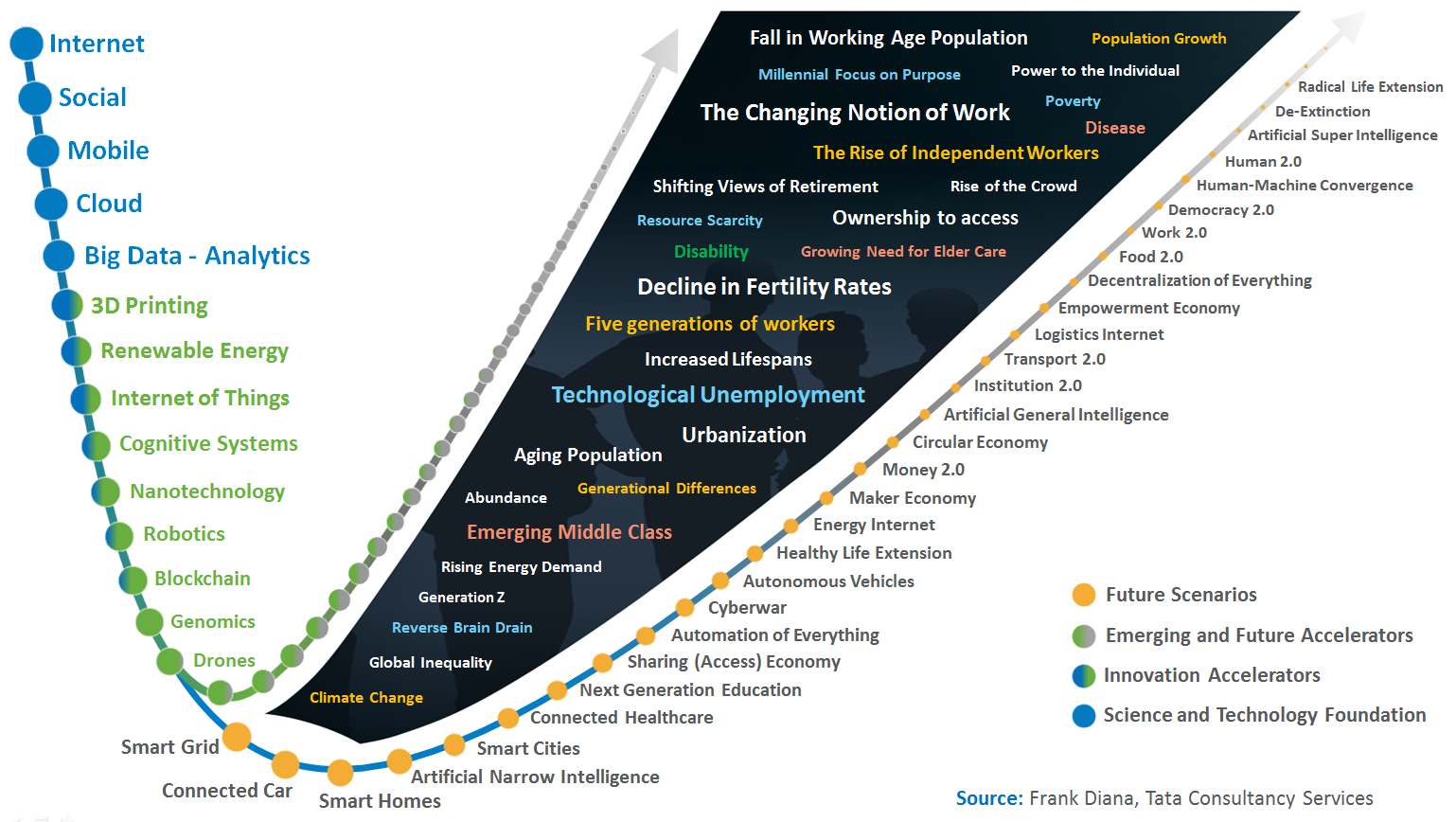
In the book referenced above, the authors compare the coming transformative period with the Industrial Revolution of the late 18th and early 19th centuries – where one new force changed everything. As I have tried to depict in my future scenario Visual, we are dealing with multiple forces or shifts that are converging. In their analysis, the authors conclude that our world is undergoing an even more dramatic transition due to this convergence. They focus on four forces (urbanization, technological change, aging, and connectivity) and deem that any of them would rank among the greatest changes the global economy has ever seen. Compared with the Industrial Revolution, they estimate that this change is happening ten times faster and at 300 times the scale, or roughly 3,000 times the impact – digest that as you consider whether our fundamental beliefs will change in the coming decade. Here is a quote from the book: “Although we all know that these disruptions are happening, most of us fail to comprehend their full magnitude and the second and third-order effects that will result. Much as waves can amplify one another, these trends are gaining strength, magnitude, and influence as they interact with, coincide with, and feed upon one another. Together, these four fundamental disruptive trends are producing monumental change”

Continue reading

Future Scenarios

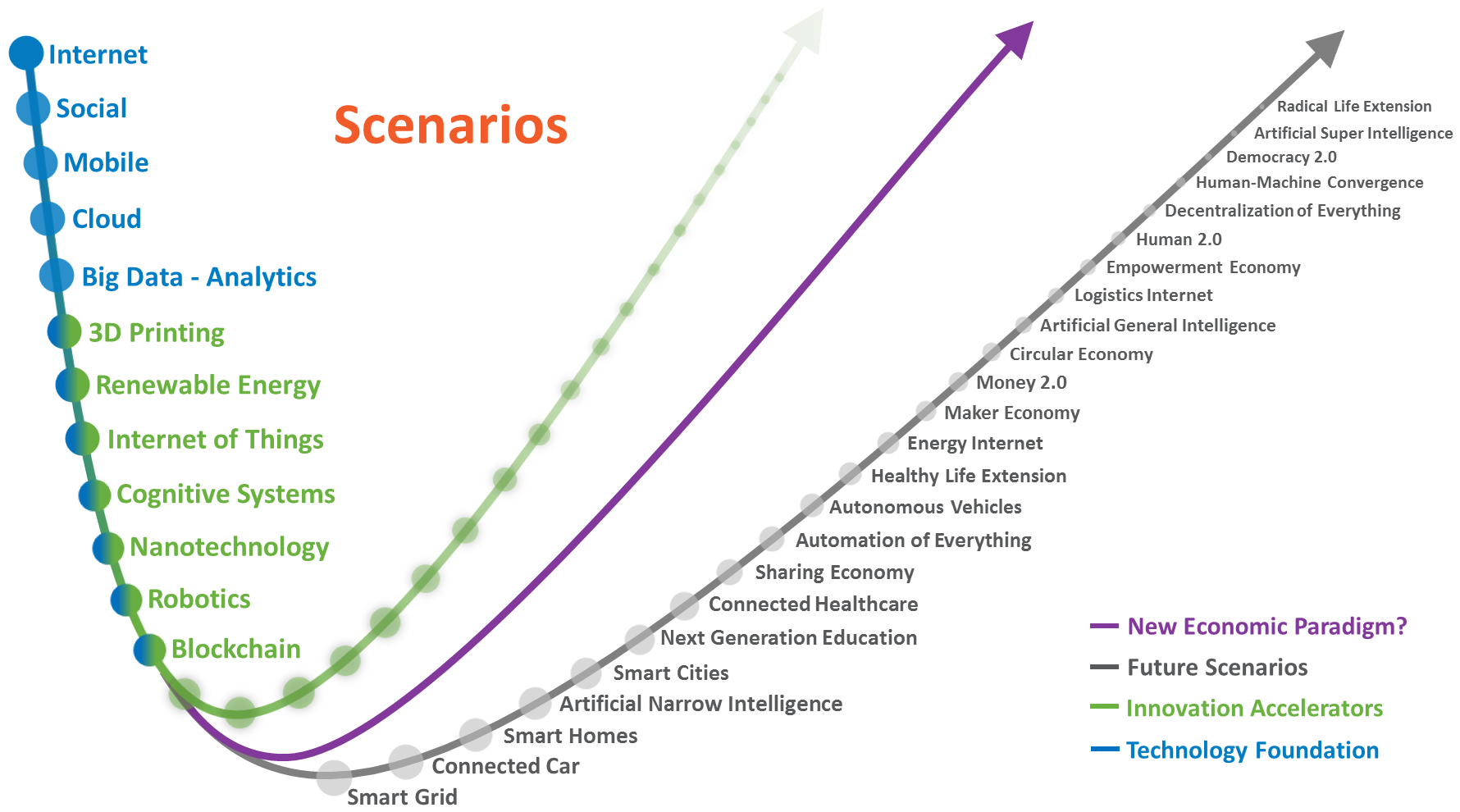
In my recent post on the Future Business Landscape, I shared predictions pulled together by SAP. The sources for this type of information are multiplying, which for me signals the start of a growing focus on the future of business. With this post, I am launching a series that delves into what that future might look like, starting in a logical place with future scenarios. This visual representing a series of paradigm shifts has anchored my thinking for some time, and sits at the heart of this future.

 emerging-future

Continue reading

The Future Business Landscape

I expect the conversation regarding the Future of Business to intensify over the coming months. Evidence is mounting that business as usual is a thing of the past. In a recent post by SAP, they present ninety nine ways that digital will change business. As you look at the information presented, and see the number of shifts occurring at the same time, it’s hard to imagine a business landscape that weathers this storm unscathed. Here are examples of these shifts from the SAP post:

  • At the current turnover rate, 75% of the companies in the S&P 500 in 2027, will be new (companies not currently in index today)
  • By 2019, approximately one quarter of the entire U.S. workforce will be independent workers (self-employed, independent contractor, freelancer, temp contractor, etc.)
  • By 2030, 10% of the largest companies in the U.S. will be virtual corporations (less than 10% of their workers will be in an office at any point in time)
  • 50% of the U.S. Jobs lost in the 2008 recession were middle-skilled jobs, but only 2% of the jobs gained since then have been middle-skilled
  • By 2025, there will be 10 global virtual currencies that will be considered mainstream. Their combined market value will exceed $5 Trillion, and Bitcoin will still be the largest.
  • Private and commercial robot use will grow 2,000% from 2015 to 2030, creating a $190 billion market
  • By 2030, 2 billion jobs will disappear – roughly 50% of all the jobs on the planet – as a result of technology advances
  • 3D Printing usage will grow 2000% between 2015 and 2030
  • Purpose-driven and value-oriented organizations outperform their competition 15 to 1
  • By 2030, sensor use will grow 700,000%, solving nearly every human need such as cancer-killing chips
  • By 2020, information will reinvent, digitize, or eliminate 80% of business processes and products
  • Although 90% of companies view advanced and predictive analytics as important, less than 30% have currently deployed them, and only 30% have plans to do so
  • There will be more words written on Twitter in the next two years than contained in all books ever printed
  • By 2025, the total worth of IoT-enabled technology is expected to reach $6.2 trillion – most of that in healthcare (2.5 Trillion) and Manufacturing (2.3 Trillion)
  • Within the next five years, more than 90% of all data from IoT will be hosted in the Cloud, reducing the complexity of supporting IoT “Data Blending

Just a small sample (more via the link above) supporting the notion that the future of business could look considerably different than its past. I’ll pursue the future business landscape in up-coming posts.

Digital Transformation of Business and Society

At a recent KPMG Robotic Innovations event, Futurist and friend Gerd Leonhard delivered a keynote titled “The Digital Transformation of Business and Society: Challenges and Opportunities by 2020”. I highly recommend viewing the Video of his presentation. As Gerd describes, he is a Futurist focused on foresight and observations – not predicting the future. We are at a point in history where every company needs a Gerd Leonhard. For many of the reasons presented in the video, future thinking is rapidly growing in importance. As Gerd so rightly points out, we are still vastly under-estimating the sheer velocity of change.

With regard to future thinking, Gerd used my future scenario slide to describe both the exponential and combinatorial nature of future scenarios – not only do we need to think exponentially, but we also need to think in a combinatorial manner. Gerd mentioned Tesla as a company that really knows how to do this.

Continue reading

Business Networks and the Digital Economy

I have had the ongoing pleasure of participating in SAP’s Coffee Break with Game Changers radio program, the most recent one on August 26th. I was joined by Dennis DeGregor, Worldwide Group Executive for customer experience services at HP, and Drew Hofler Sr. Director, Solutions Marketing, Ariba network and Financial Solutions. The show was titled “Business Networks and the Digital Economy: Ready for Digital Humanism?” and was expertly moderated by Bonnie D. Graham.

The episode description: What does it really mean for you to have a connected business? Analysts estimate that by 2020, social networks will connect 2.5 billion people, the number of connected devices will total 75 billion, and the volume of global business trade between connected businesses will reach $65 trillion. As we move to an era of true hyper-connectivity in our digital economy, how can your company turn these challenges and your business networks into sustainable profitable opportunities?

Bonnie kicks off each show by analyzing a quote provided by each panelist. The following are our quotes and their relevance to the topic: 

Continue reading

Rebroadcast: Coffee Break with Game-Changers

| Business Networks and the Digital Economy: Ready for Digital Humanism? on Coffee Break with Game-Changers | VoiceAmerica™ – The Leader in Internet Media

Source: Coffee Break with Game-Changers | VoiceAmerica™

Coffee Break with Game-Changers | VoiceAmerica™

Join me today August 26th at 11:00 EST for another episode of Coffee Break with Game-Changers | VoiceAmerica™

Episode Description

The buzz: Let’s get together, yeah yeah yeah! What does it really mean for you to have a connected business? Analysts estimate that by 2020, social networks will connect 2.5 billion people, the number of connected devices will total 75 billion, and the volume of global business trade between connected businesses will reach $65 trillion. As we move to an era of true hyperconnectivity in our digital economy, how can your company turn these challenges and your business networks into sustainable profitable opportunities? The experts speak. Dennison DeGregor, HP: “The digital CX revolution is dead – long live Digital Humanism!” Frank Diana, TCS: “The networked organization of the future knows that the lion’s share of value exists outside its walls; it looks to capture that value and bring it inside” (Dion Hinchcliffe). Drew Hofler, SAP: “We build too many walls and not enough bridges” (Sir Isaac Newton). Join us for Business Networks and the Digital Economy: Ready for Digital Humanism?

If you miss the live broadcast, follow the link later to listen to the podcast.


Empowerment Economy

On a recent Radio Program focused on the future of business, Gray Scott introduced another future scenario. He called it the empowerment economy, and he described it this way:

He sees the past in three stages: 1) companies were in the business of providing supplies and core objects 2) we moved away from that to a convenience economy where we make it convenient for you to get what you need 3) now we are moving to the empowerment economy. It’s no longer about providing an object or convenience; it’s about giving them the power to supply themselves. Gray does not believe corporations understand this. Google and Uber get this circular idea of empowering people, which he believes is the future of business. The companies that embrace this empowerment economy are the companies that are going to succeed.

Those are his words direct from the radio program referenced above. So we add empowerment economy to the growing list of future scenarios. Thanks Gray.

emerging-future

Emerging Paradigms and the Future of Business

I had the pleasure of joining SAP’s Coffee Break with Game Changers Radio Show on August 5th.  This was my third appearance on the show, and I was joined by Futurist Gray Scott and SAP Global Innovation Evangelist Timo Elliott. The show titled “Emerging Paradigms and the Future of Business” was part two of a series that was expertly moderated by Bonnie D. Graham. Part one of the series was a discussion on Decentralization.

The show abstract: The pace and scale of change is hitting unprecedented levels. This presents unique challenges for the future of business. We’re seeing new and emerging paradigms, exciting innovations in energy, challenges due to resource scarcity, big implications for the climate and environment, an increasing blurring of physical and digital boundaries, growing business decentralization, exponential progression, and many more global drivers – all contributing to an uncertain future. Futurists worldwide, including our panellists, are examining these factors and assessing their potential business impact. Some of the critical questions to address:

  • What factors will shape our future?
  • What new leadership skills will be needed?
  • How will leaders deal with challenges and implications outside of their base of experience?

Continue reading

Future Thinking

UPDATE: December 27, 2025. I posted this 10 years ago as I struggled with what I believed was traditional thinking in a world heading towards a bew reality. Ten years later, this series on systemic change captures what I was seeing back then.

I’m struggling with the term disruption and its effectiveness in driving urgency. Most definitions describe a radical change in an industry or business strategy, and most involve the introduction of a new product or service that creates a new market. My struggle is not with this decades old view of disruption, but its application in the context of our exponential world. The word disruption is viewed through a traditional lens. I end up in debates about the validity of a disruptive scenario as viewed through this lens, versus the massive implications of these future scenarios viewed through an exponential lens. The ensuing dialog focuses on:

  • Coming up with disruptive innovation before our competitors do
  • Embracing protectionist behavior to block a disruptor
  • I’m not worried, regulatory hurdles in my industry block the impact of disruptors
  • I’m safe, my industry is very stable

Continue reading

Expanding Disruptive Scenarios

The pace of change is such that no forward looking visual can stay static for too long. I have therefore updated the anchor visual that looks at the digital platform, the innovation accelerators, and the disruptive scenarios that result from the convergence of societal progression, science, and technology. It is impossible to capture the current environment in one visual, but I hope what has been captured drives a clear message: there is a lot happening, on a rapid pace, and its convergent effects are multiplicative. There are several changes to the visual, and my thanks to the authors of The Future of Business for their inspiration:

emerging-future

Continue reading

The Future of Business

To the readers of my Blog: a fascinating book titled The Future of Business was released last week. The lead Editor for the book was Rohit Talwar, CEO of Fast Future Research and Fast Future Publishing. This is a must read for anyone interested in where the world is going in the next 20 years, and its broad implications for individuals, society, business and government. From Mr. Talwar:

“The Future of Business is the first book in the FutureScapes series. The book focuses on the critical social and economic forces, business trends, disruptive technologies, breakthrough developments in science and new ideas that could reshape the commercial environment over the next two decades. It explores how these future factors could come together to force a fundamental rethinking of the purpose,  strategy, business models, values and structures of organizations as they seek to survive and thrive in a rapidly changing reality.”

I highly recommend this book

Re-Ranking the Fortune 100

In a recent post, I discussed a book on exponential organizations co-authored by Salim Ismail, Global Ambassador for Singularity University. In a Video from this week’s Exponential Finance conference, Mr. Ismail showcased their work on an Exponential Quotient that scores companies on organizational factors that determine how well they are positioned to succeed in an exponential world. This exponential quotient results from a diagnostic survey that asks 21 questions (each graded 1-4) about how companies have structured their products, services, and internal framework. At the end of the diagnostic, an Exponential Quotient score is determined.

The folks at Singularity University used this quotient to create The ExO Fortune 100 – a re-ranking of the current Fortune 100. The scoring was ratified by academic researchers at Hult Business School. I’ve re-printed a list from their site that shows some of the elements of the survey and the key attributes of ExOs that are being tested.

External facing questions

  • Does it have a Massive, Transformative Purpose, (or MTP)?
  • How externalized are business functions?
  • How much are on-demand staff and on-demand assets utilized?
  • How well are Community and Crowd leveraged?
  • Are algorithms a core part of the organization?
  • How information based are its products and services?

Internal facing questions

  • How well are interfaces created to manage external scalability?
  • Are OKRs and Lean Metrics used to track performance?
  • How well does the organization encourage risk-taking and experimentation?
  • Does the organization operate top-down, command and control hierarchies, or flat, autonomous, collaborative team structures?
  • How well are social technologies integrated into the organization?

As I said in my post on exponential organizations, there remains a single constant: it will take a different type of organization – different than the ones most of us grew up with – to survive the coming shift. The attributes or characteristics that create this different type of organization are getting clearer. It’s up to us to create it.

For a full list of the Fortune 100 and their associated ExO rank, please download this Spreadsheet

Technology versus Humans

Futurist Gerd Leonhard recently released a new short 3 minute film titled Technology versus Humans. Here is an excerpt from his Blog announcing the video:

“I am very excited to announce the release of my new short film “Technology versus Humanity”. This film marks the beginning of a new period for me, with much of my future work focusing on the topic of how exponential technological changes are changing what and who we are, as humans, where this is going in the next 15 years, and what we need to do, TODAY, to make sure that these changes will indeed be beneficial to us.

For this film, I was very fortunate to be able to team up with Story7 and Jean Francois Cardella as producer and director, and Jeremy Joly as DOP. They made this film very special – thanks!  We shot most of the footage in Cannes and the surrounding area – see some of the pics below.  If you like this movie, please share it and spread the word, or submit a comment below and let me know what you think.  Thanks!  New hashtag as of today:  #techversushuman

Gerd was kind enough to do an interview with me back in January. You can read that here. Enjoy the film

Structural Change: Decentralization

I had the pleasure of joining The Digital World with Game Changers radio program for the second time this year. Joining me as panelists were Futurist Gray Scott and SAP Innovation Evangelist Timo Elliott. First, kudos to program host Bonnie D. Graham for doing a wonderful job keeping the discussion energized and interesting. The title of the session was Eating Disruption for Lunch: Digesting Decentralization. Now there’s a term not heard much outside of futurist circles. Decentralization is one of those structural changes that make what lies ahead so impactful. According to Wikipedia, decentralization is the process of redistributing or dispersing functions, powers, people, or things away from a central location or authority.

Continue reading

Disruptive Power Lies at the Intersections

The content of this post was updated on February 16, 2017 in a new post titled Intersections Promise to Drive Multiple Paradigm Shifts


When I first started using the term “Combinatorial”, people thought I was making words up. Although I’d like to take credit for the word, I first came across it when reading The Second Machine Age, a fascinating book by Andrew McAfee and Eric Brynjolfsson. I remember thinking that it was a perfect word to capture the amplification of both innovation and its disruptive power. By now, readers of this Blog have seen the foundational Visual that describes the digital foundation, innovation accelerators, and disruptive scenarios. What the visual does not convey without the associated narrative is the power of combinatorial.

If we build on top of the visual, we begin to see the complexity at the intersections, the amplification of disruptive power, and the broad implications for the future.

intersections-and-amplification

The best way to describe this phenomenon is through examples, so let’s look at six combinatorial scenarios as an overlay. The visual is a bit overwhelming, so a better way to follow the various paths is via this PDF. Here is a description of each scenario. The numbers in the visual above map to the scenarios below, and the colors show the combinations: 

Continue reading