The Second Gilded Age

ANALYSIS OF KEY POINTS:

A recent article discusses the resurgence of “robber barons” in the modern era, particularly highlighted by the 2024 U.S. election. It draws parallels between the industrial magnates of the late 19th and early 20th centuries – such as Cornelius Vanderbilt, John D. Rockefeller, and Andrew Carnegie – and today’s tech billionaires like Elon Musk, Jeff Bezos, and Mark Zuckerberg. The core argument is that these contemporary titans wield immense economic and political power, much like their predecessors, and have significant influence over markets, governments, and even the media.

Continue reading
Learning From The Past: Unlearning For The Future

In an era of rapid change, the traditional understanding of literacy has become increasingly insufficient. Historically, literacy was defined simply as the ability to read and write – fundamental skills that enabled individuals to participate in society. However, as Alvin Toffler wisely pointed out, the definition of literacy in the 21st century has expanded far beyond these basic abilities. Today, true literacy encompasses the capacity to continuously learn new skills, let go of outdated knowledge, and acquire fresh perspectives. This shift reflects the profound changes in our world, where scientific and technological advancements, societal shifts, geopolitical tensions, and economic uncertainty are constantly reshaping the demands placed on individuals.

Continue reading

Learning From The Early 19th Century

One of the more eye-opening narratives in the story arc of my presentation is the comparison of our current era to the 1920s. Given the catastrophic period that followed, lessons can be learned. A great period of invention ran in parallel, helping to establish our modern standard of living. But there was another period of invention that is also very instructive. That period dates to the early 19th century and is closely associated with the Luddite movement and the birth of the factory system. In a book released this September, Brian Merchant explores this period in history and its similarities to our current era. If the 1920s sowed the seeds of the conflicts that followed, the early 19th century sowed the seeds of labor movements, the modern welfare state, and of all things, science fiction.

Continue reading

Against The World

I finished reading another good book. This one focused on a twentieth century topic that has surfaced again – anti-globalism. As readers of my blog know, I believe history informs our view of the future. This book provides yet another example of how our current era mirrors the era of the early 20th century. I described those similarities here. The book’s author, Tara Elizabeth Zahra is an American academic who is a Livingston Professor of East European History at the University of Chicago. She graduated from Swarthmore College and from the University of Michigan with a PhD. The book is titled, Against the World: Anti-Globalism and Mass Politics Between the World Wars.

Continue reading

What Role Did Geography Play In The Past – And What Does It Mean For The Future?

Another recent article explores the factors that drove civilization success. The article – along with a number of recent books – looks for historical signals that aid in our understanding of the future. In this case, the focus is geography, which the article positions as the reason both individuals and civilizations are the way they are today. If history informs our views of possible futures, then according to the article, geography has influenced history more than any other factor. The author uses Japan as an example.

Continue reading

Signals From The Past

When I finished a recent book by Alec Ross titled The Raging 2020s, I spent time reflecting on the various signals captured in the book and what they might mean for the future. I wrote about both the book and the signals in early January. My team at TCS then produced this short video to capture the message. I have long believed that history can be very instructive – and these 19 signals could be just that. A special thank you to Kevin Mulcahy, April Harris, and Adam Boostrom for their efforts on the video.

The Changing World Order

I believe that the times ahead will be radically different from the times we have experienced so far in our lifetimes, though similar to many other times in history.

Ray Dalio – The Changing World Order

The cycles of history tell an interesting story. That story was told brilliantly in a book titled The Fourth Turning. The authors equate the cycles of our history with the length of a long human life. What intrigued me as a Futurist is the claim by the books authors that our past can indeed predict our future – it’s a compelling argument when viewed through the lens of these historical cycles. That brings me to the quote above. Ray Dalio is the Co-Chief Investment Officer & Co-Chairman of Bridgewater Associates. In a LinkedIn Post from 2020, he describes the importance of understanding history and the cycles that repeat throughout it. Each cycle had swings between happy and prosperous times, and miserable periods that followed. He mentions the most recent analogous time was the period from 1930 to 1945, he follows that with: “This was very concerning to me.”

Continue reading

The World

When we look into the future and try to understand its path, we must consider the geopolitical sphere as a key area of influence. To that end, I just added another book to my Book Library. The World: A Brief Introduction was written by Richard Haass, an American Diplomat. Per the book abstract, The World is designed to provide readers of any age and experience with the essential background and building blocks they need to make sense of this complicated and interconnected world.

Continue reading

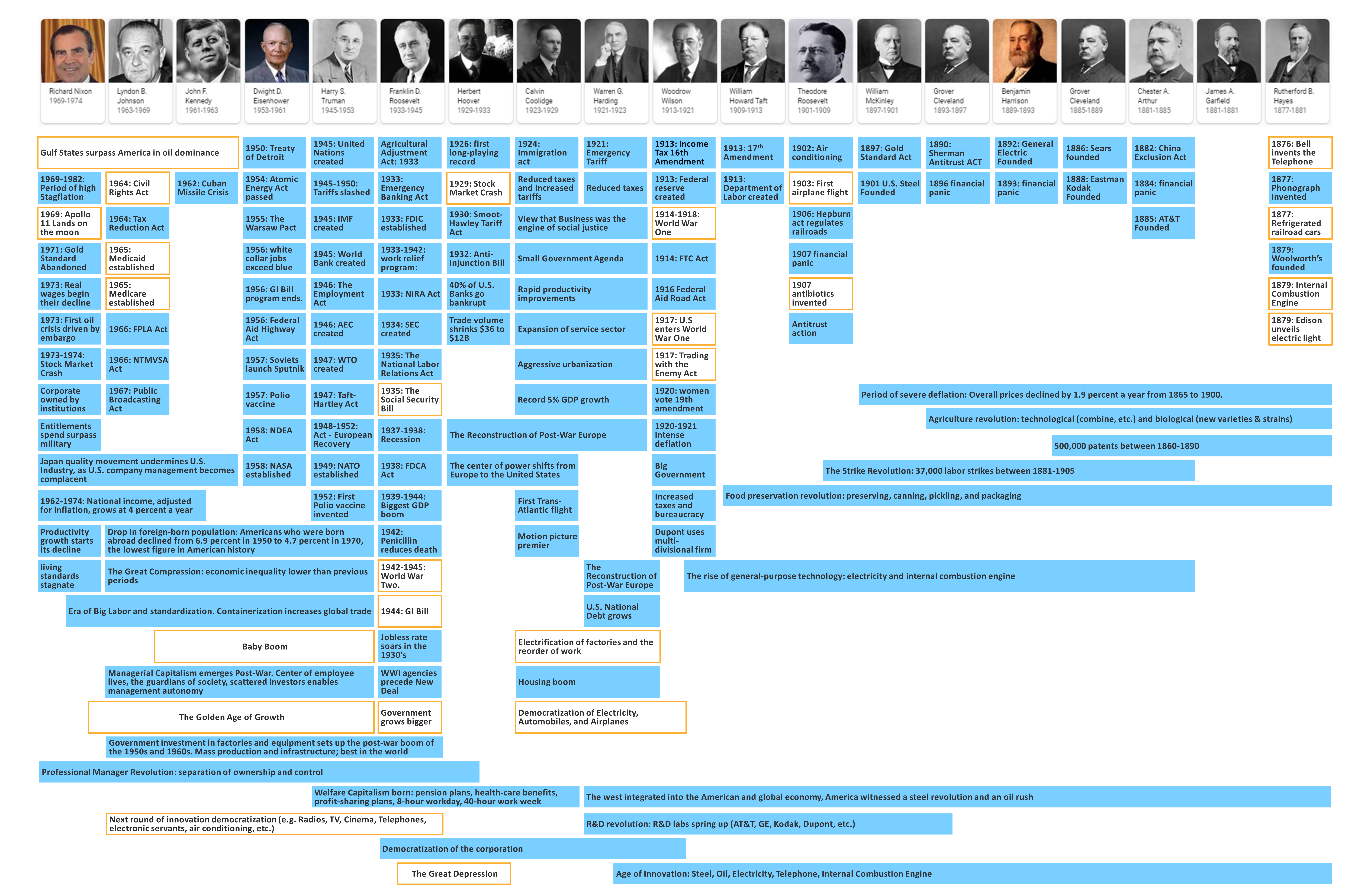
Learning from History

a journey through american history

The Growth of Knowledge

Knowledge is the engine that drives human development – and it has been throughout history. Knowledge expanded in the hunter-gatherer days with the invention of fire. In those days, a human obtained all its food by foraging. Although the source of food did not change, fire allowed humans to cook food and consume more calories. The human brain expanded with this caloric increase, and soon we invented language – the first in a series of innovations that drove the growth of knowledge.

Continue reading

Tipping Points in Human History

I’ve been talking lately about the two main tipping points in human history: from hunter-gatherer to agriculture, and agriculture to our industrial society. That second tipping point beginning about 1760 ushered in three revolutions. The First Industrial Revolution  saw the rise of iron and textile industries and the mechanization of production through the use of water and the steam engine. This second tipping point saw a reduction in physical labor and a shift in where new forms of labor were required. The Second Industrial Revolution started in 1870,  riding advances such as electricity, telephone and the internal combustion engine to drive rapid industrialization and globalization. A massive disruption followed, as established sectors were eliminated and new ones emerged.

Continue reading