
A recent report offers a comprehensive strategy for expediting the deployment of clean energy while mitigating risks and costs amidst the climate crisis. In a collaborative effort, 100 experts in clean energy and artificial intelligence convened at Argonne National Laboratory to devise a plan for ensuring America’s energy future. The AI for Energy report captures their collective vision.
Continue readingEnergy
Nuclear Fusion
This monumental undertaking, known as the JT-60SA reactor, marks a significant stride in the pursuit of harnessing the power of nuclear fusion, a technology still in its infancy but hailed by many as the answer to humanity’s future energy needs.
Joseph Shavit – World’s largest nuclear fusion reactor is now online promising to reshape global energy production
It is still early days, but progress is being made. This article and quote above describes the inauguration of the world’s largest experimental nuclear fusion reactor. The article describes a process that seeks to replicate the natural phenomenon occurring inside the sun, where fusion reactions power our solar system.
Continue readingResistance To Renewable Energy Is Similar To The Early Rejection Of Coal
Without good stories to help us envision something very different from the present, we humans are easily stuck in our conventional mental programming
Per Espen Stoknes
I was reminded of the above quote when I came across this recent article about America’s early rejection of coal. With cheap wood available and houses having wood fireplaces, not many saw the wisdom of shifting to coal. As the article states, our current societal struggle with renewable energy has a long history. Coal itself faced a similar pushback in the early 19th century when the power source promised to solve many of the country’s problems.
Continue readingThe Energy Transition
Energy transitions throughout history have ushered in times of dramatic change. These transitions represent the most impactful periods in human history. At the heart of this transition lies renewable energy.
Renewable energy technologies harness the power of the sun, wind, and heat from the Earth’s core, and then transforms it into usable forms of energy like heat, electricity, and fuel.
Govind Bhutada – What Are the Five Major Types of Renewable Energy?
That quote is from a recent Visual Capitalist article that describes the five major types of renewable energy. Given the growing focus on these sources of energy, the IEA forecasts that, by 2026, global renewable electricity capacity is set to grow by 60% from 2020 levels to over 4,800 gigawatts—equal to the current power output of fossil fuels and nuclear combined. This visual describes these five renewable energies.
An Impactful Era Is Emerging – And It Becomes More Evident Every Day
Energy transitions throughout history have ushered in times of dramatic change. Every day another series of breakthroughs can be found in the media. This astounding level of innovation speaks to the reality of an energy transition that is at the leading edge of a shift from our current era to the next. It also highlights the role that catalysts play in creating the future. In the energy context, the situation in Ukraine is a catalyst that likely accelerates the transition. For example, Denmark wants to build what it calls ‘Energy Islands’ to free Europe from using Russian fuel. This article describes how these islands were part of Denmark’s transition towards renewable energy, but tensions with Russia (catalyst) both expanded and accelerated their vision.
Continue readingIs The Age Of Fire Over?
In January, I launched a poll that represented a form of rehearsing the future. Rehearsing versus predicting allows us to envision possible futures. Complex adaptive systems contain multiple intersecting building blocks behaving and interacting in ways that make prediction impossible. Although we can’t predict, we can inform our rehearsing with an ever-expanding amount of insight and foresight. In addition, technology now enables us to continuously probe and learn. Learning our way forward through continuous learning loops enables rehearsing. To that end, the poll looked ahead and asked if people believed that artificial intelligence would ultimately be more impactful than fire, electricity, or the Internet. The results were fascinating.
Continue readingThe History Of Energy Transitions
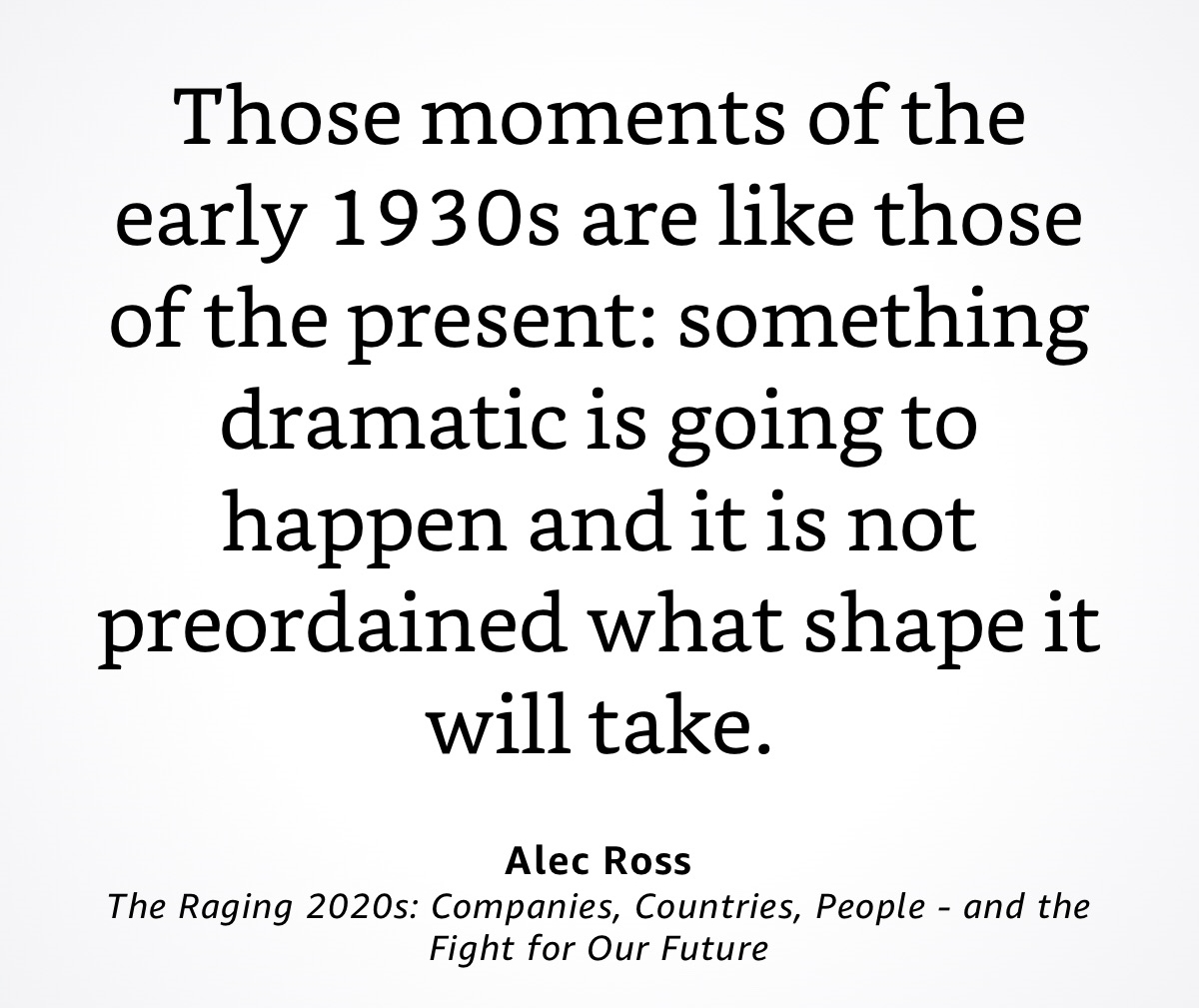
Energy transitions throughout history have ushered in times of dramatic change. While energy may be the biggest piece of this emerging story, it is part of a bigger narrative in what increasingly looks like a phase transition. That notion of dramatic change is echoed by several prominent sources. For example, Alec Ross in his recent book The Raging 2020s speaks of a world that resembles the 1930s, a growing sentiment that maps to my research on the period beginning in 1920.
As the visual below illustrates, that 1930 date aligns with the energy transition. That period began the long transition towards our current fossil fuel era – representing a major transitory period for the world. This recent article reflects on the history of energy transitions and the drastic change in our sources of energy over the last 200 years.
Continue readingClimate Investing 2.0
According to this recent article, there is a surge in environmental, social, and corporate governance (ESG) investing, which is attracting record amounts of capital and bringing shareholder activism to the forefront. In contrast to the first wave of climate investing, this second wave will benefit from a more established ecosystem. In 2021, global venture capital funding for clean technology hit $43 billion, which was more than double the $20 billion invested in 2020. Experts believe that the trend is just getting started.
Continue readingAstounding Levels Of Innovation: Energy
As we move aggressively into this period of great invention, we will increasingly marvel at astounding levels of innovation. Every domain will experience this phenomenon…and it is accelerating. The articles below make the point very clear. The most encouraging piece of these breakthroughs is growing evidence that our world of extraction is shifting ever so slightly to one of creation. Advances in materials science are critical to solving some of the worlds greatest challenges. The energy transition is underway.
Tesla aims to release $25,000 electric car in 2023, likely will not have a steering wheel
This wildly reinvented wind turbine generates five times more energy than its competitors
Experimental chlorine battery holds 6 times more charge than lithium-ion
What if walking around on your wood floors powered your home?
Hydrogen in aviation: how close is it?
Graphene innovation opens doors to low cost, sustainable, sodium-ion batteries
What Does 250 Years of Innovation History Say About Our Future?
“Without good stories to help us envision something very different from the present, we humans are easily stuck in our conventional mental programming.”
Per Espen Stoknes
That quote captures a phenomenon that has plagued humans throughout history. In a recent article, Per Espen Stoknes looks at 250 Years of Innovation and what it reveals about the future. History is indeed very revealing, a fact that explains why Futurists spend so much time in the past. Whether it is the Uncanny Similarities to the 1920’s or other Lessons from History, applying history is very instructive. That quote speaks to a status quo bias that has existed in every age. As the article’s author describes, we have a strong emotional bias that prefers the current state of affairs over change. That bias now hampers our response to an ecologically destructive future. The article views the topic through this lens.
Continue readingSustainability: Not Just Talk Anymore
Sustainability is not a new topic. The United Nations Sustainable Development Goals have been in place since 2015 and were adopted by 193 countries. At the heart of these goals lies our desire to advance our Human Development. We may be in a better position to do so now then we have in quite some time. In fact, History tells us that the last time we experienced a period of great human development spanned the century from 1870 to 1970. While there have been notable efforts to realize these U.N. goals, progress has been slow. Let’s take energy as an example. It is a big part of the sustainability story and the Future of Energy has been discussed for years. However, progress towards that future has been slow. That could all change in the next decade. Several forces are Converging to accelerate the path of energy. One of those forces is a shift in orientation to purpose:
Continue readingTransforming The Energy Paradigm
Yesterday, I Wrote about the speed at which change is likely to occur this century. Paradigm shifts will happen regularly, in stark contrast to the past, where paradigms had a long shelf life. From health and education to energy and transport, paradigms will shift. The energy transition is big discussion topic today, and rightfully so. The most transformative periods in history have been tied to energy transitions. While renewable energy dominates the dialog, rapid increase in energy demand can negate those gains. This short video captures parts of this dialog. Visit this YouTube Channel to join the discussion.
Transforming The Energy Paradigm
The most transformative periods in history are linked to eras of energy transition. The most impactful was the emergence of fossil fuels. What does that say about what lies ahead? Have we entered a period of energy transition, and if so, are we on the cusp of another highly transformative period? Energy is just one piece of a very disruptive decade ahead – but it is perhaps the biggest piece. As we Accelerate Towards a new energy paradigm, what can we expect? One thing is certain: there are societal and geopolitical implications to consider.
Continue readingThe New Map
I just finished another book and added it to my Library. Author Daniel Yergin explores the convergence of energy, climate change, and a world where an existing power is confronted by an emerging power. The New Map helps us understand global dynamics, historical perspectives, the entrenched role of oil and gas, the forces that are driving an energy transition, and the impact of a raging pandemic.
Daniel Yergin is a highly respected authority on energy, international politics, and economics, and a Pulitzer Prize-winning and bestselling author. He is vice chairman of IHS Markit, one of the leading information and research firms in the world, a member of the board of the Council on Foreign Relations, a senior trustee of the Brookings Institution, and has served on the Secretary of Energy Advisory Board under the last four presidential administrations.
Continue reading2030: The World’s Electricity Demands Are Met By Renewable Energy
It was 2014 when I was first exposed to the concept of an Energy Internet. It was Economist Jeremy Rifkin in his book The Zero Marginal Cost Society that introduced it as part of a broader vision for a new general purpose technology platform (GPTP). I have since written extensively about the Shifting Energy Paradigm and the implication for society. When evaluating the three foundational components of a GPTP (Energy, Communications, and Transport), changes to the energy component have historically driven the biggest societal transformations.
Continue readingIs Wireless Electricity Part Of The New Energy Paradigm?
Yesterday, I wrote about the potential Acceleration towards a New Energy Paradigm. 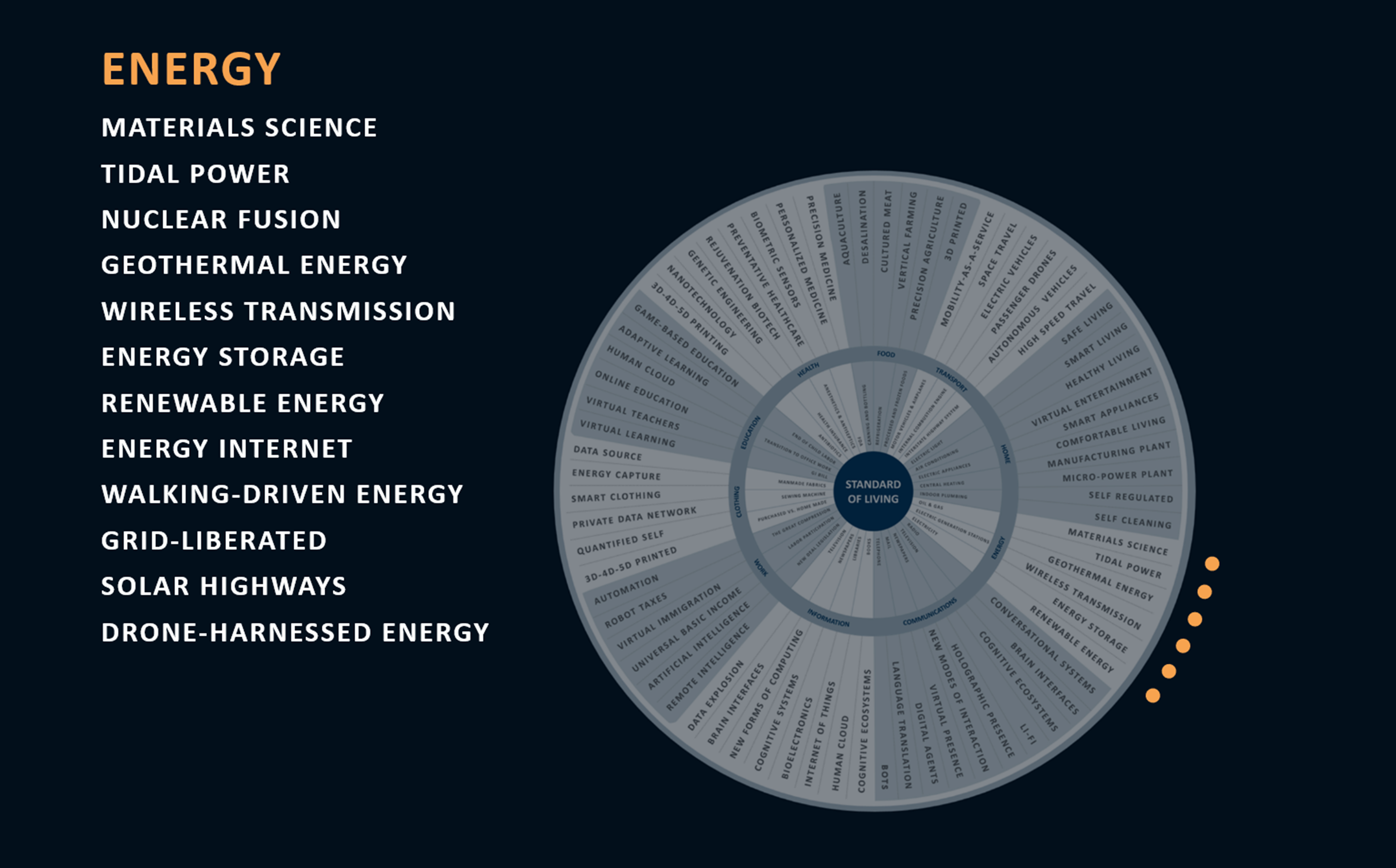 When we consider the building blocks on the innovation wheel that shape this emerging paradigm, the change is likely significant. One such building block is the wireless transmission of electricity.
This recent Article describes new innovation that enables this transmission. It was Nikola Tesla that first worked on Wireless Energy and Power Transfer. He almost succeeded when his experiment led him to the creation of the Tesla coil. It was the first system that could wirelessly transmit electricity. From 1891 to 1898 he experimented with the transmission of electrical energy using a radio frequency resonant transformer of the Tesla coil, which produces high voltage, high frequency alternating currents.
Accelerating Towards A New Energy Paradigm
My Post yesterday revisited the intersections that shape our future. Convergence across multiple domains sets these intersections in motion. In this context, convergence refers to a virtuous cycle where events in one domain spur action in another. The great inventions (electricity, telephone, and internal combustion engine) were clustered together at the end of the 19th century, forming a virtuous cycle that drove a period of astounding innovation. Several Catalysts drove an enabling convergence across the economy, science, technology, business, geopolitics, and a broader set of societal issues.
Revisiting the Intersections That Shape Our Future
The building blocks of our future are numerous, and they are intersecting in ways that drive rapid shifts. I Visualized this phenomenon a while back, trying to depict the complexity of our world and the challenges it represents. It was Futurist Gerd Leonhard that gave me the idea. As someone who used my Anchor Visual in keynotes, he reflected on how impactful it might be to demonstrate the convergence that was occurring across the visual.
The Impact of Capital on Exponential Progression
In a post back in 2018, I described a phenomenon that contributes to the rapid Acceleration of innovation and scientific breakthroughs. Peter Diamandis coined the term Techno-Philanthropists and compared and contrasted them to the Robber Barons of a different era. Billionaires get a lot of negative press these days – but one thing is clear: their wealth is both accelerating the pace of innovation and addressing some of the world’s greatest challenges. Stories described by Articles like this one highlight the point.
Electric Batteries and the Grid
This Article provides a very good example of domains that are converging in ways that shape our future. In this example, innovations in science and technology converge with future scenarios involving the emerging Mobility Ecosystem and one that is often described as the emerging Energy Internet. Author Jeff McMahon indicates that there will be more than enough batteries in electric vehicles by 2050 to support a grid that runs on solar and wind—if the two are connected by smart chargers, according to experts at the International Renewable Energy Agency.
As described in an earlier post, these Intersections across multiple domains introduce new scenarios that amplify impact. In this example, the boundaries between mobility and energy blur, creating a synergistic linkage between the two ecosystems. This complex and unpredictable dynamic complicates our Future Thinking exercise – but it may be the most critical focus of any forward-looking effort. The above referenced article provides a good example of how the Convergence of science and technology leads to a convergence with multiple future scenarios. Visualization helps to understand the various dots that are connecting.
 Reimagining the Future