Future Thinking

UPDATE: December 27, 2025. I posted this 10 years ago as I struggled with what I believed was traditional thinking in a world heading towards a bew reality. Ten years later, this series on systemic change captures what I was seeing back then.

I’m struggling with the term disruption and its effectiveness in driving urgency. Most definitions describe a radical change in an industry or business strategy, and most involve the introduction of a new product or service that creates a new market. My struggle is not with this decades old view of disruption, but its application in the context of our exponential world. The word disruption is viewed through a traditional lens. I end up in debates about the validity of a disruptive scenario as viewed through this lens, versus the massive implications of these future scenarios viewed through an exponential lens. The ensuing dialog focuses on:

  • Coming up with disruptive innovation before our competitors do
  • Embracing protectionist behavior to block a disruptor
  • I’m not worried, regulatory hurdles in my industry block the impact of disruptors
  • I’m safe, my industry is very stable
Continue reading

Expanding Disruptive Scenarios

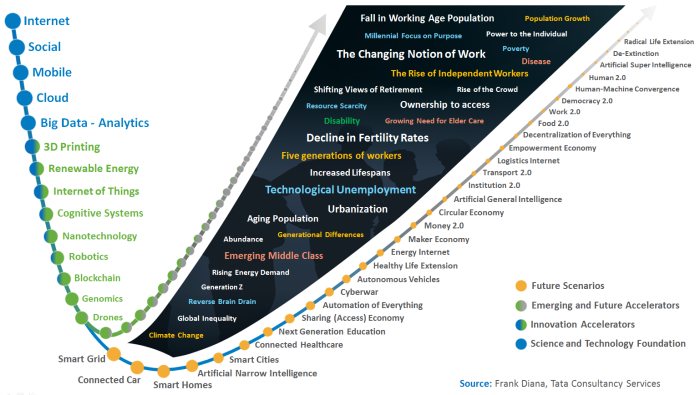
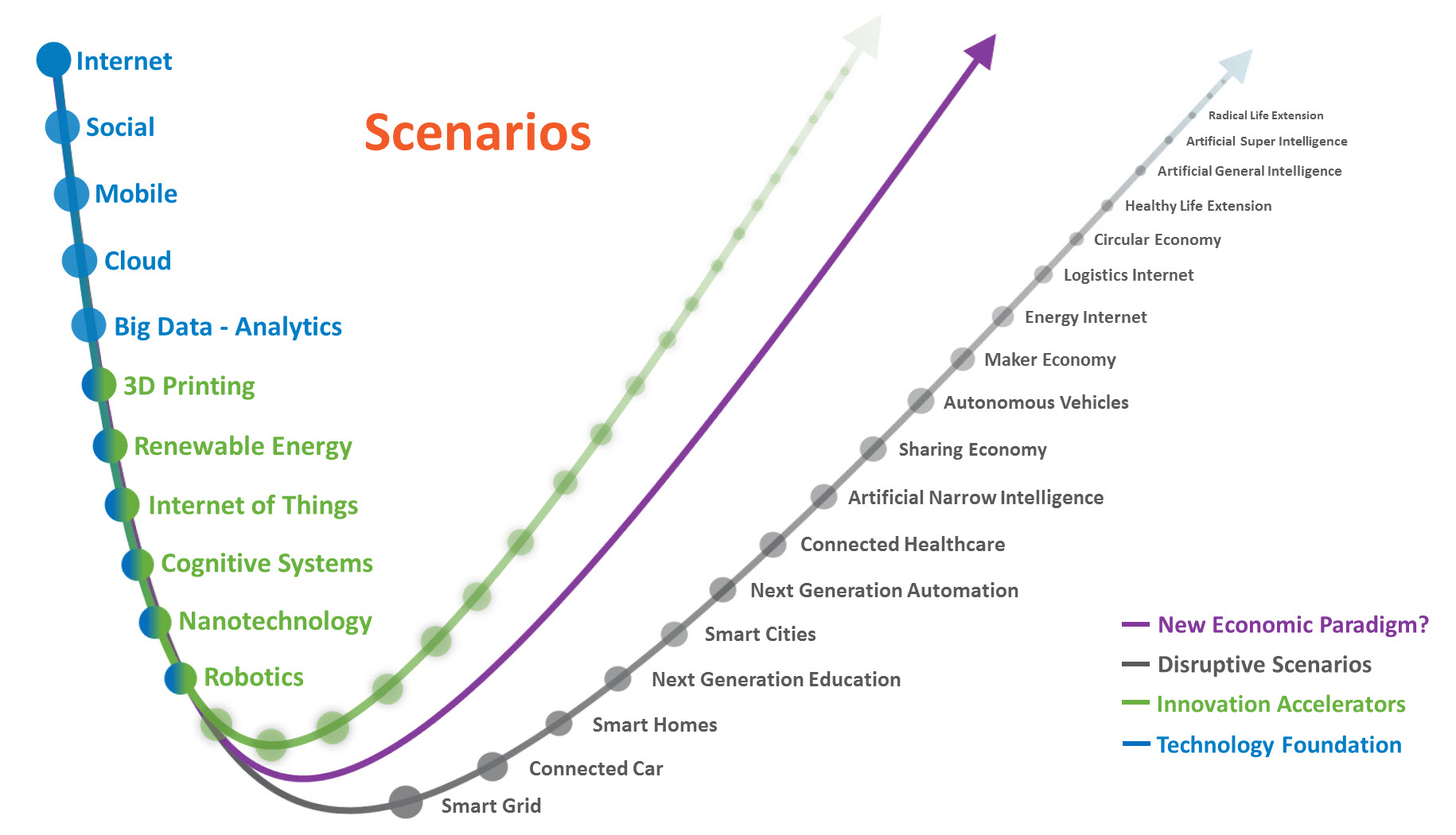
The pace of change is such that no forward looking visual can stay static for too long. I have therefore updated the anchor visual that looks at the digital platform, the innovation accelerators, and the disruptive scenarios that result from the convergence of societal progression, science, and technology. It is impossible to capture the current environment in one visual, but I hope what has been captured drives a clear message: there is a lot happening, on a rapid pace, and its convergent effects are multiplicative. There are several changes to the visual, and my thanks to the authors of The Future of Business for their inspiration:

emerging-future

Continue reading

The Future of Business

To the readers of my Blog: a fascinating book titled The Future of Business was released last week. The lead Editor for the book was Rohit Talwar, CEO of Fast Future Research and Fast Future Publishing. This is a must read for anyone interested in where the world is going in the next 20 years, and its broad implications for individuals, society, business and government. From Mr. Talwar:

“The Future of Business is the first book in the FutureScapes series. The book focuses on the critical social and economic forces, business trends, disruptive technologies, breakthrough developments in science and new ideas that could reshape the commercial environment over the next two decades. It explores how these future factors could come together to force a fundamental rethinking of the purpose,  strategy, business models, values and structures of organizations as they seek to survive and thrive in a rapidly changing reality.”

I highly recommend this book

Re-Ranking the Fortune 100

In a recent post, I discussed a book on exponential organizations co-authored by Salim Ismail, Global Ambassador for Singularity University. In a Video from this week’s Exponential Finance conference, Mr. Ismail showcased their work on an Exponential Quotient that scores companies on organizational factors that determine how well they are positioned to succeed in an exponential world. This exponential quotient results from a diagnostic survey that asks 21 questions (each graded 1-4) about how companies have structured their products, services, and internal framework. At the end of the diagnostic, an Exponential Quotient score is determined.

The folks at Singularity University used this quotient to create The ExO Fortune 100 – a re-ranking of the current Fortune 100. The scoring was ratified by academic researchers at Hult Business School. I’ve re-printed a list from their site that shows some of the elements of the survey and the key attributes of ExOs that are being tested.

External facing questions

  • Does it have a Massive, Transformative Purpose, (or MTP)?
  • How externalized are business functions?
  • How much are on-demand staff and on-demand assets utilized?
  • How well are Community and Crowd leveraged?
  • Are algorithms a core part of the organization?
  • How information based are its products and services?

Internal facing questions

  • How well are interfaces created to manage external scalability?
  • Are OKRs and Lean Metrics used to track performance?
  • How well does the organization encourage risk-taking and experimentation?
  • Does the organization operate top-down, command and control hierarchies, or flat, autonomous, collaborative team structures?
  • How well are social technologies integrated into the organization?

As I said in my post on exponential organizations, there remains a single constant: it will take a different type of organization – different than the ones most of us grew up with – to survive the coming shift. The attributes or characteristics that create this different type of organization are getting clearer. It’s up to us to create it.

For a full list of the Fortune 100 and their associated ExO rank, please download this Spreadsheet

Technology versus Humans

Futurist Gerd Leonhard recently released a new short 3 minute film titled Technology versus Humans. Here is an excerpt from his Blog announcing the video:

“I am very excited to announce the release of my new short film “Technology versus Humanity”. This film marks the beginning of a new period for me, with much of my future work focusing on the topic of how exponential technological changes are changing what and who we are, as humans, where this is going in the next 15 years, and what we need to do, TODAY, to make sure that these changes will indeed be beneficial to us.

For this film, I was very fortunate to be able to team up with Story7 and Jean Francois Cardella as producer and director, and Jeremy Joly as DOP. They made this film very special – thanks!  We shot most of the footage in Cannes and the surrounding area – see some of the pics below.  If you like this movie, please share it and spread the word, or submit a comment below and let me know what you think.  Thanks!  New hashtag as of today:  #techversushuman

Gerd was kind enough to do an interview with me back in January. You can read that here. Enjoy the film

Structural Change: Decentralization

I had the pleasure of joining The Digital World with Game Changers radio program for the second time this year. Joining me as panelists were Futurist Gray Scott and SAP Innovation Evangelist Timo Elliott. First, kudos to program host Bonnie D. Graham for doing a wonderful job keeping the discussion energized and interesting. The title of the session was Eating Disruption for Lunch: Digesting Decentralization. Now there’s a term not heard much outside of futurist circles. Decentralization is one of those structural changes that make what lies ahead so impactful. According to Wikipedia, decentralization is the process of redistributing or dispersing functions, powers, people, or things away from a central location or authority.

Continue reading

Disruptive Power Lies at the Intersections

The content of this post was updated on February 16, 2017 in a new post titled Intersections Promise to Drive Multiple Paradigm Shifts


When I first started using the term “Combinatorial”, people thought I was making words up. Although I’d like to take credit for the word, I first came across it when reading The Second Machine Age, a fascinating book by Andrew McAfee and Eric Brynjolfsson. I remember thinking that it was a perfect word to capture the amplification of both innovation and its disruptive power. By now, readers of this Blog have seen the foundational Visual that describes the digital foundation, innovation accelerators, and disruptive scenarios. What the visual does not convey without the associated narrative is the power of combinatorial.

If we build on top of the visual, we begin to see the complexity at the intersections, the amplification of disruptive power, and the broad implications for the future.

intersections-and-amplification

The best way to describe this phenomenon is through examples, so let’s look at six combinatorial scenarios as an overlay. The visual is a bit overwhelming, so a better way to follow the various paths is via this PDF. Here is a description of each scenario. The numbers in the visual above map to the scenarios below, and the colors show the combinations: 

Continue reading

Is Any Industry Safe From disruption?

I recently dipped my toe into the Metals and Mining waters and walked away with the reinforcement that every industry is susceptible to disruption. There has long been a feeling that non-digital industries are safe from the power of disruption. In a recent piece on a New Economic Paradigm, this topic is explored in greater depth, questioning the long term viability of not just current industry structures – but the economic paradigm itself. 

Disruptive scenario analysis should be a critical focus for every business across every industry. In addition, as these scenarios converge, the implications of this convergence to a given industry or industries must be understood. The anchor visual below identifies a number of scenarios to consider. Let’s take a look at disruption in the context of the Metals and Mining industry, as well as some possible industry responses.

emerging-future

Continue reading

Exponential and Combinatorial

Futurist Gerd Leonhard continues to talk about exponential progression and its impact on the world. In this recent short video, Gerd uses the Exponential and Combinatorial slide that anchors the organization evolution story. Listen to Gerd’s perspective on this emerging paradigm shift.

Exponential Organizations

Starting in 2011, I focused on the notion of a digital enterprise – a metaphor for the type of organization that is required to survive the massive paradigm shift that lies ahead. In 2013, the focus expanded to analyze disruptive scenarios and the emerging ecosystems and platforms that would give life to those scenarios. There remains a single constant through this work and the many leadership discussions that ensued: it will take a different type of organization – different than the ones most of us grew up with – to survive the shift. We as humans – and the organizations that we created – think and act linearly. The world and technology however is moving exponentially. How then do people and organizations move from linear thinking to exponential thinking? Continue reading

The Disruptive Role of Near Field Communications

Over the last several years, the big four technologies of the third platform (Social, Mobile, Big Data, and Cloud) have received the lion share of attention, and an emerging class of innovation accelerators like The Internet of Things will capture attention in the coming years. But there are also a number of supporting technologies that serve as enabling components of multiple disruptive scenarios. In some recent presentation preparation work, I focused on technologies like Near Field Communications (NFC) and iBeacon. It was fascinating to find broad applicability across many of the disruptive scenarios on the visual I have used to describe the coming paradigm shift.

emerging-future

Continue reading

Anticipating 2025 – Part Four: Redesigning Society

Part four of Anticipating 2025 summarizes the fourth section of the book, focusing on redesigning society. Once again, we see how innovation, business, Government, and society converge over the next 20 years. There is an interesting historical pattern emerging that helps explain this phenomenon, while providing a mechanism to predict the future with a higher degree of certainty (more on that in a future post). As you read this, look at how innovation that we normally view through a business lens, is playing out at the societal level. Let’s take a look at each of the topics within this section. Continue reading

Anticipating 2025 – Part Three: Redesigning Artificial Intelligence

Part three of Anticipating 2025 will summarize the third section of the book. This section focused on redesigning artificial intelligence, with a look at six important questions and the exploration of human-machine mergers. The six questions explored in this section are:

  1. Can we create a human-level artificial intelligence?
  2. If so, when?
  3. Will human-level artificial intelligence lead to super-intelligence?
  4. If super-intelligence arrives, will we like it?
  5. Can we upload our minds to computers?
  6. Can we de-risk the arrival of super-intelligence?

Like the first two sections, this section forces us to look at disruption through a different lens. Granted, the path forward is highly speculative, and even the most optimistic scenarios are likely years away from having transformative implications. Nonetheless, it does force us to broaden our lens beyond traditional views. For example, I’ve focused on the automation of knowledge work and all its ramifications, while the authors (Calum Chace, Martin Dinov, and Elias Rut) focus on creating super-intelligence by uploading our minds to computers. They explore a human-machine merger that they see as the enabler of super-intelligence benefits realization. This merger in the author’s view is the only way to avoid creating our successor. So yeah, that’s a little more impactful than automating knowledge work.

Continue reading

Anticipating 2025 – Part Two: The Future of Medicine

Part two of Anticipating 2025 will summarize the second section of the book. This section focused on three broad topics:

  1. Will advancing technology make doctors unemployed?
  2. The future of medicine and the convergence of nanotechnology and biology
  3. Rejuvenation Biotechnology program

It is fascinating to view this section through a disruptive and transformative lens. The acceleration of scientific advancement intensifies the degree and speed of change, thus positioning the type of paradigm shift that we have not seen since the steam engine. As this recent Forbes article points out, even The Acceleration is Accelerating.

The first topics author is Maneesh Juneja, Digital Health Futurist, and Founder of the Health 2.0 London Chapter. In the opening discussion, the author focuses on technology advancement and the future role of doctors. He describes a backward healthcare system that focuses on treatment versus prevention, and the difficulties of solving this problem when there is no profit in prevention. In researching systems from the past, the author looked at ancient China, where it is said that doctors only received payment while their patients stayed healthy. The author then explores the technologies projected to change the practice of medicine:

Continue reading

Anticipating 2025 – Part One

I spent time over the Christmas holiday reading a book titled Anticipating 2025. Forward looking analysis that connects leaders with disruptive scenarios and their implications are invaluable, and books like this provide tremendous support. In my next series of Blog posts, I will summarize the salient points from a number of futurists who authored this work. As described in the books opening, futurists are concerned with highlighting a whole range of possible futures, not necessarily pinpointing exactly when something will happen. From the book:

“Futurists seek to draw people’s attention to forthcoming threats, before these threats become too damaging, and to forthcoming opportunities, before these opportunities slip outside of our collective grasp due to inaction on our part”

The book is divided into five sections:

  1. Setting the scene
  2. Re-designing medicine and healthcare
  3. Re-designing artificial intelligence
  4. Re-designing society
  5. Redesigning humanity

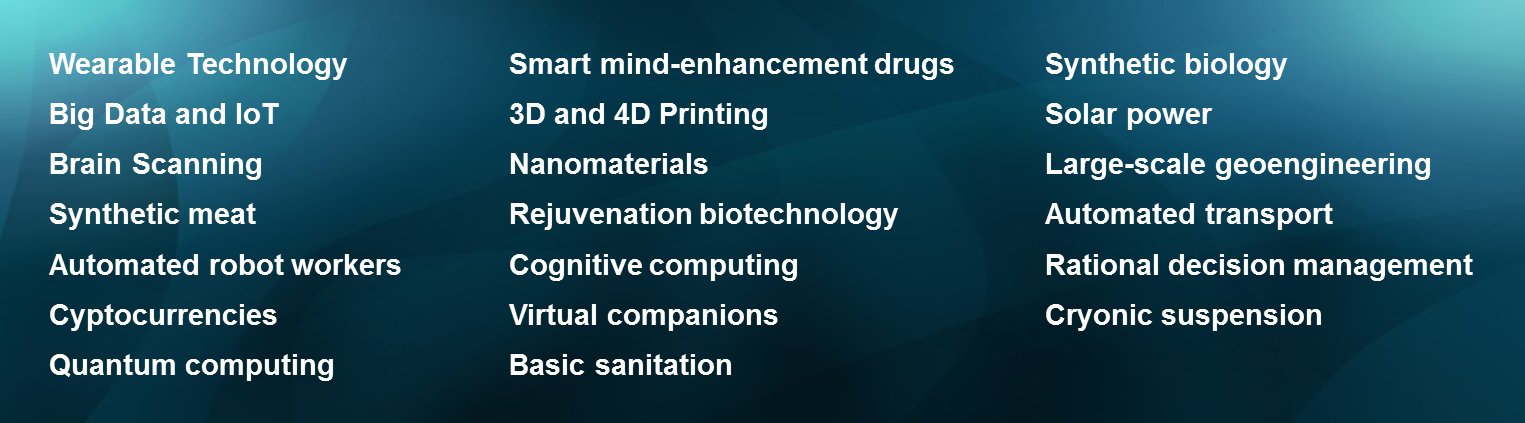
Part one of this Blog series will set the scene. In the book’s first section, the authors focus on driving forces, big shifts, and roadblocks. It is believed that if developed and deployed wisely, technology could provide a great future of unprecedented abundance, health, and vitality. But there is much uncertainty and a number of obstacles to overcome. In setting the scene, twenty technology areas where wide-ranging developments are 50% likely between now and 2025 are identified:

25 Technology Areas

Continue reading

Will we Supplant the Steam Engine?

To transform is to make a thorough or dramatic change in form, appearance, or character. Society has transformed several times, but what was the most transformative period in all of history? The folks at MIT set out to answer that question. Through their research and analysis, they determined that the invention of the steam engine ushered in the most transformative period in history.

Over two centuries later, we are likely on the verge of supplanting that transformative period. Unlike the industrial revolutions, when a period of stabilization allowed companies to retrench and exploit the disruptors of the day, this coming period promises no such period. Several key drivers have positioned the next several decades to deliver a staggering – perhaps unprecedented – amount of change. That leads to a question regarding the intensity of the coming transformative period.

An Interview with Futurist Thornton May

I thought it would be interesting to get a slightly different perspective on the questions that I posed to Futurist Gerd Leonhard in our recent interview. So I reached out to IT Futurist Thornton May. Thornton and I have interacted on a number of occasions at various events. His bio describes him as a futurist, educator and author. His extensive experience researching and consulting on the role and behaviors of C-level executives in creating value with information technology has won him an unquestioned place on the short list of serious thinkers on this topic. Thornton moderates the nationally recognized CIO Solutions Gallery program, intended for executives and senior leaders in the technology and operations communities.

With that background, I was excited to explore these broad topics with Thornton. His perspective follows.

Continue reading

An Interview with Futurist Gerd Leonhard

Over the last two months, I’ve had the pleasure of interacting with Gerd Leonhard, CEO of The Futures Agency, Futurist, Keynote Speaker, and Author. He is the co-author of the bestselling book titled The Future of Music (2005), and the author of The End of Control, Music 2.0, The Future of Content, and Friction is Fiction.

In 2015, I will continue my focus on disruptive scenarios and their likely impact on the world over the next two decades. What better way to start the year, than to pick the brain of someone who knows a thing or two about disruption – given his time spent in the highly disrupted media and entertainment industry. Here is a summary of our very enjoyable conversation. 

Introduction

To kick off our call, Gerd and I discussed the challenge of driving leaders towards a level of urgency and focus on the disruptive period that lies ahead. Our discussion started with the problem of viewing things through a technology lens versus a business model lens, and the mistaken belief that case studies and recipes exist to solve these emerging problems – versus requiring our collective resolution. Gerd used examples from Europe, where leaders look for proof, and invention is not the norm. We discussed the importance of iterative, experimental cycles that explore the unknown, and Gerd’s belief that this approach is not fully embraced in Europe. He did see the Banking Industry as an example of an emerging shift from focusing on changing into something better, to transforming into something new. But for a number of reasons, Gerd felt that at least in the short term, innovation will still come from the U.S. and China, where there is an openness to inventing.

Continue reading

The Third Revolution

I have used this picture for the better part of 18 months to describe the coming Third Revolution. The visual is getting broader exposure, so I wanted to provide a more detailed description. The blue curve is the science and technology progression curve. The progression of science and technology continues its unabated exponential rise, and leaders can only see so far on the curve. This creates an uncertainty that makes it difficult to understand the implications of technology into the future.

emerging-future

Continue reading

The CIO Discussion

The CIO role discussion is on fire, and conferences all over the world dedicate considerable time to the ongoing dialog. To add more meat to the discussion, the Corporate Executive Board (CEB) recently positioned Business-Led IT as a model for the future. Chris Mixter, senior director of advisory services for CEB distinguishes it from Shadow IT in this quote from a Forbes Article by Nikki Goth Itoi:  

“This is not about the willful or ignorant duplication of core IT services. Your internal business customers are bypassing IT and investing in activities that are driving a critical business outcome.” 

This emerging Business-led IT is therefore not what we have historically called shadow IT. The CEB recently found that 78% of business leaders’ priorities for 2014 were dependent on technology. This drives a keen interest in business-led IT, which shares three primary characteristics:

  • Funding comes directly from departmental budgets
  • The ideas do not require IT approval
  • Capabilities are delivered using business resources, external providers, and/or the cloud

Where speed takes priority over efficiency or cost, IT could be shut out of critical business initiatives. According to the CEB, the business spends three times as much on innovation as the corporate IT function does. It is said that you can’t be a CIO these days if you are not versed in the business. Considering the previous statistic on the dependence of business priorities on technology, the same may be true about business executives that are not versed in technology. As business leaders become more technology savvy, the business-led IT phenomenon broadens. The above article also positions an interesting twist on the war for talent. Here’s Chris Mixter again:

“Let’s face it, the best technology graduates in the world aren’t terribly stoked about working in corporate IT. They want to go work in marketing, R&D, or supply chain. And none of those functions are held accountable to the strict pay scales in the HR hierarchies that we are.”

Continue reading