
In a new book by James Rickards, the author explores both the COVID-19 pandemic and its economic impact. A prolific writer, Economist, and adviser, Mr. Rickards predicts years of economic turbulence ahead. In The New Great Depression, Mr. Rickards sees the pandemic through an historical lens, where crisis presents a gateway between one world and the next. With an eye towards history, he concludes that the Keynes practical definition of a depression fits, and we are now in a new depression that is more far reaching than a mere technical recession. Along the way, the author wades into controversial topics such as China’s role in spreading the virus and the lockdown that ensued (which he calls the biggest policy blunder ever).
Continue readingChina
The Great Demographic Reversal
Beginning in 1990, several forces converged to shape the global economy. Globalization, demographics, technology, deflation, debt, and interest rates have all played a role. Now, according to a recent book, at least two of those forces are reversing. In The Great Demographic Reversal, authors Charles Goodhart and Manoj Pradhan describe these forces and their influence on the last thirty years of economic activity. With this convergence, the world experienced an extended deflationary period, which per the authors, was driven in part by a labor supply shock. The book said the following:
Continue readingAre We Heading Towards A New World Order?
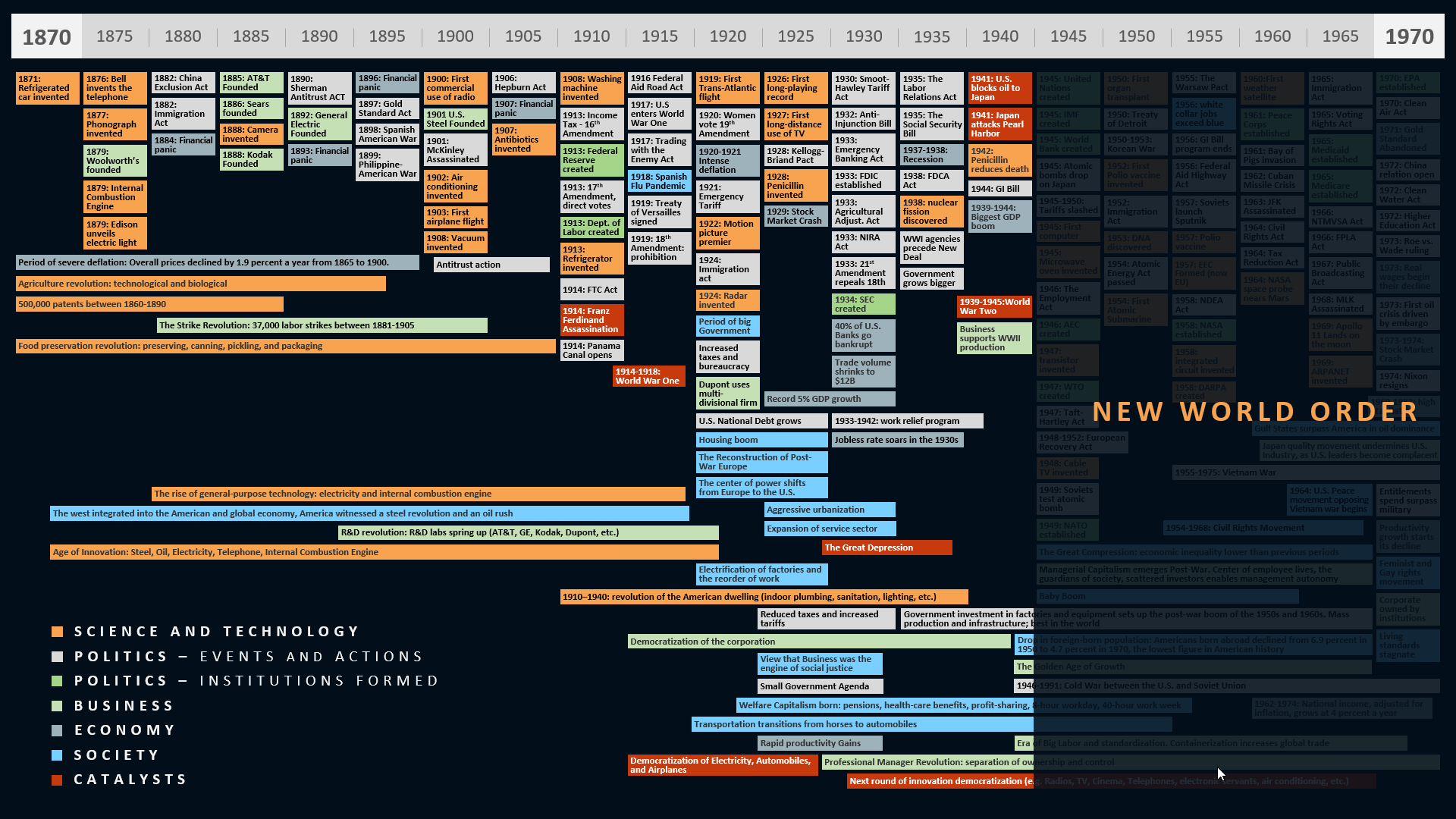
After World War Two, 730 delegates from all 44 Allied nations gathered in the U.S. at the Mount Washington Hotel in Bretton Woods, New Hampshire. The Bretton Woods Conference aimed to regulate the international monetary and financial order after the war ended. Held from July 1 to 22, 1944, agreements were signed and ratified by member governments, establishing the institutions that represented a new world order. This led to what was called the Bretton Woods system for international commercial and financial relations.
Continue readingTen Lessons For A Post-Pandemic World
“There are decades when nothing happens and weeks when decades happen.” – Vladimir Lenin
That quote is highlighted in a new book by best-selling author Fareed Zakaria. In “Ten Lessons for a Post- Pandemic World”, Mr. Zakaria helps readers to understand the nature of a world that emerges after the pandemic: the political, social, technological, and economic consequences that may take years to unfold. He does this by focusing on ten lessons:
Continue readingThe New Map
I just finished another book and added it to my Library. Author Daniel Yergin explores the convergence of energy, climate change, and a world where an existing power is confronted by an emerging power. The New Map helps us understand global dynamics, historical perspectives, the entrenched role of oil and gas, the forces that are driving an energy transition, and the impact of a raging pandemic.
Daniel Yergin is a highly respected authority on energy, international politics, and economics, and a Pulitzer Prize-winning and bestselling author. He is vice chairman of IHS Markit, one of the leading information and research firms in the world, a member of the board of the Council on Foreign Relations, a senior trustee of the Brookings Institution, and has served on the Secretary of Energy Advisory Board under the last four presidential administrations.
Continue readingGeopolitics: A Complex Area Of Convergence
The critical need to understand the rapidly approaching future relies upon our understanding of various domains that are Converging. It is difficult enough to stay abreast of rapid advancements in science and technology, but Introduce societal factors, geopolitical, economic, and environmental considerations, and the task gets harder. Yet a high-level appreciation for these domains is necessary if we hope to understand the future and steer it in constructive directions.
Continue readingThe COVID-19 Economic Impact On China and a Glimpse Of The Future
COVID-19 has had a dramatic impact on China’s economy. Jenna Ross at Visual Capitalist describes how the effects on their economy could foreshadow what the rest of the world can expect. While China turns the corner on the health side of the story, the economic side is telling its story. This Article via the World Economic Forum uses visualization to tell this economic story. Countries in the early stages of the outbreak should take notice. Continue reading
Artificial Intelligence and Disease Diagnosis
The path to breakthrough innovation is usually paved by compelling reasons to address challenges. China’s flourishing economy and continuous progress of medical reform has driven rapid expansion in their healthcare system and significant service improvements. There are over one million medical institutions in China and insurance covers more than 95% of the Chinese population. Average life expectancy has reached 76.4 years – higher than in some high-income countries. As with other countries however, population aging has put enormous pressure on their healthcare system – a phenomenon likely to play out everywhere as baby boomers retire. New innovations are likely to improve healthcare efficiency and offer new ways to address these global healthcare challenges.
AI Superpowers: China, Silicon Valley, and the New World Order – Summary
I just finished a fantastic book on artificial intelligence and the evolutionary path of China and the U.S.. Author Kai-Fu Lee inspires, as he focuses on the astounding capabilities of AI, and the one thing that only humans can provide; love. The journey includes the author’s own brush with mortality, and proposes a path forward: the synthesis on which we must build our shared future is AI’s ability to think, coupled with a human’s ability to love. He believes this synergy harnesses the undeniable power of artificial intelligence to generate prosperity, while also embracing our essential humanity. His hope for our future lies both in this new synergy between artificial intelligence and the human heart, and an AI-fueled age of abundance that fosters love and compassion in our societies.
I recommend reading this book from cover to cover. In the meantime, here is a summary organized by several key themes.
Artificial Intelligence and Jobs
This very good opinion piece addresses a subject that is gaining more attention and driving more dialog. Will artificial intelligence destroy jobs? Author Kai-Fu Lee has an opinion:
“It will soon be obvious that half of our job tasks can be done better at almost no cost by AI and robots. This will be the fastest transition humankind has experienced, and we’re not ready for it”
 Reimagining the Future