The Future Ain’t What It Used To Be

For those that have taken the thought leadership course focused on our emerging future, thank you. For those that may have interest, the course will run for foreseeable future. In this post from last year, I summarized the key messages from the course. It has been updated to reflect the progression of our emerging future.

Yogi Berra is credited for once saying that the future ain’t what it used to be. What a perfect way to describe what is coming: a complete change in the way we think about the future. Our journey to the future begins with a look back. A convergence of multiple forces during a special century following the U.S. Civil War established the standard of living in developed economies. Some believe that we will never see a convergence of forces as dramatic and impactful as that which occurred during this period. I pulled this wheel together to capture that convergence across the various areas of our well-being, leveraging the work of economist Robert J. Gordon. I captured his thinking in a recent post titled Revolution and the Innovation Wheel.
Continue reading

Intersections Promise to Drive Multiple Paradigm Shifts

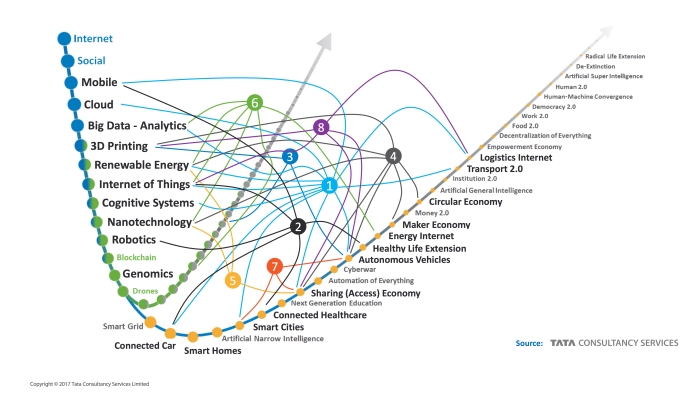
Since the time I completed this post on Disruptive Power and Intersections, it continues to receive attention. It is by far the most effective component of any Future Thinking effort. Given the continued traffic to this two year old post, I am updating with current content. The visual below connects the intersections of 8 combinatorial scenarios. This is not an exhaustive set of connections; it is strictly intended to describe the scenarios at a high level. disruptive-power

Figure 1: Intersections amplify both power and impact

Continue reading

The Future of Energy: A Discussion with David Cohen

future-of-energy-infographic

Continue reading

Technological Socialism and Demonetization

In a recent post titled Demonetized Cost of Living, Peter Diamandis describes how technological socialism (i.e. having our lives taken care of by technology) will drive our cost of living close to zero. A similar case was made by Economist Jeremy Rifkin in his book titled The Zero Marginal Cost Society. Diamandis defines demonetization as the ability of technology to take a product or service that was previously expensive and making it substantially cheaper, or potentially free; removing money from the equation. Demonetized is one of the Six D’s of digital, as described by Diamandis.

Continue reading