A Post Pandemic Society

Updated December 16, 2025: Five Years Later

I am resurfacing this post because it captures a moment when convergence became impossible to ignore. Long before the pandemic, my work focused on how multiple domains — science, technology, society, economics, geopolitics, philosophy, and environment — were beginning to move together, creating conditions where change felt faster, more uneven, and harder to predict. COVID-19 did not initiate that convergence, but it revealed it in compressed form. The systemic change series builds on this longer arc of thinking, extending beyond the pandemic to examine how these forces continue to interact and reinforce one another today. This post remains relevant not as a historical artifact, but as an early, real-time glimpse into dynamics that are still unfolding.

Continue reading
Rehearsing For 2025: A Year-End Reflection

As another year draws to a close, I find myself drawn to a practice that transcends simple predictions. Rather than attempting to forecast the future, I focus on rehearsing it – imagining possible scenarios that help us prepare for whatever may unfold. Predictions often fail to capture the complexity, volatility, and cultural nuances of our interconnected world. Rehearsal, by contrast, is an active and flexible exercise: it invites us to consider “what if” and then equip ourselves with the tools, mindsets, and strategies to adapt.

As we look toward 2025, I invite you to consider a set of interrelated themes. These are not forecasts, but lenses through which we can examine global currents. By exploring these possibilities, we do not claim certainty. Instead, we gain the agility and resilience necessary to respond thoughtfully, no matter how events evolve.

Continue reading

A Deep Dive with Kevin Benedict

RegalixTv - Deep DiveI had the pleasure of joining Kevin Benedict on RegalixTv for a conversation about the Future. This 20 minute conversation focused on making sense of this fast changing world of ours, identifying those things that require our attention today, rehearsing the future, and more. Click the visual to view this short video discussion.


Visualizing our Emerging Future

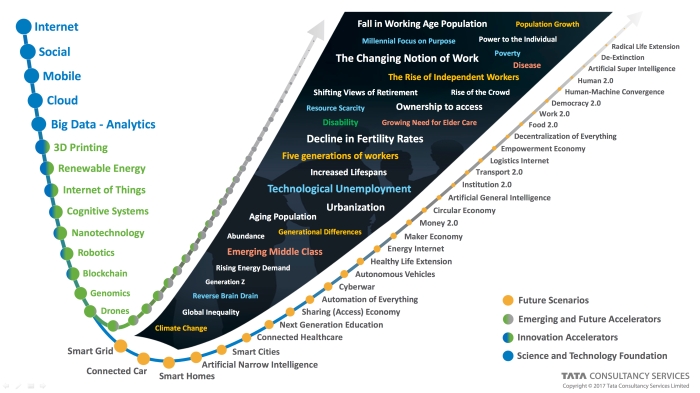
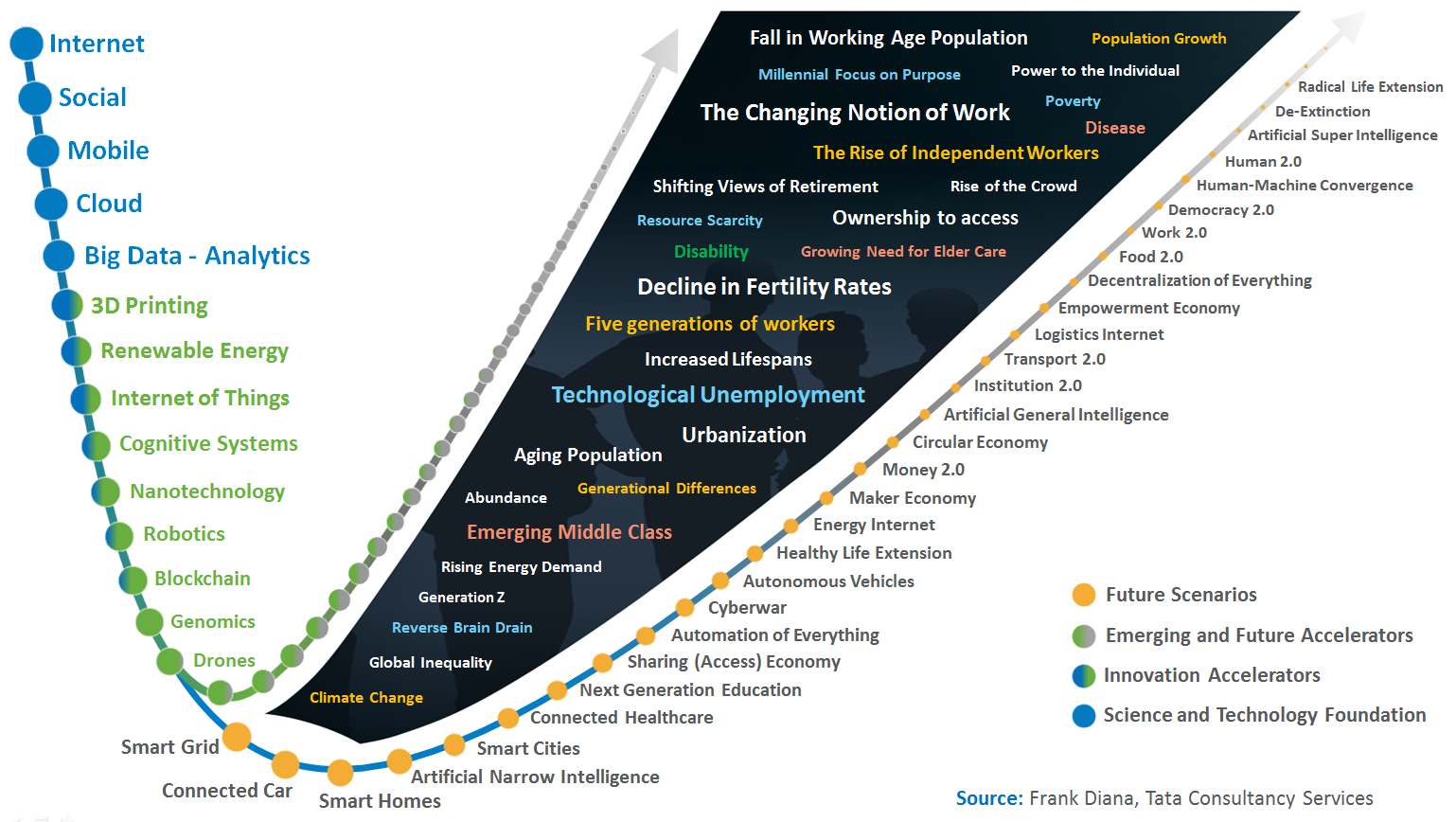
As the pace of science, technology, and societal change accelerates, a vision of our future is emerging. Many future scenarios are viewed as science fiction, or thought to have timelines that are too far into the future to worry about. I hold a firm belief that these timelines are collapsing and future scenario analysis is critical both at a business and societal level.

I have used this visual as a driver of future scenario analysis. It has been captured and utilized in workshop and events. It is described in a post on Connecting Dots, which I view as a critical leadership trait.

emerging-future

The Year of Shifts

The year of shifts is upon us. 2016 will ultimately be viewed as the bridge to a different future; a year where our intuition and beliefs will be reset. Accelerating advancements across science and technology have set the foundation for these shifts. Driven by societal and economic challenges, we will leverage this foundation to change current institutions and build new ones. To succeed, organizations of all types must view transformation through a different lens; one that enables their role in this future. In my current series, I am focusing on the thirteen (13) key enablers of future viability. The first post explored Structural Change. In this post, I will look closer at the pillars of transformation, and delve into the second enabler: a holistic digital foundation.

the-pillars-of-transformation

Continue reading

Empowerment Economy

On a recent Radio Program focused on the future of business, Gray Scott introduced another future scenario. He called it the empowerment economy, and he described it this way:

He sees the past in three stages: 1) companies were in the business of providing supplies and core objects 2) we moved away from that to a convenience economy where we make it convenient for you to get what you need 3) now we are moving to the empowerment economy. It’s no longer about providing an object or convenience; it’s about giving them the power to supply themselves. Gray does not believe corporations understand this. Google and Uber get this circular idea of empowering people, which he believes is the future of business. The companies that embrace this empowerment economy are the companies that are going to succeed.

Those are his words direct from the radio program referenced above. So we add empowerment economy to the growing list of future scenarios. Thanks Gray.

emerging-future