
Throughout history, demographic trends have shifted in ways that defy prediction. One such phenomenon is the decline in fertility rates, which serves as a powerful reminder that the current state is not the future state. Today, discussions around declining fertility often frame it as a looming crisis, raising fears of aging populations and economic stagnation. Yet, history provides a compelling counter-narrative. The reversal of fertility decline in the mid-20th century, driven by the baby boom, highlights the impossibility of predicting how societal, economic, and geopolitical forces will interact to shape our future.
Continue readingFertility Rates
Falling Birth Rates
In a 2022 Post I described a societal signal that represents a global phenomenon. A decline in fertility rates has wide ranging implications, introducing an area of uncertainty that ripples across multiple scenarios. The societal piece of the convergence framework is massively impactful, with fertility being just one of multiple forces. A recent article decribes this global trend of declining fertility rates.
The data from the UN World Population Prospects (2022) compiled by Our World in Data shows a consistent decrease in birth rates across the six most populated countries. Notably, China has experienced the fastest decline, which could lead to similar challenges as seen in Japan with an aging population and significant socio-economic implications. This decline in fertility rates underscores the broader global pattern, where the average number of births per woman has decreased from 3.2 in 1990 to 2.5 in 2019, with an expected further decline to 2.2 births by 2050. A visual from the article plots the trajectory.
Societal Signals Are Flashing
This latest article via the World Economic forum highlights a fundamental truth about the current era: signals are flashing across multiple domains. Although much attention is paid to advancements in science and technology, signals across society, geopolitics, economy and environment are converging. As described in various posts on the topic, convergence itself is a signal. In similar periods in the past, when multiple domains were in a state of flux, it was their convergence that shaped the future. In the referenced article, it is a societal signal that is flashing. If we view these signals as building blocks, it is the model that emerges that allows us to explore their combinations.
Continue readingThe World’s Aging Population
Most countries around the world have experienced population explosions, or are about to. Combine this with declining birth rates and falling mortality rates, and it’s clear that the global senior population will continue to reach new heights.
Pablo Alvarez – Charted: The World’s Aging Population from 1950 to 2100
That quote from a recent article underscores a series of demographic shifts that play a major role in shaping the future. While science and technology rightfully receive a lot of attention, these societal shifts are just as impactful. That message is resonating, as my recent post on population growth is now my most read post since I started blogging thirteen years ago.
Continue readingAmerica’s Demographics
Demographics are a big piece of forward-looking analysis – and we are living in times of significant demographic shifts. An aging society, a fall in working age population, a drop in fertility rates, and a diversifying population are just a handful of examples. This recent article provides a great interactive visual via Visual Capitalist that captures one hundred years of demographic change in America.
Continue readingThe Two Sides Of Population Growth
My last two posts focused on labor shortages and population growth; two critical societal building blocks that converge in ways that shape our future. Continuing with that theme, this recent article looks at these building blocks through the lens of China.
China has edged over a demographic precipice: Its population has begun to shrink. United Nations data published on Monday showed that the long-anticipated tipping point came in the first half of the year; it’s a significant moment for a country whose large population helped transform it into a manufacturing powerhouse
Continue reading
The Global Decline In Fertility Rates
Societal change is a critical area of convergence that is likely to play a major role in shaping the future. Three building blocks provide an example: declining fertility rates, an aging population, and a fall in working age population. This article connects those dots visually. In looking at the global decline in fertility rates, the article illuminates the impact to global stability, as a given area needs an overall total fertility rate of 2.1 to keep a stable population. But why are women having fewer children? According to Dr. Max Roser, the founder of Our World in Data, most of the literature boils down to three main factors:
Continue readingThe Impact Of Societal Forces On Our Future

Convergence is a big part of how the future reveals itself. I have written often about convergence across geopolitics, science and technology, and other domains. Even a domain like philosophy is converging in ways that help shape our future. Macro-level forces illuminate possible futures, and forces in the societal domain play a major role in determining that future. This article on population provides a great example.
Continue readingThe Critical Need For Foresight
Foresight is growing in importance – and it is great to see leaders focused here. In this world of complexity, uncertainty, and rapid pace, generating foresight is not easy. It is a moving target, with change dynamics altering even the safest predictions. We need look no further than the impact of COVID-19 on the pictures of possible futures we were painting just 18 months ago. As difficult as it is, we are fortunate to have people like Alexandra Whittington around to help. She recently tweeted a pandemic influenced view of the future of population, work, and lifestyles.
In some cases, COVID-19 exacerbated trends that already existed. For example, birthrates were already dropping around the world, a phenomenon that grew more acute in the past 18 months. Africa was viewed as the outlier, contributing to future population growth even in the face of declining fertility rates. If the 2020 Oxfam study referenced in the visual below is accurate, a reversing of family planning gains could drive more growth.
Continue readingThe Implications Of Slowing Population Growth
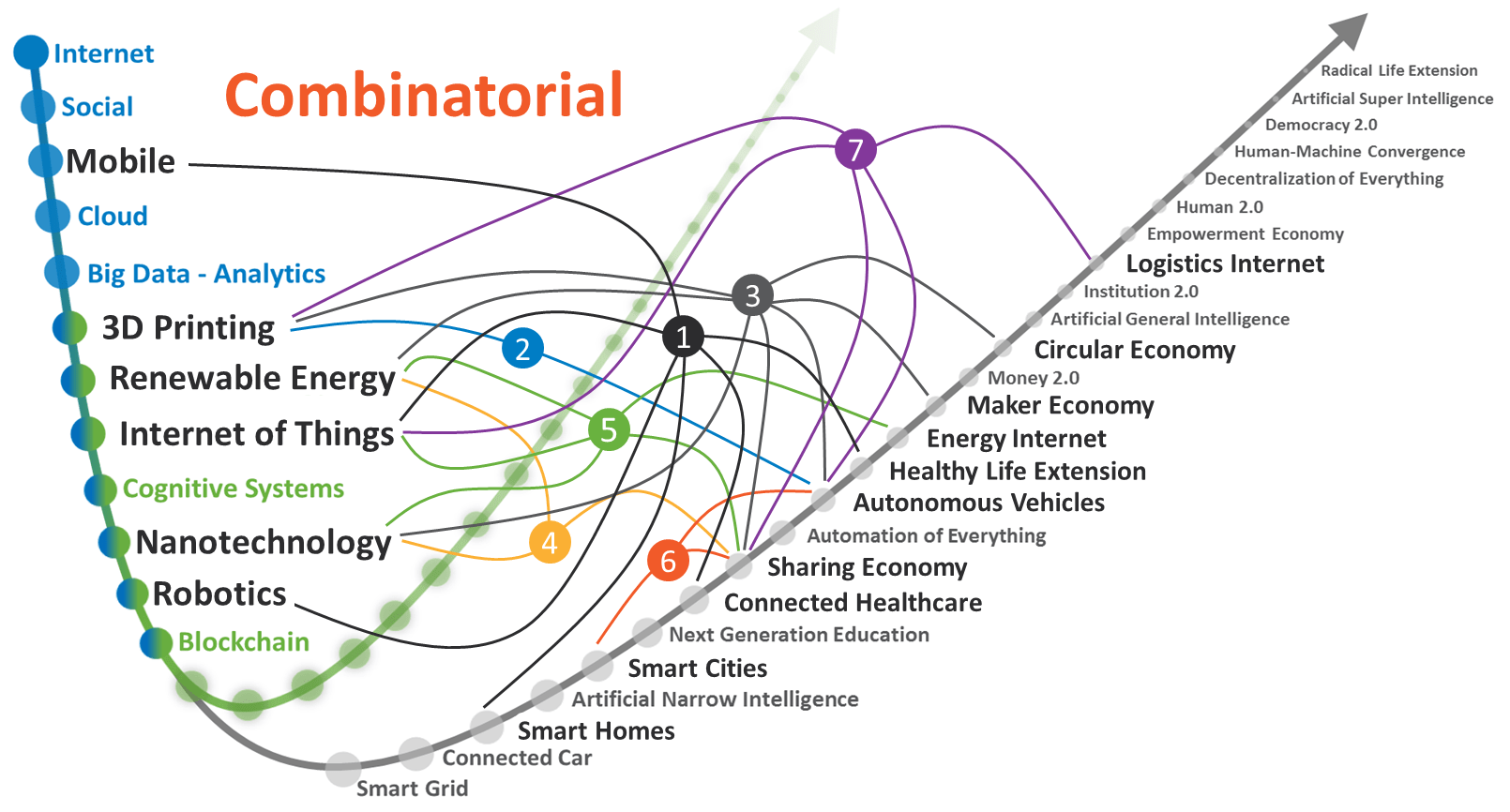
The power lies at the intersections. When I first started using the term “Combinatorial”, people thought I was making words up. Although I would like to take credit for the word, I first came across it when reading The Second Machine Age, a fascinating book by Andrew McAfee and Eric Brynjolfsson. In a post from 2015, I explored several possible combinations that represented disruptive power. A visual from that post attempted to show how science and technology spawned a number of several scenarios, using two curved lines, one for science and technology, and the other for scenarios. As the building blocks combined across the curves, the world would transform.
Continue readingColliding Trends Reshape 2030
A recent book explores aspects of a broader Convergence story. The book – 2030: How Today’s Biggest Trends Will Collide and Reshape the Future of Everything – was authored by Mauro F. Guillen. In exploring a number of trends, he shows how the only effective way to understand the global transformations underway is to think laterally. Said another way, we need to think at the systems level. Understanding pieces in isolation blinds us to the combinatorial nature of change. The book abstract says it this way:
Continue readingThe Future Impact Of Societal Factors
Societal factors are one area of Convergence that is shaping our future. The accelerating progression of science and technology gets a lot of attention, but our various societal issues are a major part of the story. For example, there have been various projections for global population growth during this century. Early projections had the globe exceeding 11 billion people by the close of the century (the world is currently at about 7.8 billion people). The number of people on earth – and where those people live – will have profound implications.
Birth Rates, Workers, and Volatility
I wrote about a recent analysis conducted by Bain & Company in an earlier post on the Turbulent 2020s and what it means for the 2030 and beyond. An interesting related exchange on Twitter focused on the impact of birth rates on the core issues of demographics, automation, and growth.
 Reimagining the Future