The Second Machine Age and Business Evolution

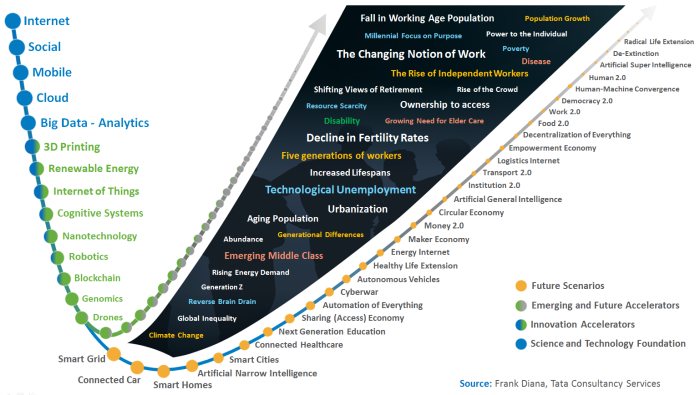
I just finished reading a new book titled The Second Machine Age written by Andrew McAfee and Erik Brynjolfsson – both from MIT. The book is a must read for leaders everywhere. Its journey offers a view into the potential societal, economic, and business impact of technological advancement in the digital age. Although I am fascinated by each of these, my interest in summarizing this book is to connect their perspective to the future of business. Consistent with my recent disruption theme, the question is: how does the world that the authors envision impact the future of business?

Continue reading

Large Companies and Innovation

“The pace of innovation is about to surge – and more powerfully than ever before”

That sentiment comes straight from a new book titled: The New Killer Apps: How Large Companies Can Out-Innovate Start-Ups. As obvious as that statement seems, many leaders still act as if nothing is really changing – or any impact to their business is too far into the future to worry. This well written book focuses on the problem with this kind of thinking. Anyone that has worked in a corporate setting will resonate with the challenges identified in this book. Behavior at every level of an organization is the biggest obstacle to innovation and the identification of what the authors call “Doomsday Scenarios”. Most of us are familiar with traditional company politics and turf-driven behaviors. The authors conclude as I have, that most bias in an organization goes toward keeping the status quo.

Continue reading

Cognitive Computing and the Internet of Things

2014 has started with a bang! If this is indicative of things to come – it will be an interesting and exciting year. Two major events usher in our New Year: IBM announcing the formation of the IBM Watson Group and Google acquiring Nest. We’ve heard a lot about the Internet of Things and the growing adoption of Smart Home components. Perhaps not as widely discussed is the emergence of cognitive computing – a space that IBM just made a huge bet on.

In my transformation series last year, I discussed the automation of knowledge work as both an emerging enterprise disruptor, and future enterprise enabler. Cognitive Computing promises to be a major driver of both sides of this equation.  In its simplest form, cognitive computing is technology that allows us to ask natural language-based questions and get answers that support action, smarter decision making, and optimal outcomes. Gartner is weighing in and focused their recent 2013 Hype Cycle on the relationship between humans and machines. The focus – driven by the increased hype around smart machines, cognitive computing and the Internet of Things – is rooted in the belief that the divide between humans and machines is narrowing. Gartner encourages enterprises to look beyond the narrow perspective that only sees a future in which machines and computers replace humans. They see three main scenarios: 1) Augmenting humans with technology 2) Machines replacing humans 3) humans and machines working alongside each other. This is a very reasonable perspective on the likely path. The future enterprise as described through this Blog will use a combination of these scenarios to drive outcomes and transform stakeholder experiences (i.e., customer, employee, citizen, partner, etc.)

Continue reading

The Biggest Ideas of 2014

In the latter months of 2012, LinkedIn launched a Blogging platform for some of the world’s best known thought leaders. As part of that series, posts were gathered to provide a perspective on the biggest ideas for 2013. LinkedIn has replicated that series for 2014. I have provided the links to each post below, along with some commentary on those that stood out to me.

But first, my Big Idea is that the convergence of a number of forces makes 2014 the year of the transformation agenda. Those companies that have already embarked on a transformation journey will accelerate their efforts. A good percentage of those that have yet to begin their journey will find compelling reasons to start. But sadly, many companies will fall further behind. I expect these transformation efforts to tackle much needed structural change – driven by the disruptive influence of technological, societal, and other factors. Transformation efforts that have merely scratched the surface will find another gear. The one common thread will be the realization that this transformative period is different than those of the past. Many of the Big Ideas described in the LinkedIn series underscore this point. For instance, it’s not your Father’s innovation process anymore, as Collaborative Innovation is Shaping and Changing Our World. No single company can master all the knowledge it needs; rather, innovation relies on a network of connected firms. In short, companies need to collaborate to compete.

Continue reading

Progress Towards Systems of Engagement

In my recently concluded transformation series, I identified Systems of Engagement as a key enabler of the future enterprise. A recent Survey conducted by Forrester suggests that systems of engagement will soon rearrange the landscape of IT organizations, technologies, architectures, budgeting, funding, and governance. It is not surprising that in this age of the customer, systems of engagement are finally getting attention – but as the survey reports, they require more than organizations are prepared to deliver.

Continue reading

The Flat Organization

As I described in my closer look at transformation, one of the key enablers of the future enterprise is Structural Change. This slide from a conference presentation I delivered this week speaks to some of the drivers of structural change. A key driver on this list is the ineffectiveness of command and control models in the future business environment.

Structural Change

As command and control slowly disappears, new models emerge and questions about effective ways to manage in flatter organizations arise. I recently fielded one such question during  the above mentioned presentation on the future enterprise. The response focused on culture, the corporate value system, collaboration, communication, openness, transparency and trust. One great example of a flat company that exhibits many of these characteristics is not surprisingly an Internet company – Google. Google’s approach is outlined in a recent Article from the Harvard Business Review . Additional thoughts on moving towards an open and transparent culture can be found in this IBM CEO Study from 2012.

Examples of companies that are starting to create these new models are emerging – and I firmly believe that it’s only a matter of time before structures suited for the digital age take hold. There are still many skeptics out there – and no one has this all figured out. Leaders of the Industrial revolution era created the management structures that enabled business in that era. It’s time for leaders in this very different era to re-imagine these structures for the present day environment.

IBM Report on Analytics

In October, IBM released a report from their Institute for Business Value titled Analytics – A Blueprint for Value. IBM releases these reports on a periodic basis, and this one is focused on the growing importance of analytics to business success. Through their analysis, they came up with nine levers that represent the sets of capabilities that most differentiated leaders exhibit:

  1. Culture: Availability and use of data and analytics within an organization
  2. Data: Structure and formality of the organization’s data governance process and the security of its data
  3. Expertise: Development of and access to data management and analytic skills and capabilities
  4. Funding: Financial rigor in the analytics funding process
  5. Measurement: Evaluating the impact on business outcomes
  6. Platform: Integrated capabilities delivered by hardware and software
  7. Source of value: Actions and decisions that generate results
  8. Sponsorship: Executive support and involvement
  9. Trust: Organizational confidence

Continue reading

The Future of Business

This list of 99 Facts pulled together by SAP continues to build the case for inevitable change. The title of this SAP presentation  is “The Future of Business”. Here are some of the key facts from various sources. There are embedded links in the content that take you to the source documents. Enjoy.

Continue reading

Digital Enterprise Transformation – Wrap Up

Over the last three months, I have presented a framework for thinking about transforming the enterprise to the type of enterprise that can succeed in the year 2020 – What I call a digital enterprise.

Throughout this multi-part transformation series, I have focused on those forcing functions that push us to transform – the drivers that stir us to action. Old models that were created for another time cannot lead us into this future – we must think differently. We must invent the models that define business in the decades ahead.

So, I wrap up this closer look at transformation with the hope that I’ve convinced you in some small way that we are indeed heading towards what is likely to be the most transformative period in history. My hope is that leaders everywhere think differently to usher in a period of prosperity and societal advancement. Instead of talk of disruption, let us talk of enablement and advancement. May we each have the wisdom, vision and courage to lead in this emerging transformative period.

For a review of this entire transformation series, here is an intro and link to each of the prior posts. As a reminder, forcing functions are those things that force the enterprise to invest in a future state. The enablers are those facilitators of change that allow us to address the forcing functions and build a path towards the future. Click on the underlined title to access each post.

Continue reading

A Closer Look at Transformation: Thinking Differently

Next up in this transformation series is the ninth and final enabler: thinking differently. How can we enable the characteristics so important to future success, if we don’t start thinking differently? Status quo thinking is the cause of many transformation failures – a trend that will continue without the re-imagining necessary to support the coming transformative period. The keyword to reflect on is “re-imagine”. To do this in the context of where the world is heading forces us to think differently and involves creativity – a trait that consistently heads the list of key traits that CEOs look for in leaders. It requires design thinking, innovative approaches and a willingness to let go of models built for another time.

Continue reading

A Closer Look at Transformation: Descriptive to Prescriptive

Next up in this transformation series is the eighth enabler: the evolution from descriptive to predictive analytics. At the heart of future success lies the ability to leverage insight for competitive advantage. Yet, analytic capability and data driven cultures are lacking in most organizations, and most executives when assessing their positioning on a descriptive-to-prescriptive scale answer level one. The table below defines each level:

Continue reading

A Closer Look at Transformation: Collective Intelligence

Next up in this transformation series is the seventh enabler: Collective Intelligence. One of the key themes throughout this transformation series is the clear movement from an enterprise entity to an extended enterprise of stakeholders. This extended enterprise – or what I alternatively call value ecosystem – increases complexity and requires a new management approach to be effective. I use the term collective intelligence as an umbrella phrase that combines the critical need for both collaboration and analytic excellence. This includes other forces like crowd computing, crowdsourcing, co-creation, and wisdom of the crowd – all of which stem from the connectedness of our world, and the growing realization that value creation requires a broader community.

Continue reading

A Closer Look at Transformation: Sense and Respond Systems

Next up in this transformations series is the sixth enabler: sense and respond systems. These systems are critical to the transformation agenda, as most of the disruptive technologies likely to impact the enterprise in the next decade have data at its core. The resulting data explosion promises to complicate information management for most companies. As the speed of business accelerates and the amount of data flowing through company ecosystems expands, the need to sense stimuli and enable a real time response intensifies. Fortunately, rapid advancements in the price and performance of technology make realizing this sense and respond paradigm achievable and economical for a wide range of use cases – but this is arguably one of the most difficult components of transformation road maps.

Continue reading

A Closer Look at Transformation: Systems of Engagement

Next up in this transformation series is the fifth enabler: systems of engagement. Geoffrey Moore introduced the Systems of Engagement concept about two years ago. This vision for the future of Information Technology is gaining broader acceptance – but a surprising number of executives are blind to the coming sea change. Where current enterprise systems are designed around records (systems of record); these new systems are designed around interactions. Where technology investment in the last two decades enabled transaction workers and executives – these systems enable the middle of organizations with a focus on growth.

Continue reading

A Closer Look at Transformation: Next Generation Experiences

Next up in this transformations series is the fourth enabler: next generation experiences. As we are now deep into this transformation series, some of the drivers and tactics are similar across the various enablers, so you will start to see some redundancy across posts. The issues of customer experience, customer-centricity, and customer intimacy are top-of-mind and dominate many executive discussions and conference agendas. According to Forrester, only 3% of companies manage to succeed at delivering an excellent customer experience, but 60% intend to use customer experience as a strategic differentiator. Driven by the rapid commoditization of products and services, the speed at which new market entrants emerge, and the rise of consumerization, experience is now the new battle ground – and sustainable competitive advantage is the prize. But as Forrester concludes in their book Outside-in, customer experience remains the most misunderstood element of corporate strategy today.

Continue reading

MIT Big Data Panel Discussion

In May, I participated in a Big Data panel discussion at the 2013 MIT Sloan CIO Symposium. The panel was moderated by Tom Davenport, Harvard Professor and co-founder of the International Institute for Analytics. The panel participants aside from myself were:

  • Annabelle Bexiga, CIO, TIAA-CREF
  • Jack Norris, CMO, MapR
  • Keith Collins, SVP, CIO & CTO, SAS Institute
  • Michael Chui – Senior Fellow, Mckinsey Global Institute

This was a very good discussion on the potential of Big Data and the possible direction it takes in the future. Michael Chui did a great job with his opening remarks, referencing this Mckinsey Report and using examples from it. This report, which I have mentioned previously, focuses on major disruptive technology. It is interesting to hear the perspectives (and sometimes biases) of these industry players. It’s an hour and ten minutes long, with some very good audience questions.

A Closer Look at Transformation: Value Ecosystems

The next focus of this transformation series shifts to the emergence of value ecosystems and their role in driving the Enterprise of 2020. As we look at the Apple ecosystem and offerings like the connected car, mobile commerce, energy efficiency, electric cars, eHealthcare, and energy performance contracts, we can see the lines between industries blurring. Some even question the relevance of Industry constructs in the future. As this phenomenon accelerates, more and more companies must identify the relevant ecosystem(s) that enable their growth strategies. These value ecosystems are complex and relationship-oriented, representing future growth opportunities that are increasingly outside a company’s traditional business.

Continue reading

A Closer Look at Transformation: Edge-Driven Design

Next up in this transformation series is edge-driven design, the second enabler. This key enabler is growing in importance as developed economies are moving away from command and control models and towards edge interaction that is value-based. The design principles of our past where the core (Systems of record) drove design and the edge adapted do not support this shift. This future state requires the edge to drive design from the outside-in and a core that is adaptive. This reversal in design principles supports two future dynamics: 1) Value is increasingly created by an ability to connect capabilities across organizations within an ecosystem of services, and 2) The shift from a transactional paradigm to an experiential one. An edge-driven design addresses both of these dynamics and begins to instill a fast, iterative and responsive culture.

Continue reading

A Closer Look at Transformation: Structural Change

This closer look at transformation now shifts to the enablers. By way of summary, we have covered the forcing function piece of the diagram below; those forces that drive leaders to invest in a future state. In the absence of a burning platform, one must turn to vision as a catalyst for change in what promises to be the most transformative period in history. Once the impetus for change is established, what are the enablers of change? Where do companies invest to move towards that future state? The enabler side of the visual identifies those facilitators of change that allow us to address the forcing functions and build a path towards the future. The next nine posts will address each of these individually, starting with structural change.

Continue reading

A Closer Look at Transformation: Digital DNA

This closer look at transformation continues with part five focused on Digital DNA; the sixth forcing function. My perspective on Digital DNA is based on a view of the business environment that is likely to exist in 2020. Enterprise DNA must reflect those characteristics that enable success in the digital world likely to exist in seven years. Business speed in the next decade and the rapid rate of change makes Digital DNA critical to future success. Today, Internet companies like Facebook, Twitter, Amazon, Apple, Google and others have fairly high Digital DNA quotients. Start-ups are born with much more Digital DNA than traditional companies, and the rate and ease at which start-ups are entering the market will continue to create a competitive environment where traditional companies are disadvantaged. Since most companies are traditional companies, the majority will enter business transformation from a challenging legacy position.

Continue reading