This series began with a simple observation: something feels different about the world right now. Not just faster. Not just noisier. But more tightly connected, more reactive, and harder to stabilize using the assumptions we inherited from the last age. Over the course of these posts, we made that feeling legible. We explored how systems change, why pressure accumulates, and how societies move through periods of compression before reorganizing around new forms of order. We looked at history not to romanticize the past, but to recognize patterns that repeat when civilizations cross thresholds.
Continue readingSystemic Change
The Traits We Need For The Future We’re Entering
Over the last ten posts, we have been building a clearer picture of what it means to live in a world approaching a systemic turning point. We began by examining why today feels unusually active and uneven, then traced the deeper pattern behind major shifts in history. We explored how change accumulates, compresses, destabilizes, and eventually reorganizes life around new assumptions. We introduced the seven domains that shape every transition and showed why no single force ever moves a civilization forward on its own. We examined the three drivers that push societies across thresholds and built gauges that make systemic pressure legible. Using those gauges, we read four major transitions in the long arc of history: from hunter-gatherer life to agriculture, from agriculture to the Axial reorientation of ideas, from the Axial age to the Renaissance, and from the Renaissance into the Industrial world. We then applied the same lens to the present, showing why the 2020s feel dense, fast, and tightly connected. Most recently, we explored the possibility of another transition forming and the kind of governance required when intelligence itself becomes a shared utility. Together, these posts formed a simple arc: understand the moment, understand the mechanics, understand what may be forming next.
Continue readingThe Compressed Present
THE BIO-INTELLIGENT SIGNATURE: A LENS ON THE CURRENT AGE

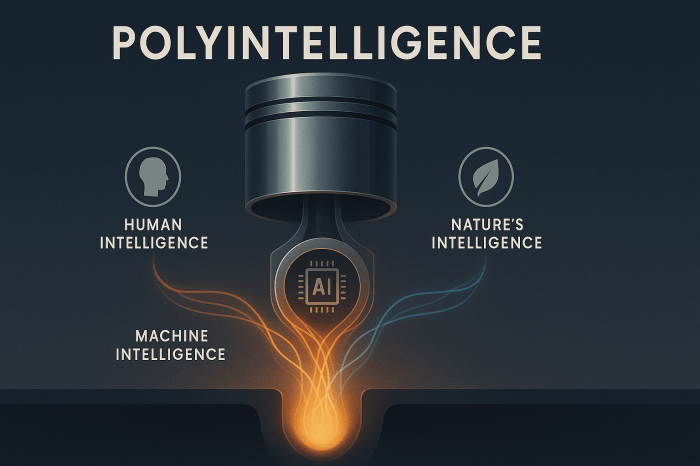
The present moment is shaped by three converging streams of intelligence: machine intelligence, biological intelligence, and planetary intelligence. These are the same sources that form what I have described elsewhere as polyintelligence — cognition distributed across humans, machines, and nature. Each stream is advancing on its own, but their deeper significance appears in how they now influence one another. Artificial intelligence extends cognition beyond the human mind. Synthetic biology brings design and computation into living systems. And the planet — long treated only as a resource base — is increasingly recognized as a source of insight. Through biomimetics, natural systems provide design principles refined through evolution: circularity instead of waste, resilience through diversity, and adaptation through constant sensing and feedback.
Continue readingCrossing The Threshold
Civilization’s great shifts are the moments when continuity fails and a new order takes shape. Each historical age reached a point where the old logic could no longer hold, and pressures converged into a transformative release. By examining four major transitions – from Hunter–Gatherer to Agricultural, Agricultural to Axial, Axial to Renaissance, and Renaissance to Industrial – we can see how rising Total Systemic Domain Score (TSDS) and changing Activation Dispersion (AD) signaled that a threshold was near. Some transitions unfolded slowly over millennia, while others struck within a few centuries. In each case, the build-up of energy and imbalance hit a critical point, and society crossed into an irreversible new configuration that only in hindsight feels inevitable.
Continue readingWhat The Gauges Reveal Across The Ages
Over the first seven posts, we explored the seven domains that shape civilization, the forces that move within them, the thresholds that mark major transitions, and the drivers that push systems toward those turning points. We also built two gauges that help make those movements visible. TSDS shows how much energy sits across the seven domains. AD shows how that energy is arranged. Together, they help us see the internal structure of an age: how active its domains were, how evenly that activity spread, and how tightly the system was coupled. With that groundwork in place, we can now use the gauges to trace the long arc of history and examine how pressure accumulated across major ages of civilization.
Continue readingHow The Gauges Were Built: Making Systemic Pressure Legible
Over the first six posts, I built the foundation needed to understand how civilizations change. I explored the seven domains that shape collective life, the forces that move within them, the thresholds that mark historical turning points, and the three drivers that push systems toward those moments. With that groundwork in place, I introduced a pair of gauges that make those movements easier to see. In this post, I describe the gauges in greater detail. TSDS reflects how much energy sits across the seven domains. AD shows how that energy is arranged. Before we apply these gauges to the long arc of history, we need to explain how they were built. Every measure rests on a set of choices. This post walks through those choices in a way that keeps the gauges intuitive while grounding them in the history they aim to describe.
Continue readingReading The Pulse Of A Civilization In Motion
The first five posts laid the foundation for understanding why the world feels dense, fast, and tightly connected. We explored the sense that something in the operating logic of civilzation is shifting. We looked at phase transitions, the four-stage pattern that repeats across history, and the seven domains that structure civilization. The last post introduced the three deep drivers that push civilizations across thresholds: growing convergence, system-shaping technologies, and the acceleration of knowledge. Taken together, they help explain why pressure builds, why systems couple, and why some ages move differently than others.
Continue reading