Will we Supplant the Steam Engine?

To transform is to make a thorough or dramatic change in form, appearance, or character. Society has transformed several times, but what was the most transformative period in all of history? The folks at MIT set out to answer that question. Through their research and analysis, they determined that the invention of the steam engine ushered in the most transformative period in history.

Over two centuries later, we are likely on the verge of supplanting that transformative period. Unlike the industrial revolutions, when a period of stabilization allowed companies to retrench and exploit the disruptors of the day, this coming period promises no such period. Several key drivers have positioned the next several decades to deliver a staggering – perhaps unprecedented – amount of change. That leads to a question regarding the intensity of the coming transformative period.

An Interview with Futurist Thornton May

I thought it would be interesting to get a slightly different perspective on the questions that I posed to Futurist Gerd Leonhard in our recent interview. So I reached out to IT Futurist Thornton May. Thornton and I have interacted on a number of occasions at various events. His bio describes him as a futurist, educator and author. His extensive experience researching and consulting on the role and behaviors of C-level executives in creating value with information technology has won him an unquestioned place on the short list of serious thinkers on this topic. Thornton moderates the nationally recognized CIO Solutions Gallery program, intended for executives and senior leaders in the technology and operations communities.

With that background, I was excited to explore these broad topics with Thornton. His perspective follows.

Continue reading

An Interview with Futurist Gerd Leonhard

Over the last two months, I’ve had the pleasure of interacting with Gerd Leonhard, CEO of The Futures Agency, Futurist, Keynote Speaker, and Author. He is the co-author of the bestselling book titled The Future of Music (2005), and the author of The End of Control, Music 2.0, The Future of Content, and Friction is Fiction.

In 2015, I will continue my focus on disruptive scenarios and their likely impact on the world over the next two decades. What better way to start the year, than to pick the brain of someone who knows a thing or two about disruption – given his time spent in the highly disrupted media and entertainment industry. Here is a summary of our very enjoyable conversation. 

Introduction

To kick off our call, Gerd and I discussed the challenge of driving leaders towards a level of urgency and focus on the disruptive period that lies ahead. Our discussion started with the problem of viewing things through a technology lens versus a business model lens, and the mistaken belief that case studies and recipes exist to solve these emerging problems – versus requiring our collective resolution. Gerd used examples from Europe, where leaders look for proof, and invention is not the norm. We discussed the importance of iterative, experimental cycles that explore the unknown, and Gerd’s belief that this approach is not fully embraced in Europe. He did see the Banking Industry as an example of an emerging shift from focusing on changing into something better, to transforming into something new. But for a number of reasons, Gerd felt that at least in the short term, innovation will still come from the U.S. and China, where there is an openness to inventing.

Continue reading

The Third Revolution

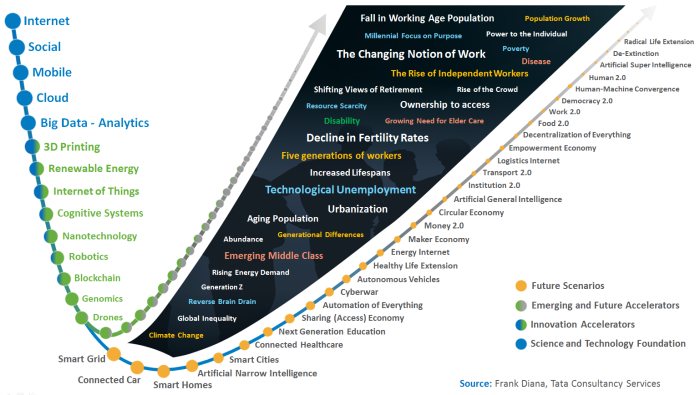
I have used this picture for the better part of 18 months to describe the coming Third Revolution. The visual is getting broader exposure, so I wanted to provide a more detailed description. The blue curve is the science and technology progression curve. The progression of science and technology continues its unabated exponential rise, and leaders can only see so far on the curve. This creates an uncertainty that makes it difficult to understand the implications of technology into the future.

emerging-future

Continue reading

The CIO Discussion

The CIO role discussion is on fire, and conferences all over the world dedicate considerable time to the ongoing dialog. To add more meat to the discussion, the Corporate Executive Board (CEB) recently positioned Business-Led IT as a model for the future. Chris Mixter, senior director of advisory services for CEB distinguishes it from Shadow IT in this quote from a Forbes Article by Nikki Goth Itoi:  

“This is not about the willful or ignorant duplication of core IT services. Your internal business customers are bypassing IT and investing in activities that are driving a critical business outcome.” 

This emerging Business-led IT is therefore not what we have historically called shadow IT. The CEB recently found that 78% of business leaders’ priorities for 2014 were dependent on technology. This drives a keen interest in business-led IT, which shares three primary characteristics:

  • Funding comes directly from departmental budgets
  • The ideas do not require IT approval
  • Capabilities are delivered using business resources, external providers, and/or the cloud

Where speed takes priority over efficiency or cost, IT could be shut out of critical business initiatives. According to the CEB, the business spends three times as much on innovation as the corporate IT function does. It is said that you can’t be a CIO these days if you are not versed in the business. Considering the previous statistic on the dependence of business priorities on technology, the same may be true about business executives that are not versed in technology. As business leaders become more technology savvy, the business-led IT phenomenon broadens. The above article also positions an interesting twist on the war for talent. Here’s Chris Mixter again:

“Let’s face it, the best technology graduates in the world aren’t terribly stoked about working in corporate IT. They want to go work in marketing, R&D, or supply chain. And none of those functions are held accountable to the strict pay scales in the HR hierarchies that we are.”

Continue reading

Business Evolution

This Presentation tells the full business evolution story articulated below.

Several key drivers have positioned the next two decades to deliver a staggering – perhaps unprecedented – amount of change. The accelerating pace of business, the growing impact of digital, and several other major indicators suggest that a next generation enterprise is on the horizon. The first of these indicators is the level of societal change impacting everything from business to war. In the business world, the implications of this change can be seen in our employees, where for the first time in history, four generations of workers are in our work force. The associated challenges are coming into focus, as some of these workers are digital natives, but the vast majorities are digital immigrants. With customers, the shift of power to the individual has changed their role forever and placed them at the center of the company ecosystem. Other indicators include an intense focus on growth, which increasingly requires collaboration within and outside the four walls of the Enterprise. This growth agenda drives a new type of value ecosystem, enabling growth that in many cases is outside a company’s traditional business.

Continue reading

IT and Business Integration

The CMO and CIO relationship discussion has been raging for months, and there is a growing perspective that IT budget ownership will shift from IT to the business. Add to this the growing list of new executive roles, and the role of CIO could look very different in the near future. I recently participated in a panel discussion on this topic at a CIO Summit attended by over 40 CIOs. I was somewhat surprised by several of the answers provided by the CIO panel, as well as those provided to poll questions posed during the session. It would indicate that those raging discussions about IT and business integration are unfounded. I thought I’d get a different perspective from someone with one of those new executive titles, so I interviewed Heidi Schwende, a Chief Digital Officer with WSI World. The following are her thoughts on similar questions.

Continue reading

Geoffrey Moore on Disruption

In a recent Post, Geoffrey Moore expands his Systems of Engagement (SOE) vision to focus on disruption. Many by now are familiar with his views on SOE and next generation edge architecture. Mr. Moore describes a future dominated by Social and Mobile on the client side and Analytics and Cloud on the server side. In this recent piece, the focus broadens to include the inevitable disruption facing every industry. In doing so, he introduces a new Systems of Business (SOB) concept and provides some examples that highlight the differences between SOB and SOE. These examples help visualize a distinction that Mr. Moore is making between these two systems: systems of engagement instantiate new operating models, while systems of business instantiate new disruptive business models.

Continue reading

A New Economic Paradigm?

Does the combination of emerging disruptive scenarios create a new economic paradigm? In The Zero Marginal Cost Society, Jeremy Rifkin describes a world where nearly free goods and services are enabled by the Internet of Things to drive a new paradigm that eclipses capitalism – the Collaborative Commons. It seems the exponential curve of technology is pushing the operating logic of Capitalism – which focuses on driving ever increasing levels of productivity – towards an extreme level of productivity. Its success could therefore be its undoing. I am a firm believer that this emerging period will ultimately be viewed as the most transformative of all time – but I must admit – I did not make this leap. While reading, I found myself focused on business model questions facing every industry – and through that lens, the story resonated with me. It prompted me to revise the anchor visual that I have used throughout this look at disruptive scenarios. I posed this simple question: does combinatorial innovation create a third curve?

Continue reading

The Second Machine Age and Business Evolution

I just finished reading a new book titled The Second Machine Age written by Andrew McAfee and Erik Brynjolfsson – both from MIT. The book is a must read for leaders everywhere. Its journey offers a view into the potential societal, economic, and business impact of technological advancement in the digital age. Although I am fascinated by each of these, my interest in summarizing this book is to connect their perspective to the future of business. Consistent with my recent disruption theme, the question is: how does the world that the authors envision impact the future of business?

Continue reading

The Biggest Ideas of 2014

In the latter months of 2012, LinkedIn launched a Blogging platform for some of the world’s best known thought leaders. As part of that series, posts were gathered to provide a perspective on the biggest ideas for 2013. LinkedIn has replicated that series for 2014. I have provided the links to each post below, along with some commentary on those that stood out to me.

But first, my Big Idea is that the convergence of a number of forces makes 2014 the year of the transformation agenda. Those companies that have already embarked on a transformation journey will accelerate their efforts. A good percentage of those that have yet to begin their journey will find compelling reasons to start. But sadly, many companies will fall further behind. I expect these transformation efforts to tackle much needed structural change – driven by the disruptive influence of technological, societal, and other factors. Transformation efforts that have merely scratched the surface will find another gear. The one common thread will be the realization that this transformative period is different than those of the past. Many of the Big Ideas described in the LinkedIn series underscore this point. For instance, it’s not your Father’s innovation process anymore, as Collaborative Innovation is Shaping and Changing Our World. No single company can master all the knowledge it needs; rather, innovation relies on a network of connected firms. In short, companies need to collaborate to compete.

Continue reading

The Flat Organization

As I described in my closer look at transformation, one of the key enablers of the future enterprise is Structural Change. This slide from a conference presentation I delivered this week speaks to some of the drivers of structural change. A key driver on this list is the ineffectiveness of command and control models in the future business environment.

Structural Change

As command and control slowly disappears, new models emerge and questions about effective ways to manage in flatter organizations arise. I recently fielded one such question during  the above mentioned presentation on the future enterprise. The response focused on culture, the corporate value system, collaboration, communication, openness, transparency and trust. One great example of a flat company that exhibits many of these characteristics is not surprisingly an Internet company – Google. Google’s approach is outlined in a recent Article from the Harvard Business Review . Additional thoughts on moving towards an open and transparent culture can be found in this IBM CEO Study from 2012.

Examples of companies that are starting to create these new models are emerging – and I firmly believe that it’s only a matter of time before structures suited for the digital age take hold. There are still many skeptics out there – and no one has this all figured out. Leaders of the Industrial revolution era created the management structures that enabled business in that era. It’s time for leaders in this very different era to re-imagine these structures for the present day environment.

Digital Enterprise Transformation – Wrap Up

Over the last three months, I have presented a framework for thinking about transforming the enterprise to the type of enterprise that can succeed in the year 2020 – What I call a digital enterprise.

Throughout this multi-part transformation series, I have focused on those forcing functions that push us to transform – the drivers that stir us to action. Old models that were created for another time cannot lead us into this future – we must think differently. We must invent the models that define business in the decades ahead.

So, I wrap up this closer look at transformation with the hope that I’ve convinced you in some small way that we are indeed heading towards what is likely to be the most transformative period in history. My hope is that leaders everywhere think differently to usher in a period of prosperity and societal advancement. Instead of talk of disruption, let us talk of enablement and advancement. May we each have the wisdom, vision and courage to lead in this emerging transformative period.

For a review of this entire transformation series, here is an intro and link to each of the prior posts. As a reminder, forcing functions are those things that force the enterprise to invest in a future state. The enablers are those facilitators of change that allow us to address the forcing functions and build a path towards the future. Click on the underlined title to access each post.

Continue reading

A Closer Look at Transformation: Thinking Differently

Next up in this transformation series is the ninth and final enabler: thinking differently. How can we enable the characteristics so important to future success, if we don’t start thinking differently? Status quo thinking is the cause of many transformation failures – a trend that will continue without the re-imagining necessary to support the coming transformative period. The keyword to reflect on is “re-imagine”. To do this in the context of where the world is heading forces us to think differently and involves creativity – a trait that consistently heads the list of key traits that CEOs look for in leaders. It requires design thinking, innovative approaches and a willingness to let go of models built for another time.

Continue reading

A Closer Look at Transformation: Descriptive to Prescriptive

Next up in this transformation series is the eighth enabler: the evolution from descriptive to predictive analytics. At the heart of future success lies the ability to leverage insight for competitive advantage. Yet, analytic capability and data driven cultures are lacking in most organizations, and most executives when assessing their positioning on a descriptive-to-prescriptive scale answer level one. The table below defines each level:

Continue reading

A Closer Look at Transformation: Collective Intelligence

Next up in this transformation series is the seventh enabler: Collective Intelligence. One of the key themes throughout this transformation series is the clear movement from an enterprise entity to an extended enterprise of stakeholders. This extended enterprise – or what I alternatively call value ecosystem – increases complexity and requires a new management approach to be effective. I use the term collective intelligence as an umbrella phrase that combines the critical need for both collaboration and analytic excellence. This includes other forces like crowd computing, crowdsourcing, co-creation, and wisdom of the crowd – all of which stem from the connectedness of our world, and the growing realization that value creation requires a broader community.

Continue reading

A Closer Look at Transformation: Sense and Respond Systems

Next up in this transformations series is the sixth enabler: sense and respond systems. These systems are critical to the transformation agenda, as most of the disruptive technologies likely to impact the enterprise in the next decade have data at its core. The resulting data explosion promises to complicate information management for most companies. As the speed of business accelerates and the amount of data flowing through company ecosystems expands, the need to sense stimuli and enable a real time response intensifies. Fortunately, rapid advancements in the price and performance of technology make realizing this sense and respond paradigm achievable and economical for a wide range of use cases – but this is arguably one of the most difficult components of transformation road maps.

Continue reading

A Closer Look at Transformation: Systems of Engagement

Next up in this transformation series is the fifth enabler: systems of engagement. Geoffrey Moore introduced the Systems of Engagement concept about two years ago. This vision for the future of Information Technology is gaining broader acceptance – but a surprising number of executives are blind to the coming sea change. Where current enterprise systems are designed around records (systems of record); these new systems are designed around interactions. Where technology investment in the last two decades enabled transaction workers and executives – these systems enable the middle of organizations with a focus on growth.

Continue reading

A Closer Look at Transformation: Next Generation Experiences

Next up in this transformations series is the fourth enabler: next generation experiences. As we are now deep into this transformation series, some of the drivers and tactics are similar across the various enablers, so you will start to see some redundancy across posts. The issues of customer experience, customer-centricity, and customer intimacy are top-of-mind and dominate many executive discussions and conference agendas. According to Forrester, only 3% of companies manage to succeed at delivering an excellent customer experience, but 60% intend to use customer experience as a strategic differentiator. Driven by the rapid commoditization of products and services, the speed at which new market entrants emerge, and the rise of consumerization, experience is now the new battle ground – and sustainable competitive advantage is the prize. But as Forrester concludes in their book Outside-in, customer experience remains the most misunderstood element of corporate strategy today.

Continue reading

A Closer Look at Transformation: Value Ecosystems

The next focus of this transformation series shifts to the emergence of value ecosystems and their role in driving the Enterprise of 2020. As we look at the Apple ecosystem and offerings like the connected car, mobile commerce, energy efficiency, electric cars, eHealthcare, and energy performance contracts, we can see the lines between industries blurring. Some even question the relevance of Industry constructs in the future. As this phenomenon accelerates, more and more companies must identify the relevant ecosystem(s) that enable their growth strategies. These value ecosystems are complex and relationship-oriented, representing future growth opportunities that are increasingly outside a company’s traditional business.

Continue reading