Last month, I wrote a piece for Time titled The Issue with Living Longer. In it, I explored a sobering reality: while global life expectancy continues to rise, the experience of those added years often falls short of what we imagine. Instead of extra time spent thriving, many people are spending those years managing chronic illness, cognitive decline, or financial instability.
Continue readinglongevity
Invisible at Rush Hour
What it feels like to grow old in a society speeding past you.
The World Is Getting Older—Fast
Across the globe, populations are aging at unprecedented speed. By 2030, more than 1 in 6 people worldwide will be over 60. In countries like Japan, South Korea, Italy, and Germany, that number will be closer to 1 in 3. The dependency ratio is tipping. Pensions are under strain. Healthcare systems are overwhelmed. And in many cities, there are now more people leaving the workforce than entering it.
Continue readingThe Longevity Trap
What if living longer isn’t the gift we imagine it to be?
In this op-ed for TIME, I explore the quiet crisis that comes with rising life expectancy – a world where our bodies may outlast our purpose, our savings, and our social roles. We’ve extended human life, but not always human meaning. The piece asks a deeply personal question with global consequences: What happens when we live longer, but not better?
I unpack why the “aging society” story is about more than pensions and healthcare – it’s about identity, purpose, and the design of a future that works across all life stages. This is a call to rethink how we structure work, caregiving, community, and belonging in an era where the old assumptions no longer hold.
Read the full piece on TIME: Time Op-Ed
Rehearsing The Future: Scenario Thinking And Longevity
For years, I’ve championed the power of scenario thinking as a way to “rehearse” the future. In my work, I’ve seen how structured, forward-looking narratives help us move beyond guesswork or simple extrapolation, allowing us to imagine multiple possibilities and develop more resilient strategies. This approach is particularly vital when it comes to the challenges of longevity and the strain on social safety nets like Social Security – areas where demographic shifts, policy decisions, and economic factors converge in ways that few people anticipate. By rehearsing tomorrow’s potential realities today, we equip ourselves with the foresight to adapt, innovate, and thrive no matter which scenario becomes our new normal.
Continue readingThe Future Of Longevity: Projected Gains In Global Life Expectancy By 2050

As the world advances in public health and medical interventions, significant increases in global life expectancy are anticipated by 2050. A recent analysis of the Global Burden of Disease (GBD) 2021 study reveals promising projections for both life expectancy and healthy life expectancy across various regions. A recent article delves into the key findings of the GBD 2021 study, examining the factors driving these changes and exploring alternative scenarios that could further impact global health outcomes.
Continue readingSolving Humanities Greatest Challenges
Every so often, the knowledge base of society expands in a way that can be felt across multiple domains. When science pushed technology to new heights starting in the 1870s, it put society on a path towards transformative change. With science continuing to produce amazing breakthroughs in a synergistic relationship with technology, it feels much like that period so long ago. Take a look at the headlines from the past week:
Continue readingLiving An Extra One Hundred Years
One of the future scenarios that I have focused on for some time is healthy life extension. When I mention to an audience that the first person to live to 200 has already been born – it gets quite the reaction. That scenario is not as far-fetched as people believe. This recent article explored research in the field of senolytics – drugs that work to eliminate cells that degrade tissue function. The drugs are already showing promising results and could become available on the market within the next decade.
Continue readingHealthspan Is As Important As Lifespan
I like the way Daniel Davis described the prospects of humans living both longer and healthier lives. In his article on the topic of ageing, he points to scientific advancements that are leading to life extension. At the same time, he underscores a key tenet of the journey: healthspan is just as important as lifespan. This lies at the heart of a key future scenario identified as healthy life extension. That one scenario has many thinking about a world where people live much longer, healthier lives. Imagine a key institution like retirement. As much as we believe that our lives have always been segmented into three dominant phases (education, work, retirement), those phases represent a small portion of human history. This is an example of the institutional change that lies ahead. Now imagine a scenario referred to as radical life extension.
Continue readingTherapeutic Agents That Target Cancer Cells Directly
Two scenarios in our emerging future are healthy life extension and radical life extension. The former extends are healthy lives and the latter pursues immortality. At the heart of both scenarios lies astounding and rapid advances in science and technology. A recent article provides a great example while exploring the possibility of cancerous tumors eliminating themselves. Per the article, a new technology developed by University of Zurich (UZH) researchers enables the body to produce therapeutic agents on demand at the exact location where they are needed.
Continue readingRadical Life Extension
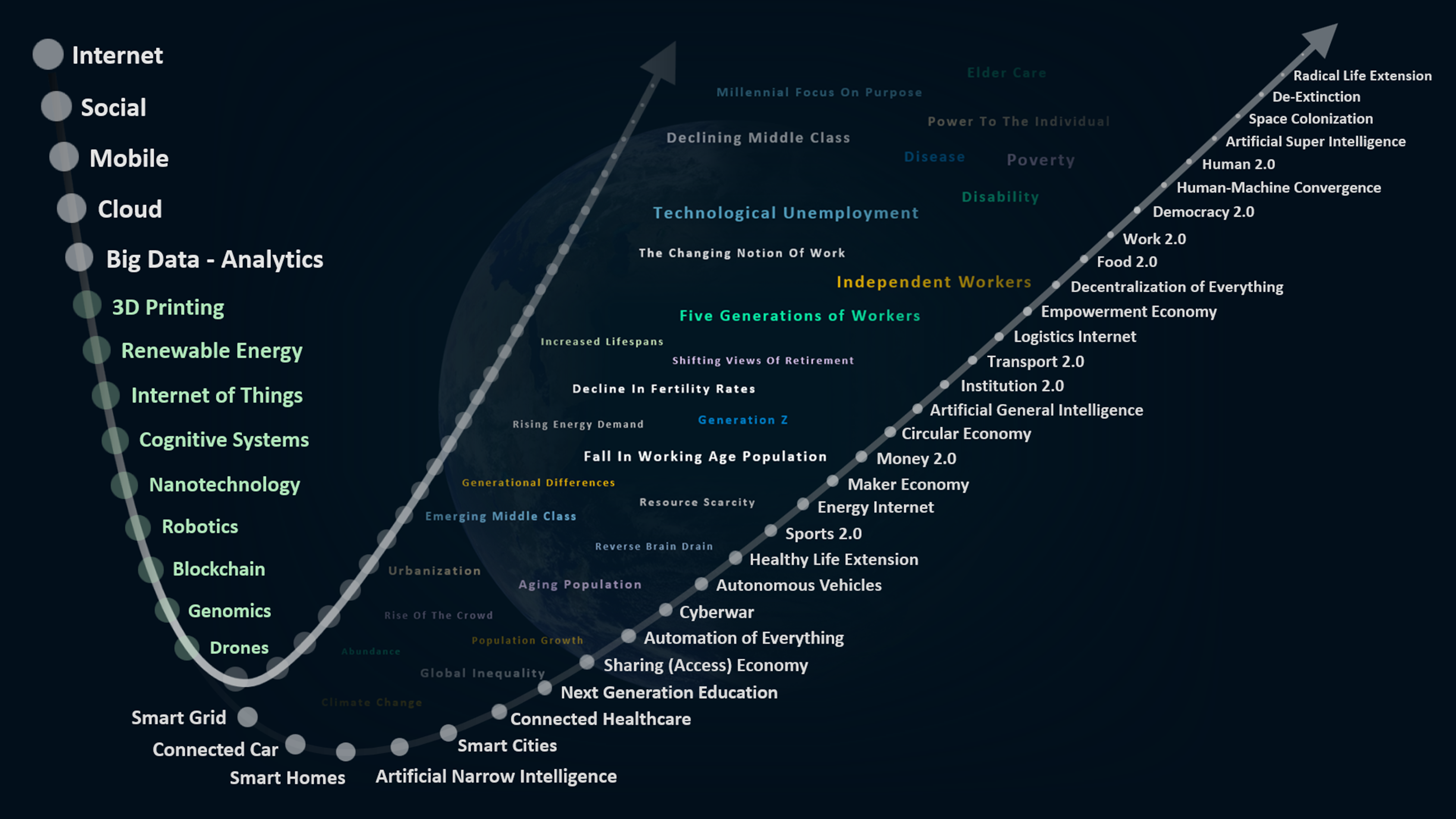
At the furthest point of the future scenario curve sits radical life extension. I use this emerging future visual to depict the exploding number of building blocks that combine to shape the future, challenging our ability to track its complexity. Convergence across aspects of science, technology, economic forces, politics, society, our environment, and a growing conversation around ethics, is creating a highly uncertain world. At the heart of the pace dynamic is the exponential progression of science and technology – reflected in the first curve on the visual.
Continue readingThe Probability Of Living Past 110 Is On The Rise
I posed this question in 2018 in a post on healthy life extension: Has the first person to live to 200 already been born? I ask that question in various forums to provide a good example of how one scenario can challenge current institutions and traditional thinking. In that earlier post, Johnty Andersen, had this perspective on that question:
Continue readingReversing The Aging Process
Advances in life sciences have scientist believing that the first person to Live to 200 has already been born. This Healthy Life Extension scenario has major societal implications. In this scenario, we are not just enabling people to live longer, but we will also be healthier. This healthy longevity challenges traditional views of retirement, wealth, savings, our social contract, and the phases of our lives, among other things. Now, you may ask, how is it possible to extend our lives in a healthy manner? In a Post from 2018, I shared a perspective from Johnty Andersen, Biotechnology, Nanotechnology and Anti-Aging Medicine researcher:
Continue readingThe Intersection of Longevity and Finance
I have a fundamental belief that we will not solve the challenges ahead using the institutions and mechanisms of the past. These structures served us during a manufacturing era that looked very different than the world that has emerged in the last three decades. In a recent Article authored by Margaretta Colangelo, she provides an example of this phenomenon. In a time when populations are living much longer than previous generations, leaders are beginning to realize that institutions must be organized in a different way. Ms. Colangelo provides an example in the Finance space, stating that traditional banks weren’t designed to serve a large number of clients living a long time. Today, banks have a small number of clients who are over 100 and they are outliers. In the next decade that demographic will increase dramatically.
Longevity Escape Velocity
Google’s head of engineering, innovator and futurist Ray Kurzweil often discusses the concept of longevity escape velocity; or the point at which science can extend your life for more than a year for every year that you are alive. Kurzweil believes we are much closer than you might think. In fact, he believes we are just another 10 to 12 years away from the point that the general public will hit this longevity escape velocity.
Life, Health, and Longevity
Healthy life extension is a future scenario depicted on this emerging future visual. In this era of genomics, precision medicine, and rejuvenation biotechnology, extending our healthy lives is not only possible, but likely. It is believed in some circles that the first person to live to 200 may have already been born. This animated video was developed to support a recent event on the topic of life and health. It closes with a quick glimpse of TCS capability via a next generation sequencing facility and an analytics platform for genomics and metagenomics.
Loneliness, Aging, Robots and Health
At the Health Summit in D.C. last week, I used this emerging future visual to describe the combination of building blocks that enable our healthy life extension – one of many emerging future scenarios. This two minute video captures that portion of our panel discussion.
One of the key issues that emerged during our panel dialog was the acceleration of aging and death associated with isolation and loneliness. Could robotic companions solve this problem? Do these advances – many that feel like science fiction – combine to solve the challenges that likely emerge as we live longer? Can Sophia be a robotic companion?
 Reimagining the Future