In his book titled Homo Deus, Yuval Harari provides a look into possible futures; he echoed those themes as he addressed the attendees of this years annual meeting of the World Economic Forum. I encourage everyone to read his Address, as it touches on the three existential threats that he believes humanity faces: nuclear war, ecological collapse, and technological disruption. Given the attention paid to the first two, Mr. Harari focused his address on technological disruption.
Inside the Next Transition
-

Wednesday Musings: Education, Energy, Currency, and Purpose
Every morning, I scan the horizon. Horizon Scanning is a systematic process that serves as an early warning system to inform decision makers about possible futures. It identifies actions, innovations, and events that have the potential to alter our future, both positive and negative. I am struck by the sheer volume of news, areas to consider, and emerging building blocks that are likely to impact society. The Possibilities – both good and bad – seem endless.
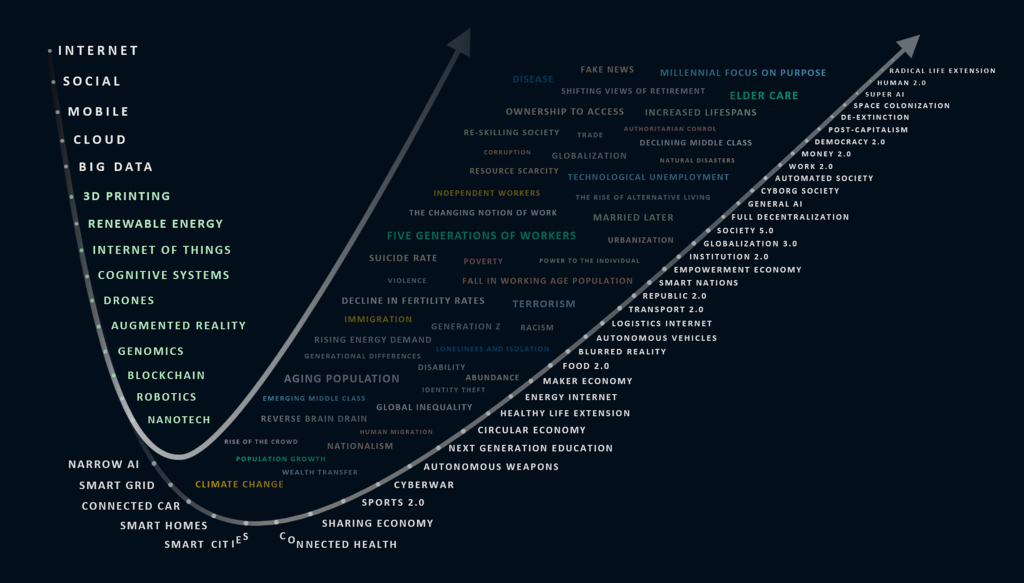
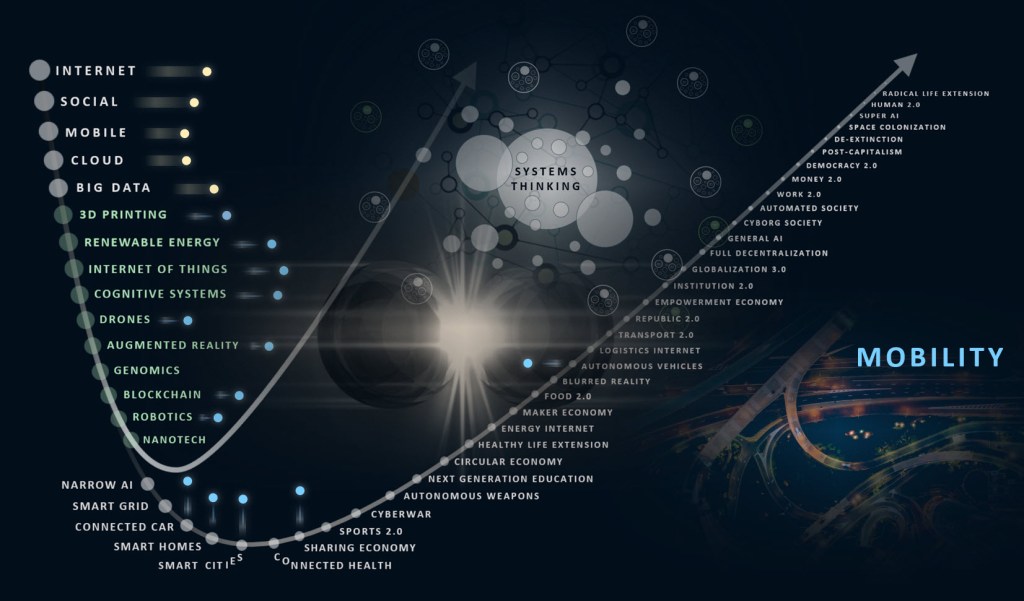
Thinking about the Future should be a normal part of every leaders day. With so many building blocks to consider, the need to understand them intensifies, as well as the various ways they are connecting. A Canvas that helps us to visualize can be very helpful. My scanning this morning underscores just how much to consider. In a short period of time, I explored the World Economic Forum’s continued focus on Purpose. Having just written about How Different Jobs will be in the next ten years, I read another Article on the need for a Global Reskilling revolution. As the world explores a profound shift in our energy paradigm, I learned that the windows in our buildings will provide all the Energy Required. The foundational elements of society are shifting. Even money is likely to transform, as Central Banks study the possibilities of Digital Currencies.
So, scan away my friends, the horizon is approaching rapidly.
-
5G is Likely to Accelerate Innovation in the 2020s
As a foundational piece of the Fourth Industrial Revolution, 5G is likely to drive the human development that many anticipate. Viewing 5G through the lens of convergence provides an organizing principle that allows us to leverage insight across domains and derive foresight as a result. 5G, the next generation of cellular mobile communications technology, is the best example of convergence – as geopolitics is getting involved in emerging technology decisions and technology discussions are influencing geopolitics.
-
Jobs will be very different in 10 years
As many focus on the future of work, various different perspectives are presented. A common theme is emerging: Jobs will be there, but they will be very different within the next decade. This recent Article draws three conclusions:
- In 10 years time, 50% of jobs will be changed by automation – but only 5% eliminated.
- 9 out of 10 jobs will require digital skills.
- Young, low-skilled and vulnerable people – all need help with up-skilling.
Several critical points are made by the World Economic Forum article:
-

Looking at Possible Futures
Many Future Scenarios are spawned by convergence across multiple domains. The most obvious Convergence is occurring between science and technology. I have been posting links to numerous articles that explore possible futures. These futures are important for us to understand, as they usher in a very Pivotal Decade. Here is another set of articles that help us envision the future.
-
Shifting Platform and Ecosystem Dynamics
As platform business models increasingly gain board-level attention, the ecosystem conversation intensifies. David Kish – a TCS colleague – recently worked with the broader team (Kevin Mulcahy, Rose Rodriguez, Bill Quinn, Bill Bosak) to author an article focused on shifting platform and ecosystem dynamics. I am sharing Dave’s article via this guest post.
Since the advent of the internet, the combinatorial effect of innovation in science and digital technologies has rapidly driven the world toward a platform economy where software, apps and APIs enable every human activity and radically change how people interact and create value. Companies like Google, Microsoft, Facebook, Amazon, Apple, Alibaba and Tencent, which represent seven of the top ten valued companies by market capitalization, are leading this transformation and have created an imperative for all companies: develop platform capabilities and adapt your strategy to survive and succeed in the platform economy.
-

Can History Point to Possible Futures?
A view into history helps us better understand the future. A recent Article describes this phenomenon in detail, exploring how to apply historical reasoning to the future. I have invested considerable time in understanding the Cycles of History and how they help us better understand the future. As Future Thinking becomes an increasingly bigger part of a leaders agenda, a historical perspective provides valuable input. As described in the article, the goal is to reason well, using an understanding of history to think more clearly about a range of possible futures and how probable a given outcome might be.
-
Our Ultimate Job is to be Human
After posting this Article on Education and Learning, colleague and fellow Futurist Gerd Leonhard made me aware of his recent video. In his short video, Gerd describes why our ultimate job is to be human. Enjoy.
-
Learning and Education in the 2020s
How we handle learning and education in the coming decade will play a major role in determining societal outcomes. Will people gain the skills required by the jobs that scientific and technological advancement spawn? Will education enable us to operate in a future environment that requires collaboration, system leadership, resilience, a learning mindset and entrepreneurial drive? Will we unlearn the shareholder value focus and broaden our focus to consider the full stakeholder community? How we educate future leaders and a society of life-long learners will provide answers to these questions.
A new Article via the World Economic Forum delves into the topic, as the authors explore the university of the future and how it must adapt to train future leaders. The article states that universities must evolve in four ways to meet the demands of future leadership needs:
- Embrace technology
- Create more action-based learning models
- Understand the expanded role of business in society
- Support life-long learning
Education and learning remains a critical issue for me, as it lies at the heart of how society emerges from the transformative pressures of the coming decade. My recent posts share several thoughts on the topic.
The Shifting Winds of Education and Artificial Intelligence
Higher Education in the Age of Artificial Intelligence
MBA Education and Short Term Thinking
Future Hiring: Skills-Based or Credentials-Based?
-
Change Has Never Been This Fast – It Will Never Be This Slow Again
Happy New Year all! As we enter the next decade, an expression that is now popular rings true: Change Has Never Been This Fast – It Will Never Be This Slow Again. It is not just the speed of change – which many attribute to Exponential Progression driven in part by the Convergence of Science and Technology –
but the sheer number of Dots Connecting in what is a very complex system. As is customary this time of year, there is no shortage of content focused on the year or decade ahead. -
What things are Likely to Disappear in the Next Ten Years?
To dematerialize is to become free of physical substance; cease to have material character or qualities. In the digital age, many things have dematerialized. The iPhone for example has eliminated cameras, GPS devices, and several other pieces of hardware. More is likely to disappear in the next ten years, as innovation renders relics from our past obsolete. Here is a List of ten things that are likely to disappear in the next ten years.
-
The Future is Asian
While the 19th Century belonged to the British
, and the 20th Century to the Americans, Parag Khanna believes the 21st Century belongs to Asia. In his recent book The Future is Asian, the author takes us on a journey to Asia’s past. Along the way, we learn about the historical events that shaped Asia, and the role that the western world played in that shaping. As Mr. Khanna shifts to the present, we learn about the fascinating stories unfolding across Asia – from all corners of the eastern world. From Saudi Arabia, Africa and Australia, to China, Vietnam, Russia, and Korea. The coming together of Asians as a people is a core theme. The author explores the prominent role that Technocracy played in Singapore, and holds it up as a model to be replicated. He compares and contrasts the progress made in the East, to the dysfunction of the West. As we witness the populist outbreak in the west, we see a coming together in the east. As it does so, the Post-War (One and Two) global order defined by the West gives way to a global order increasingly defined by the East.
-
Artificial Intelligence and Disease Diagnosis
The path to breakthrough innovation is usually paved by compelling reasons to address challenges. China’s flourishing economy and continuous progress of medical reform has driven rapid expansion in their healthcare system and significant service improvements. There are over one million medical institutions in China and insurance covers more than 95% of the Chinese population. Average life expectancy has reached 76.4 years – higher than in some high-income countries. As with other countries however, population aging has put enormous pressure on their healthcare system – a phenomenon likely to play out everywhere as baby boomers retire. New innovations are likely to improve healthcare efficiency and offer new ways to address these global healthcare challenges.
-
A Pivotal Decade Lies Ahead
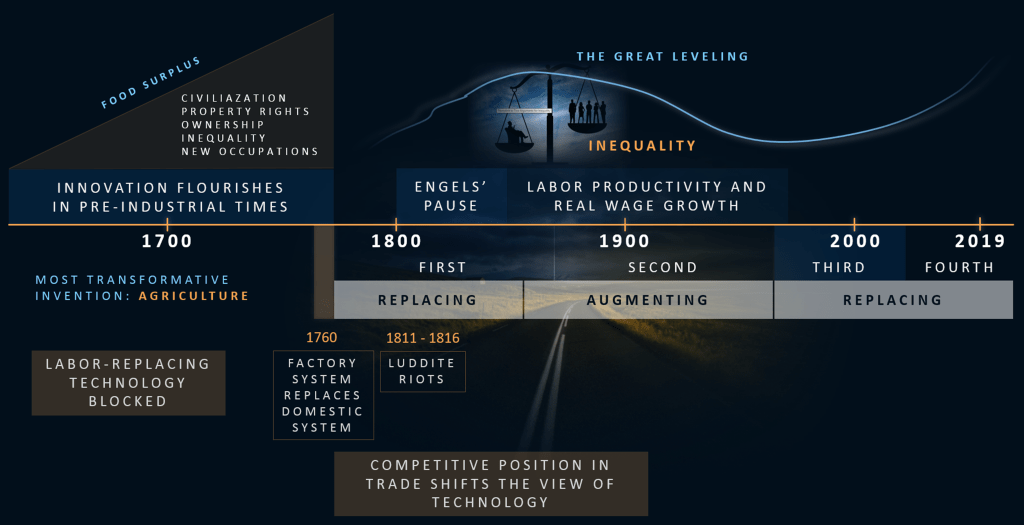
The world is about to enter a pivotal decade. This decade is likely to be remembered as the launching pad to a very different future. The next ten years are marked by uncertainty, complexity, and an inability to predict how an overwhelming number of Dots Connect to shape the decade. In a 2018 post, I looked at some work by Karen Harris and others that focused on some of the Macro Trends that drive the decade. In the supporting insights report, the authors see volatility emerging from the Collision of Demographics, Automation, and Inequality. These three factors drive a very Turbulent 2020s and Beyond.
-
Future Hiring: Skills-Based or Credentials-Based?
An Article by IEEE Spectrum captured a dialog that occurred at a recent MIT conference. The topic: AI and the Future of Work. The conference discussion underscores the struggles between Techno-Optimism and Techno-Pessimism. Pessimistic when AI and automation are viewed as an industry-destroying path that takes jobs via self-driving technology, smart law algorithms, and robots that continue to put factory and warehouse workers out of work. Optimistic when those same technologies are viewed as augmentation that improves the employee experience.
-
Moore’s Law
A recent article regarding Moore’s Law explores the winding down of a phenomenon that has impacted the world considerably since Gordon Moore, the founder of Intel, predicted that the number of components that could fit on a microchip would double every year. The article states that Moore’s Law has begun to reach its natural end, as efficiently manufacturing smaller transistors gets more difficult. Author Tom Hoggins projects that by the mid-2020s, the law will have plateaued completely as production costs increase and transistors reach their physical limits.
The pictures I try to paint of our emerging future rely upon the continued expansion of our compute power and its synergistic relationship with energy. An example of a Virtuous Cycle in action, as advances in one area drive compelling reasons for advancement in the other. Realizing innovations’ potential to advance the human development envisioned by my Innovation Wheel relies on continued advancement in both areas. As the author states, Moore’s Law has in some ways eliminated the need for creativity in both design and manufacturing. As it comes to an end, a new era of creativity is likely to bridge the gap between the wind-down and a new computing paradigm such as quantum computing.
We already see creativity in advancements such as neural network processors that support the processing needs of AI solutions. The author strikes a positive tone, as he sees new approaches emerging to both software and processor architecture. The opportunity for innovators and investors is very large.
-

Agility
Agility is one of those buzzwords that can have many different meanings. In a recent article by Leo M. Tillman and General Charles Jacoby, they define Agility much the same way I think about it:
Agility is the capacity to detect, assess, and respond to environmental changes in ways that are purposeful, decisive, and grounded in the will to win
-

Take the Lead
I had the pleasure of joining Dr. Diane Hamilton on her Take the Lead radio show. Here is a description of this segment from a Blog Post that Diane published:

If there is one thing constant in this world, that would definitely not be the future. It varies according to the different types of influences and technologies we encounter. Frank Diana, a recognized futurist, thought leader, and frequent keynote speaker, explains his thoughts on these influences that affect the future and how they come together. He goes deep into predicting trends, thought-leadership focused on emerging future, perception between real and not real, climate change, cryptocurrencies, AI, and more.
You can listen to this short interview at Take the Lead Radio. Platforms for conversation allow us as a society to discuss the various issues and opportunities that we face. Education and awareness are critical in a world that moves as fast as ours does. I thank Diane for the opportunity to have this discussion with her audience.