
In recent discussions across media, business, and academia, much has been said about the convergence of human and artificial intelligence. This powerful combination is already leading to remarkable discoveries. However, there is another form of intelligence that often goes unrecognized – nature’s intelligence.
A recent article I came across highlights this critical dimension, introducing the concept of polyintelligence – an integrated framework of natural, human, and machine intelligence. The notion that nature itself embodies intelligence, with its ability to learn, adapt, and encode knowledge, aligns closely with the interdisciplinary approach I have long advocated. It also reinforces the need for a lateral, ecosystem-driven perspective – one that transcends silos and embraces holistic thinking.
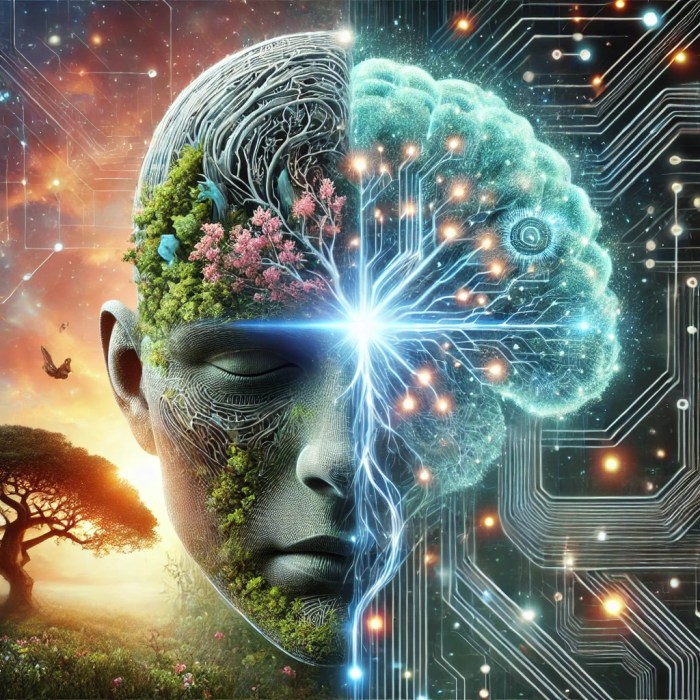
Leonardo da Vinci, a true polymath, understood this reality centuries ago. His genius lay not only in his mastery of multiple disciplines but in his ability to perceive the deep interconnections governing the natural and mechanical worlds. Whether studying the human body, designing machines, or creating art, he approached his work holistically. This mindset is more critical than ever today, as the complexity of modern challenges demands polymathic thinking – valuing breadth and integration alongside depth and specialization.
The article underscores the transformative potential of polyintelligence in biotechnology, particularly in synthetic biology and protein engineering. By fusing AI, human ingenuity, and nature’s intelligence, researchers are unlocking breakthroughs in medicine, such as designing novel proteins with therapeutic applications. This mirrors the power of convergence that I often emphasize: the most profound advancements arise from integrating diverse intelligences rather than relying on any single one in isolation.
Beyond medicine, polyintelligence offers promising solutions to some of humanity’s greatest challenges, including climate change and food security. AI, coupled with nature’s evolutionary intelligence, is being used to enhance staple crops, enabling them to thrive in harsher conditions. This shift exemplifies the transition from industry-based thinking to an ecosystem-based model – one that acknowledges the intricate interdependencies between technological, biological, and environmental systems.
Yet, as the article rightly points out, fully realizing the potential of polyintelligence requires a transformation in how we think. It demands humility – acknowledging that nature’s intelligence often surpasses our own understanding. As I have frequently discussed, adaptability is crucial in times of rapid invention. This applies not only to organizations and institutions but to our own mental models. Just as da Vinci remained open to learning from nature, we too must integrate insights from natural systems into our decision-making frameworks.
The implications for governance, ethics, and interdisciplinary collaboration are profound. Polyintelligence cannot flourish in a world constrained by rigid hierarchies and siloed expertise. Instead, it calls for cross-disciplinary research, collective intelligence, and systems-level thinking. Scientists, policymakers, industry leaders, and educators must work together to create ethical and operational structures that guide this emerging paradigm.
This article’s core message aligns with my broader perspective. We are witnessing a profound transformation where the convergence of forces across science, technology, society, geopolitics, environment, philosophy, and economics is reshaping progress. Polyintelligence represents this shift, modeling innovation after the decentralized, interconnected, and adaptive nature of ecosystems.
The future will belong to those who can think across disciplines, recognize patterns of convergence, and harness the combined power of human, artificial, and natural intelligence. As we navigate this new landscape, the lessons of polymaths like da Vinci remind us that the most transformative breakthroughs emerge from the fusion of diverse intelligences working in harmony to expand the realm of possibility.
Discover more from Reimagining the Future
Subscribe to get the latest posts sent to your email.
 Reimagining the Future
It’s becoming clear that with all the brain and consciousness theories out there, the proof will be in the pudding. By this I mean, can any particular theory be used to create a human adult level conscious machine. My bet is on the late Gerald Edelman’s Extended Theory of Neuronal Group Selection. The lead group in robotics based on this theory is the Neurorobotics Lab at UC at Irvine. Dr. Edelman distinguished between primary consciousness, which came first in evolution, and that humans share with other conscious animals, and higher order consciousness, which came to only humans with the acquisition of language. A machine with only primary consciousness will probably have to come first.
What I find special about the TNGS is the Darwin series of automata created at the Neurosciences Institute by Dr. Edelman and his colleagues in the 1990’s and 2000’s. These machines perform in the real world, not in a restricted simulated world, and display convincing physical behavior indicative of higher psychological functions necessary for consciousness, such as perceptual categorization, memory, and learning. They are based on realistic models of the parts of the biological brain that the theory claims subserve these functions. The extended TNGS allows for the emergence of consciousness based only on further evolutionary development of the brain areas responsible for these functions, in a parsimonious way. No other research I’ve encountered is anywhere near as convincing.
I post because on almost every video and article about the brain and consciousness that I encounter, the attitude seems to be that we still know next to nothing about how the brain and consciousness work; that there’s lots of data but no unifying theory. I believe the extended TNGS is that theory. My motivation is to keep that theory in front of the public. And obviously, I consider it the route to a truly conscious machine, primary and higher-order.
My advice to people who want to create a conscious machine is to seriously ground themselves in the extended TNGS and the Darwin automata first, and proceed from there, by applying to Jeff Krichmar’s lab at UC Irvine, possibly. Dr. Edelman’s roadmap to a conscious machine is at https://arxiv.org/abs/2105.10461
LikeLiked by 1 person
Thanks for sharing!
LikeLike
[…] and planetary intelligence. These are the same sources that form what I have described elsewhere as polyintelligence — cognition distributed across humans, machines, and nature. Each stream is advancing on its own, […]
LikeLike