
In my last post, I described a Sense and Respond model that sits at the heart of several activities, including scenario, opportunity, and risk analysis. As complexity and pace continue to intensify, uncertainty increases. To survive in this Emerging Future, we must embrace a framework for future thinking, and an organization that can adapt as it shifts. In essence, we must see the future, rehearse it, continuously monitor for shifts, and adapt as the shifts occur. A sense and respond model sits at the core of the framework – but represents the biggest cultural challenge.
Society
Visualizing our Emerging Future
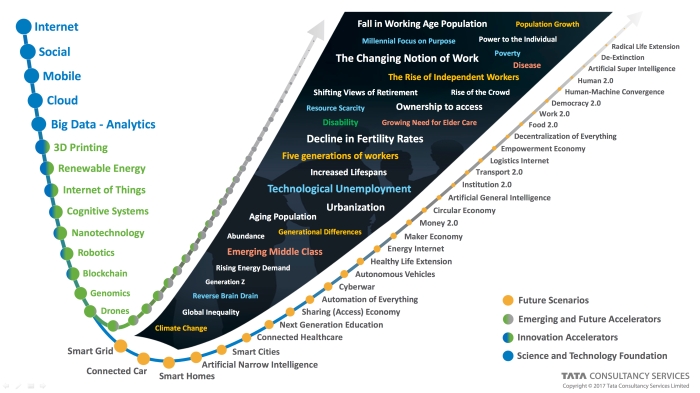
As the pace of science, technology, and societal change accelerates, a vision of our future is emerging. Many future scenarios are viewed as science fiction, or thought to have timelines that are too far into the future to worry about. I hold a firm belief that these timelines are collapsing and future scenario analysis is critical both at a business and societal level.
I have used this visual as a driver of future scenario analysis. It has been captured and utilized in workshop and events. It is described in a post on Connecting Dots, which I view as a critical leadership trait.
Digital Transformation of Business and Society
At a recent KPMG Robotic Innovations event, Futurist and friend Gerd Leonhard delivered a keynote titled “The Digital Transformation of Business and Society: Challenges and Opportunities by 2020”. I highly recommend viewing the Video of his presentation. As Gerd describes, he is a Futurist focused on foresight and observations – not predicting the future. We are at a point in history where every company needs a Gerd Leonhard. For many of the reasons presented in the video, future thinking is rapidly growing in importance. As Gerd so rightly points out, we are still vastly under-estimating the sheer velocity of change.
With regard to future thinking, Gerd used my future scenario slide to describe both the exponential and combinatorial nature of future scenarios – not only do we need to think exponentially, but we also need to think in a combinatorial manner. Gerd mentioned Tesla as a company that really knows how to do this.
Autonomous Vehicles: The Automotive Ecosystem
This post continues the disruption scenario discussion initiated by my earlier Insurance Industry Case Study. I’ve been using the autonomous vehicle (AV) as an example of a disruptive scenario with potential societal, economical, and environmental impact. In this post, the focus shifts to the scenario’s possible effect on the automotive ecosystem.
Autonomous vehicle technology can be viewed using a five-part continuum suggested by the National Highway Traffic Safety Administration (NHTSA), with different benefits realized at different levels of automation:
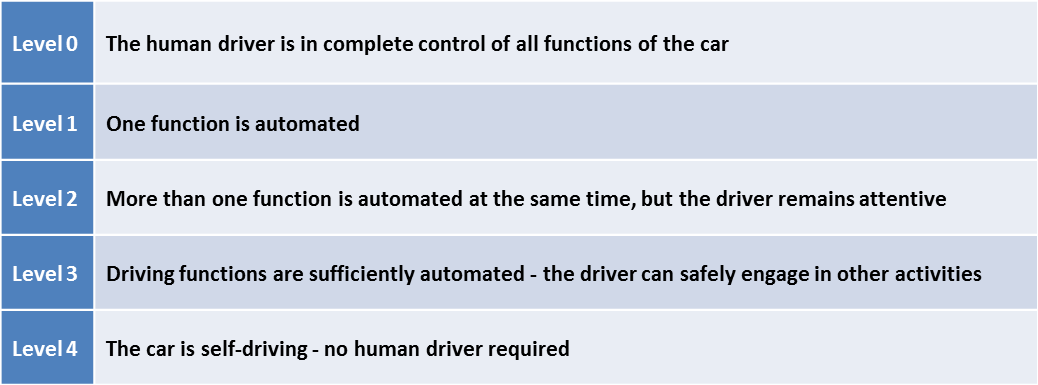
Last month, an IHS Automotive study predicted the world will have nearly 54 million self-driving cars by 2035. The study also predicts that nearly all vehicles in use are likely to be self-driving cars or self-driving commercial vehicles sometime after 2050. Meanwhile, automakers and others are unveiling both their plans for – and introduction of – automated features:
Why Focus on Disruption?
My post on the disruptive implications of the Autonomous Vehicle generated dialog that has been very insightful and provocative. Before posting additional analysis of the societal, economical, and environmental impact of emerging disruptive scenarios, I wanted to restate my reason for doing so, and share some great perspective from leaders that engaged in this recent dialog. I launched this last series to support the growing belief that: 1) we are entering what is likely the most transformative period in history, and 2) this should drive a sense of urgency for leaders everywhere. This coming period brings with it many possible disruptive scenarios, each with its own set of consequences. In my experience, leaders view these scenarios as too far off into the future to warrant their time – we’ve been conditioned to think short term. In their new book The Second Machine Age, Andrew McAfee and Erik Brynjolfsson provide their perspective on why the time to focus on the future is now. The three forces they describe (exponential, digital, and combinatorial) are perhaps the best description of the drivers behind the accelerating effect of disruption.
The Second Machine Age and Business Evolution
I just finished reading a new book titled The Second Machine Age written by Andrew McAfee and Erik Brynjolfsson – both from MIT. The book is a must read for leaders everywhere. Its journey offers a view into the potential societal, economic, and business impact of technological advancement in the digital age. Although I am fascinated by each of these, my interest in summarizing this book is to connect their perspective to the future of business. Consistent with my recent disruption theme, the question is: how does the world that the authors envision impact the future of business?
 Reimagining the Future