
History teaches us that transformative technologies do not emerge in isolation, nor do they reshape the world overnight. Instead, they follow a discernible pattern – an evolutionary journey that unfolds in response to human needs. Two phenomena help us understand this journey: the Evolutionary Phases of General-Purpose Technologies (GPTs) and the role of necessity, invention, and convergence (NIC). When viewed together, they provide a powerful lens for understanding not just how technologies evolve, but why they emerge and when they reach their full potential.
Continue readingNecessity
The Converging Forces Of Progress: Necessity, Invention, And Systemic Outcomes
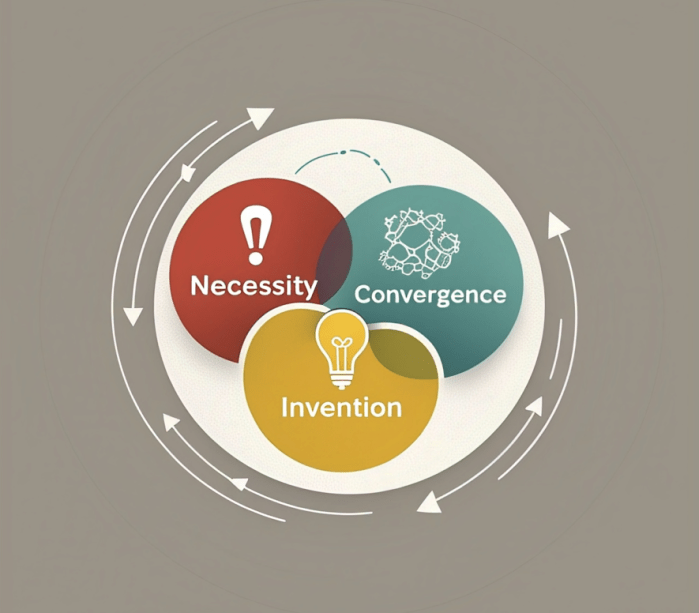
What if the very inventions that propel humanity forward also sow the seeds of our greatest challenges? History shows that progress is rarely a straight line. Instead, it moves in cycles: necessity sparks invention, and inventions converge to reshape society. From the steam engine’s role in the Industrial Revolution to the internet’s impact on globalization, each wave of transformation has brought profound change – economic shifts, new social structures, and unintended consequences. These disruptions, from rising inequalities to environmental crises, often take decades to address. As we stand on the brink of the next great convergence – whether in AI, biotechnology, humanoid robots, cyber, climate or health – we must ask – how can we harness innovation to create a more equitable and sustainable future?
Continue readingThe Necessity-Invention-Convergence Framework
The Necessity-Invention-Convergence Framework provides a structured way to analyze the forces that drive human progress. At its core, necessity serves as the fundamental driver of change, arising from pressing challenges, constraints, or demands. Whether economic, social, environmental, or geopolitical, necessity compels action and forces innovation. Throughout history, this dynamic has played out in transformative ways. The Industrial Revolution was fueled by labor shortages and an increasing demand for goods, just as the Digital Revolution emerged in response to the need for faster, decentralized communication. Today, the global energy transition is being shaped by the necessity of addressing climate change and resource limitations.
Continue reading Reimagining the Future