A Post Pandemic Society

Updated December 16, 2025: Five Years Later

I am resurfacing this post because it captures a moment when convergence became impossible to ignore. Long before the pandemic, my work focused on how multiple domains — science, technology, society, economics, geopolitics, philosophy, and environment — were beginning to move together, creating conditions where change felt faster, more uneven, and harder to predict. COVID-19 did not initiate that convergence, but it revealed it in compressed form. The systemic change series builds on this longer arc of thinking, extending beyond the pandemic to examine how these forces continue to interact and reinforce one another today. This post remains relevant not as a historical artifact, but as an early, real-time glimpse into dynamics that are still unfolding.

Continue reading
Another Roaring Twenties?

Lost in the focus on life after the pandemic are all the forces that were already shaping our future. I explored many of them in various posts, but none have been as intriguing to me as the forces tied to history. If we look at history and apply it to current day, we can seek out periods that look like ours. This Application of History illuminates possible futures and has the potential to inform our actions. What happened in these similar periods and what can we learn? A recent article posed this question: Will the 2020s Really Become the Next Roaring Twenties? This seemingly simple question is loaded with implications. The article provides several links with great content and I highly recommend it.

Continue reading

Global Progress and The Post-War Order

A recent Article by Bryan Walsh explores the human development enabled by a post-world war two order. To avoid a repeat of the turbulence of the Thirty Year period that began in 1915, this post-war order was established. Institutions like the International Monetary Fund (IMF), United Nations (UN), World Bank, World Trade Organization (WTO), and the North Atlantic Treaty Organization (NATO) were formed. Despite an occasional spike of violence, the article reports that the absolute number of people killed in war and conflict has been declining since 1946.

Continue reading

Marriage, Alternative Living, Biometrics, and the Rise of Nationalism

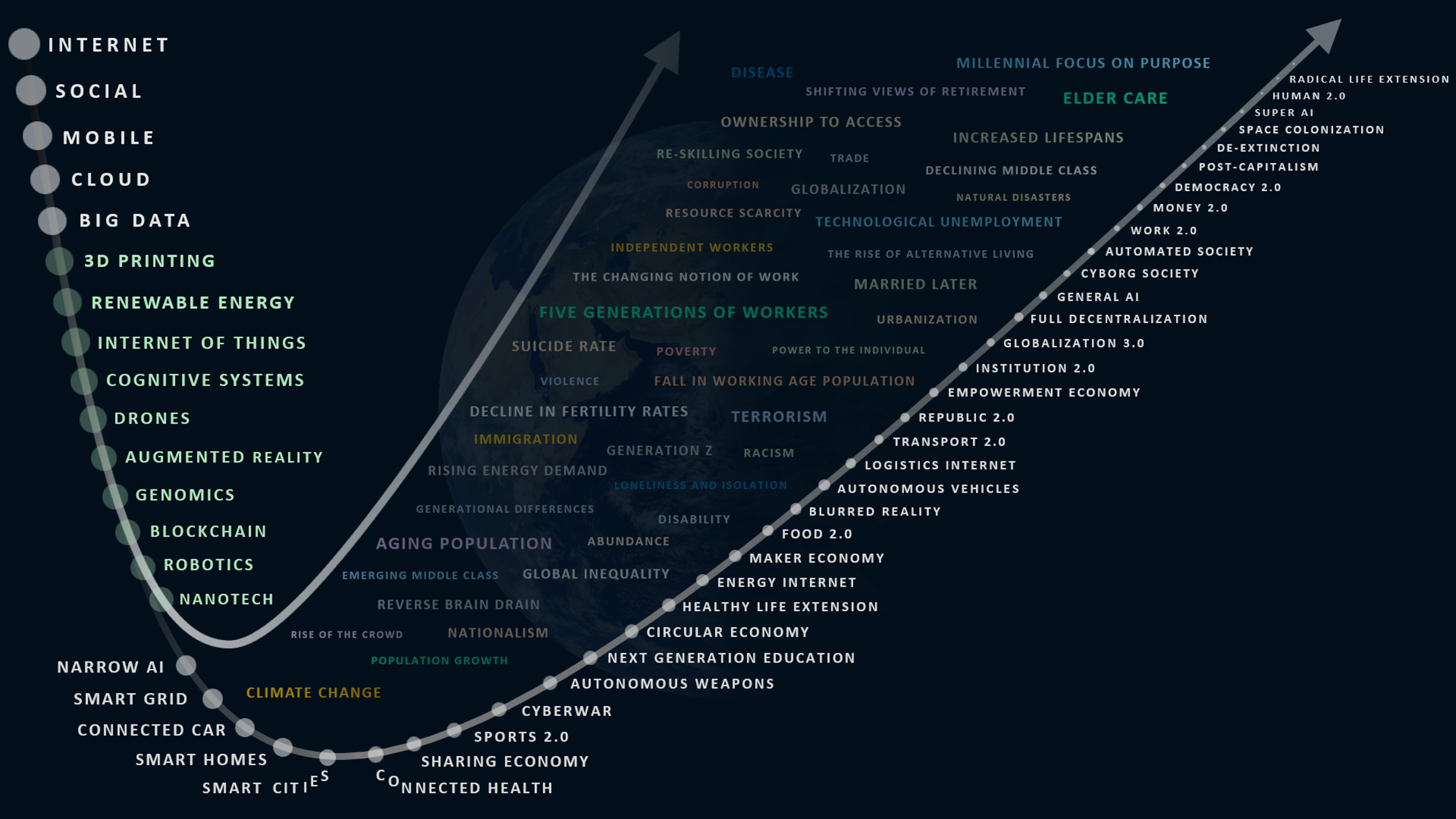
The visual below depicts aspects of our emerging future (Explained Here). I update it periodically to reflect impactful areas that affect the science and technology foundation, the future scenarios they spawn, and the wide array of societal factors that interact with both.

Our Emerging Future

Continue reading