As the pace of science, technology, and societal change accelerates, a vision of our future is emerging. Many future scenarios are viewed as science fiction, or thought to have timelines that are too far into the future to worry about. I hold a firm belief that these timelines are collapsing and future scenario analysis is critical both at a business and societal level.
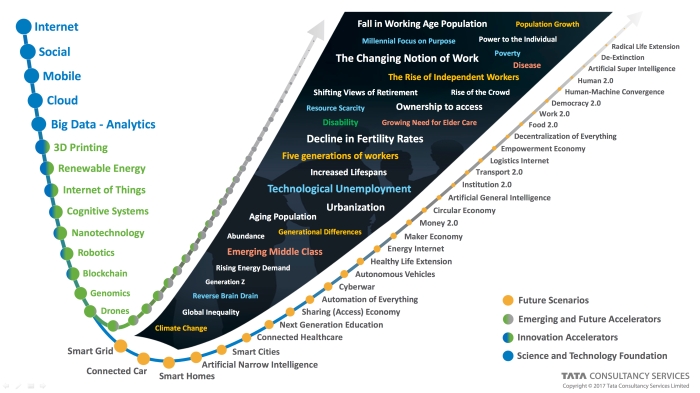
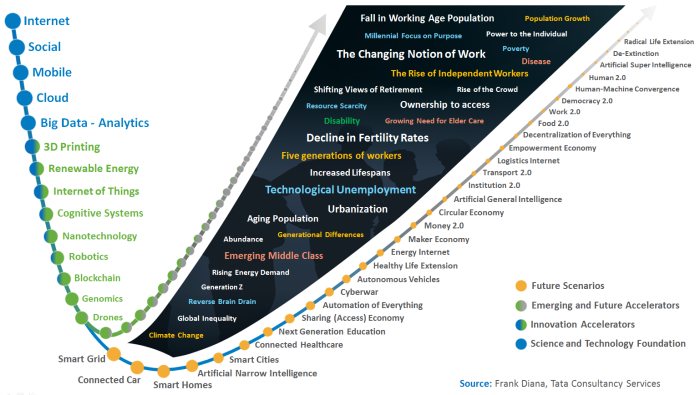
I have used this visual as a driver of future scenario analysis. It has been captured and utilized in workshop and events. It is described in a post on Connecting Dots, which I view as a critical leadership trait.
If we are to Think about the Future in a way that helps us thrive in that future, we must excel at connecting dots. I developed the Future Scenarios visual in an attempt to help visualize the dots, as well as the various intersections that amplify the impact of those dots. In parallel with this scenario view, I have looked at various aspects of social change that both influence and impact these scenarios – and vice versa – but until now, those views were separate. Convergence is occurring not just across the technology and future scenario curves, but also the various aspects of social change. So in the interest of maximizing future thinking impact, I have combined the two views and will describe a connecting the dots scenario. First, the new future scenario visual:
On a recent Radio Program focused on the future of business, Gray Scott introduced another future scenario. He called it the empowerment economy, and he described it this way:
He sees the past in three stages: 1) companies were in the business of providing supplies and core objects 2) we moved away from that to a convenience economy where we make it convenient for you to get what you need 3) now we are moving to the empowerment economy. It’s no longer about providing an object or convenience; it’s about giving them the power to supply themselves. Gray does not believe corporations understand this. Google and Uber get this circular idea of empowering people, which he believes is the future of business. The companies that embrace this empowerment economy are the companies that are going to succeed.
Those are his words direct from the radio program referenced above. So we add empowerment economy to the growing list of future scenarios. Thanks Gray.
UPDATE: December 27, 2025. I posted this 10 years ago as I struggled with what I believed was traditional thinking in a world heading towards a bew reality. Ten years later, this series on systemic change captures what I was seeing back then.
I’m struggling with the term disruption and its effectiveness in driving urgency. Most definitions describe a radical change in an industry or business strategy, and most involve the introduction of a new product or service that creates a new market. My struggle is not with this decades old view of disruption, but its application in the context of our exponential world. The word disruption is viewed through a traditional lens. I end up in debates about the validity of a disruptive scenario as viewed through this lens, versus the massive implications of these future scenarios viewed through an exponential lens. The ensuing dialog focuses on:
Coming up with disruptive innovation before our competitors do
Embracing protectionist behavior to block a disruptor
I’m not worried, regulatory hurdles in my industry block the impact of disruptors

 Reimagining the Future

