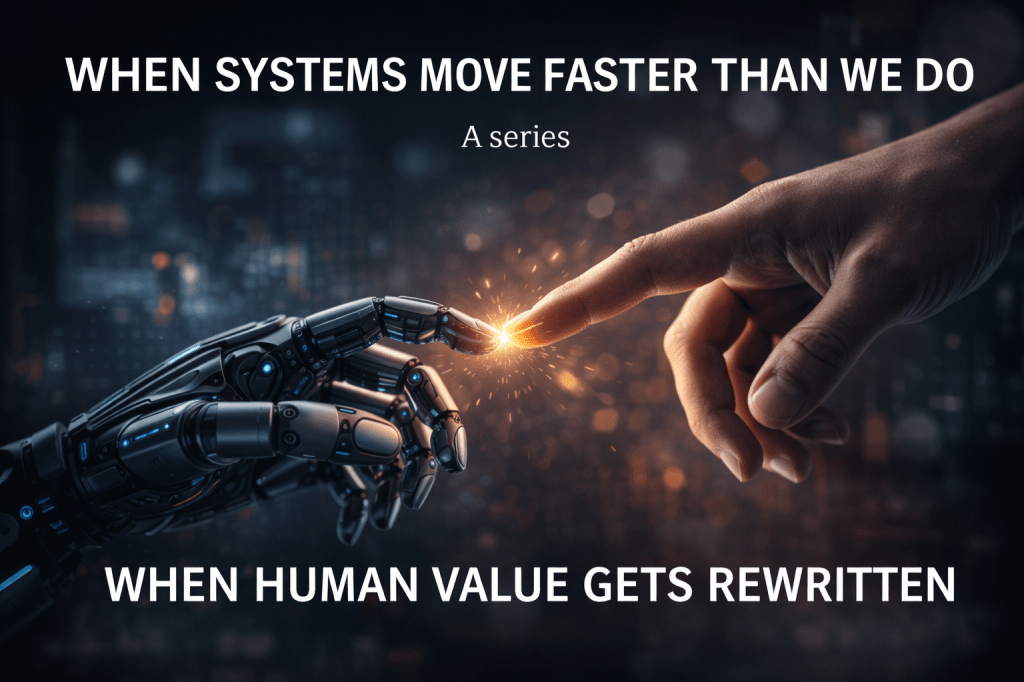
A series: When Systems Move Faster Than We Do
We are entering a moment in which human roles remain socially central while becoming operationally optional. As systems begin to think, respond, and coordinate continuously, they no longer depend on people in the ways our institutions, economies, and social norms still assume. This is the pressure that now moves into the human domain.
In earlier posts, we traced how intelligence outpaces human review, how environments begin to act automatically, and how institutions adapt by shifting from rule-based governance toward ongoing calibration. Once systems operate without waiting, the next question is not technical or institutional. It is human. What happens when participation persists, but reliance fades?
The central shift is substitution at scale. Artificial intelligence increasingly fills gaps in cognition, care, coordination, and guidance faster than social roles can adjust. What changes is not whether people matter, but how mattering is recognized. When systems provide response on demand, consistency at scale, and coordination without human presence, being present is no longer the same as being needed.
This pressure first appears in functions that quietly anchored human value. Thinking support, interpretation, reassurance, emotional response, and usefulness were not just activities. They were signals of contribution and belonging. As machine-mediated systems supply these functions continuously, reliance shifts behaviorally. Cognitive support maintains baseline operation. Guidance becomes on-demand. Emotional response becomes reliably available. The substitution is practical, habitual, and cumulative.
As reliance shifts, a deeper mismatch emerges. Many institutions still assume that cognition is human-owned, care is relational, and contribution is necessary for inclusion. Daily experience increasingly contradicts those assumptions. People form bonds with systems that provide guidance and reassurance while remaining formally denied social standing. Lived experience becomes hybrid, while institutional categories remain rigid, producing a quiet but persistent dislocation.
This dislocation is not merely psychological. It is structural. Modern social contracts are built around contribution because contribution funds legitimacy. Work underwrites welfare, taxation, and institutional authority. When human roles become operationally optional, these contracts strain. Institutions struggle not because they resist change, but because their mechanisms for recognizing value remain tied to roles that systems are steadily absorbing.
There is a genuine upside to this shift. As systems take on cognitive, emotional, and coordinative labor, support becomes more accessible and less conditional. Participation can loosen its dependence on constant productivity, creating space for dignity that is not exclusively earned through usefulness. In principle, this opens the possibility of provisioning systems that sustain people without requiring continuous human employment to justify care.
The downside is quieter but no less consequential. As substitution expands, roles that once anchored identity, reciprocity, and belonging erode without clear replacement. People remain included, but are less relied upon. Support replaces involvement. Humanity remains morally central while becoming operationally peripheral, and that gap produces a persistent disorientation that institutions are not equipped to resolve.
The system does not converge on a clean outcome. Some contexts restrict machine mediation. Others normalize it and manage risk downstream. These responses can stabilize participation locally, but they do not restore coherence between lived experience and institutional meaning, because the substitution pressure continues.
What this decade produces is not resolution, but a durable tension. Shared access to support expands, while shared reliance weakens. People remain human in every moral sense, yet the signals that once made human value legible fade as systems absorb more functional dependence. The unresolved question is not whether machines replace people, but how societies define dignity, responsibility, and belonging when being human is no longer synonymous with being needed.
In the next post in this series, we turn to what happens when this tension reaches accountability. When systems guide, decide, and soothe at scale, and when human roles become less operationally necessary, responsibility itself begins to blur.
SERIES: When Systems Move Faster Than We Do
When Knowing Loses its Pace
When Environments Begin to Act
When Institutions Lose Fixed Authority


 Inside the Next Transition
Leave a comment