
In my recent post, Sense and Respond: A Survival Trait for a Converging World, I explored how the ability to detect and react to change in real time has become essential to survival. As convergence accelerates the pace of disruption across industries, systems, and geographies, the ability to sense what’s happening and respond effectively is no longer optional. It has become a core operating principle for organizations navigating uncertainty. But as the landscape continues to evolve, a deeper strategic shift is emerging—one that calls us to go beyond reacting quickly and begin shaping what comes next.
The strategic advantage is increasingly found not just in responsiveness, but in foresight. Waiting to respond to an event that is already in motion may not be fast enough—especially when disruption compounds across connected systems. In this new reality, the focus shifts to anticipating signals earlier and influencing outcomes before risks fully materialize or opportunities pass by. This doesn’t mean abandoning the Sense and Respond model—it means building on it.
Think of Sense and Respond as the operational core. It remains the foundation for agility, real-time awareness, and adaptive action. Around this foundation, we can now build a second layer – a strategic loop that enables forward-looking influence. Together, these two loops form a dual-mode system: one optimized for now, the other optimized for next.
The inner loop continues to do what it does best. It senses signals across the environment, processes streaming data, and activates rapid responses. This is where real-time data ecosystems, AI-based stimulus recognition, and feedback loops operate in concert. But the outer loop takes us further. It focuses on what might happen, not just what is. This loop uses simulation, modeling, digital twins, and foresight to anticipate future conditions. It helps organizations prepare – not just to react, but to proactively shape the landscape they operate within.
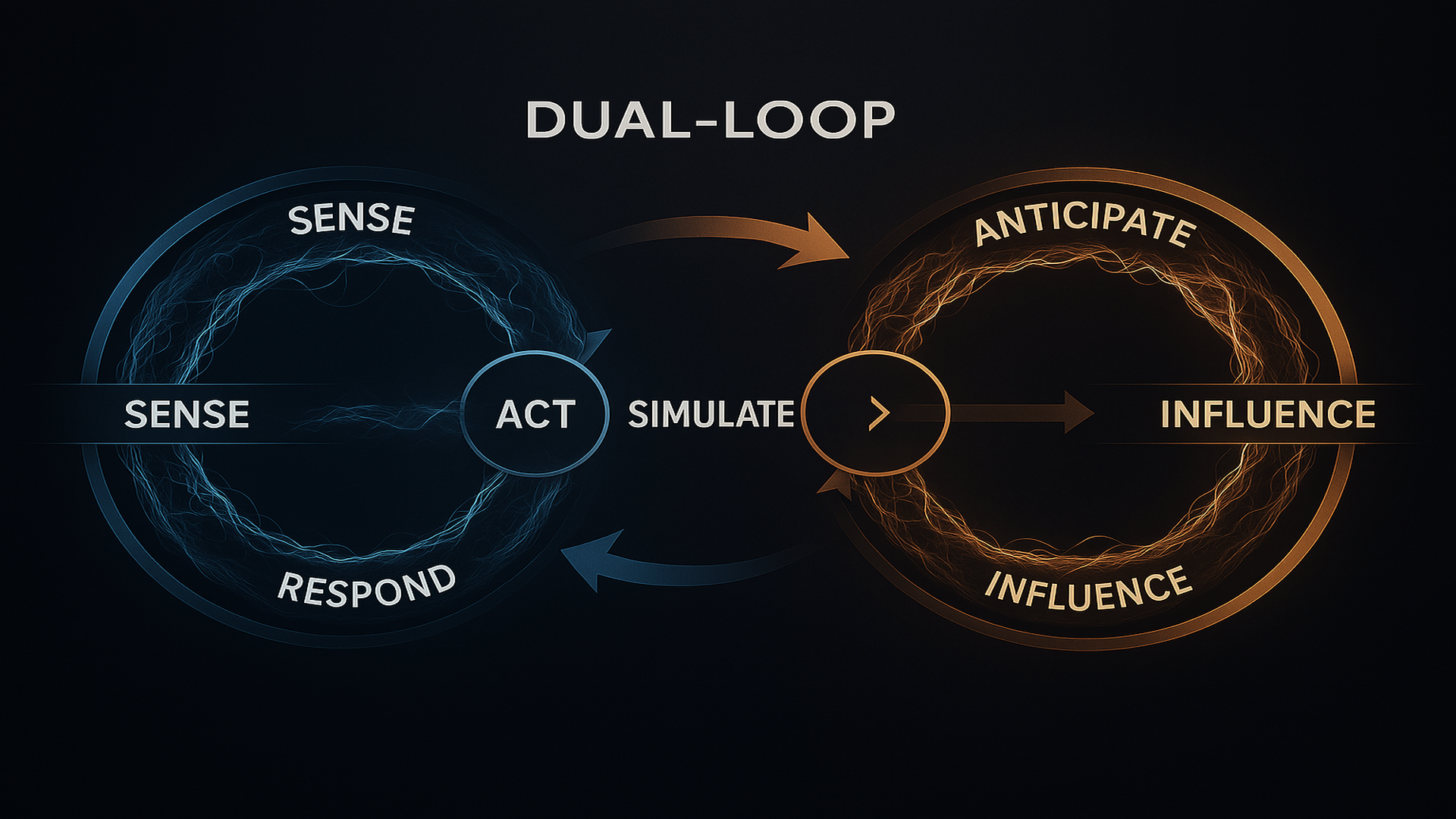
To reflect this evolution, a useful framing emerges: Sense → Simulate → Act. Simulation becomes the bridge between perception and action – a decision space where possible futures can be explored, tested, and stress-checked. In this structure, the final phase – Act – offers a branching path. In some cases, organizations will still need to respond to unfolding events. But increasingly, the imperative is to influence outcomes earlier – to preempt crises, unlock emerging value, or guide system behavior before it becomes locked in.
This hybrid model doesn’t diminish the importance of responsiveness. Instead, it extends it—elevating response into strategic influence. The table below highlights how these two loops differ and complement one another:
| Feature | Inner Loop: Sense and Respond | Outer Loop: Anticipate and Influence |
|---|---|---|
| Temporal Focus | Immediate and real-time | Future-facing and forward-looking |
| Primary Capability | Agility and adaptation | Foresight and proactive shaping |
| Triggering Mechanism | External stimulus | Simulated system conditions |
| Core Technologies | Real-time data, feedback loops | Simulation, digital twins, AI forecasting |
| Typical Use Cases | Operational shifts, emergent issues | Strategic threats, systemic risk |
This dual-loop architecture provides both resilience and agency. It enables organizations to respond swiftly when needed – but also to influence the trajectory of change before it arrives. It brings together situational awareness and strategic – foresight into a single system of intelligence and action.
The convergence of domains, technologies, and disruptions makes it clear: sensing and responding are no longer enough. In an increasingly interconnected world, we must sense and simulate in order to influence and adapt. That means learning not just how to react to the world as it is, but how to shape the world as it could become.
This is not simply an operational upgrade. It is a new strategic posture. A way of thinking – and designing systems – not just for speed, but for anticipation. Not just for resilience, but for relevance. The shift from Sense and Respond to Anticipate and Influence is already underway – and the organizations that embrace both loops will define the future.
Discover more from Reimagining the Future
Subscribe to get the latest posts sent to your email.
 Reimagining the Future