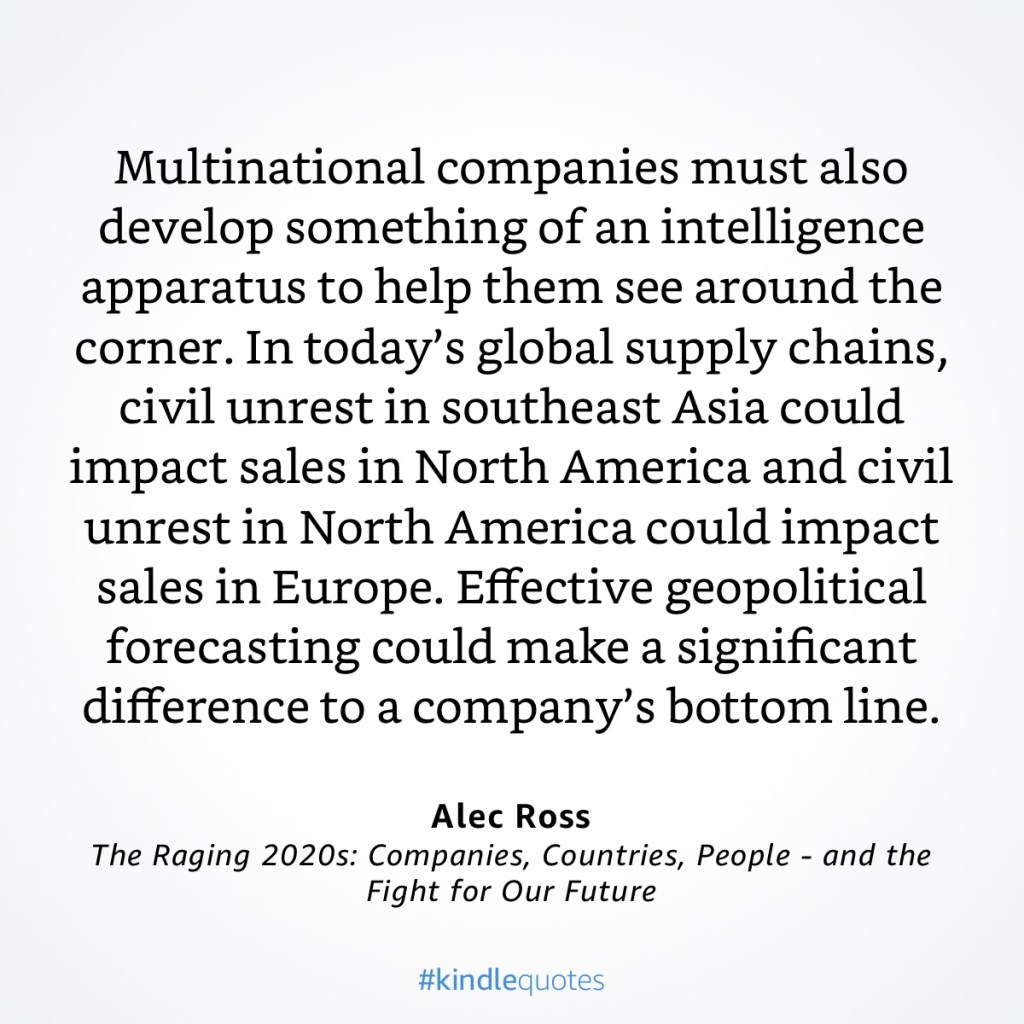
The signals are coming from every direction. To understand the future, signals illuminate possible paths. As I have written multiple times, history provides a wealth of signals. Looking at similar historical periods provides insight that feeds foresight. A book I recently completed did an incredible job of using history as a source of signals. In The Changing World Order, Ray Dalio explores all the major historical empires, the world order they presided over, and their eventual collapse. In doing so, he points to several signals that are shining bright red. Decision-makers would be wise to understand these signals.
(more…)Inside the Next Transition
-
The Changing World Order
Ray Dalio is the Co-Chief Investment Officer & Chairman of Bridgewater Associates, In making decisions, he has found history to be very instructive. This is a recurring theme that I write about often, as I view history as a key source of signals. I’ve included links that explore these signals below. In exploring possible futures, it is helpful to understand the patterns of history – and they really do rhyme. In the book The Fourth Turning, the authors describe what the cycles of history tells us about our next rendezvous with destiny. What intrigued me as a Futurist is the claim by the books authors that our past can indeed predict our future – it’s a compelling argument when viewed through the lens of these historical cycles.
(more…) -
Strategic Uncertainty
The goal is to create the capacity for resilience, no matter what’s thrown at you
Soren Kaplan – Don’t Create a Plan. Create a Strategy Uncertainty MapThose that follow my Blog know that I do not believe in prediction. I am however a big believer in rehearsing the future. That quote above from a recent article points to why. It was several years ago when it became clear that the way we think about strategy needed to change. It was then that resilience and adaptability rose to the top of my imperatives list for leaders. If we cannot shift with the rapid shifts on the horizon, it will be difficult to succeed. Soren Kaplan, the author of the article, said it this way: “Forget 10-year visions. Forget 5-year roadmaps. Forget three-year plans. Long term is a year. Short-term is a month.” I couldn’t agree more.
(more…) -
Floating Cities
(more…)OCEANIX, an ambitious floating architecture concept envisioned to be built off the South Korean coast by BIG – Bjarke Ingel‘s design group. It was first revealed in 2019 and now has received the green light from UN-Habitat and the Metropolitan City of Busan to begin construction. The futuristic sustainable city can also withstand category 5 hurricanes!
Chi Thukral – The World’s First Floating City Designed by BIG & Backed by U.N. Can Withstand Category 5 Hurricanes! -
The Great Resignation
We like labels. In this case, our current labor market dynamic has been called “The Great Resignation”. This article explores the current resignation phenomenon, providing great insight into why it is happening. There are several survey results presented via The Conference Board’s latest workforce survey. The high-level theme from the survey is that although it’s a culmination of a multitude of factors, employees are seizing this moment of leverage. But, as the article states, it’s also about workers’ pursuit of flexibility and autonomy.
(more…) -
Humanoid Robots Making Remarkable Progress
A picture is worth a thousand words. I’ve written recently about our robotic journey and everyday robots – but to that adage about pictures, this video says it all about accelerating progress. This recent article describes how This lifelike robot is terrifying everyone with its realism.
-
The Great Reduction: A Metaverse Counterpoint
I would define reductionism as the concept of depicting something – or rather mirroring or simulating something – that can pass as a useful and entertaining copy of the real thing.
Gerd Leonhard – The Great Reduction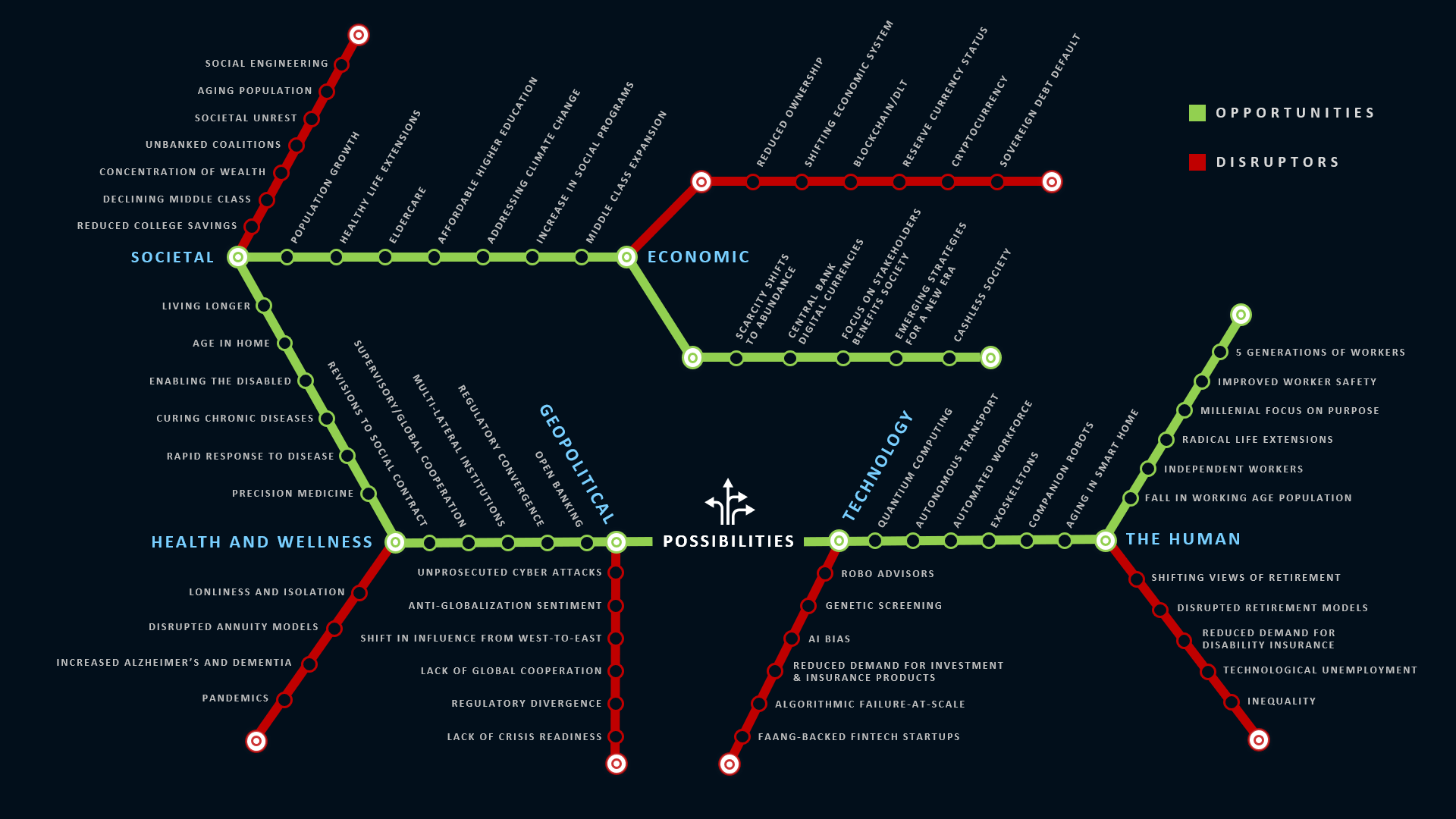
Yesterday I posted about the Metaverse and shared a video that described how Norway envisioned a future where the Metaverse provided endless possibilities, improving the lives of generations to come. Having seen the post, Futurist Gerd Leonhard shared one of his recent posts with me.
As he and I have discussed in the past, the future is all about balancing the opposing forces of innovation. This has always been true about innovation, reflected in examples like fire positively transforming the world, but also burning down villages – and so it is with the metaverse. The quote and related post above positions the counterpoint to the Norway video. I’ve included a separate video from Gerd’s post below that underscores his message.
(more…) -
Work
Conversations about work take many forms these days. Is remote work here to stay? What will a hybrid work model look like? Will we need to work in the future? In the short term, the pandemic has driven a focus on different models of working. In the long term, the polarized discussion centers on the impact of automation. That discussion is explored in incredible detail in a recent book titled Work: A Deep History, from the Stone Age to the Age of Robots. Anthropologist and author James Suzman sets out to answer several questions. He does so by looking at the history of work and the lessons we can learn.
(more…)To answer these questions, James Suzman charts a grand history of “work” from the origins of life on Earth to our ever more automated present, challenging some of our deepest assumptions about who we are. Drawing insights from anthropology, archaeology, evolutionary biology, zoology, physics, and economics, he shows that while we have evolved to find joy meaning and purpose in work, for most of human history our ancestors worked far less and thought very differently about work than we do now.
James Suzman – Work: A Deep History, from the Stone Age to the Age of Robots -
Slowly Then Suddenly: RoboTaxis Take Paying Customers In China
The old adage that change happens slowly then suddenly is on display again in the form of robotaxis in China. While the adage still applies, the time between slow and sudden is collapsing. While we are not where many predicting we would be with autonomous driving, these small steps indicate progress. Advances in autonomous trucking is another step that likely fuels acceleration. This video posted yesterday describes the 67 driverless taxis that are taking paying customers. For now, a taxi firm employee will supervise the trips but the project’s backers are hopeful the fleet will be fully autonomous in the coming years. You can read more here.
-
The Acceleration Of The Robotic Journey
Although predictions these days may be even more difficult given our complex systems are progressing and scaling at an unprecedented rate, a macro-level focus can provide an ability to scan beyond the horizon. So rather than attempt to predict, here are my 2019 thoughts on several macro-level forces.
Frank Diana – What to Expect in 2019That quote comes from a post I wrote to usher in 2019. One of those macro-level forces was acceleration (the other two were convergence and a burst of possibilities). As we close 2021, acceleration is all around us, but in 2019, no one knew that a pandemic would enable a great acceleration. There are countless examples of how the pandemic pulled possible futures forward, and one such example is robotics. In a recent article, Greg Nichols says that there is no denying we’re in the midst of a robotic renaissance, as industries like construction and delivery reach a tipping point.
(more…) -
A Growing Number Of Building Blocks Make Prediction Impossible
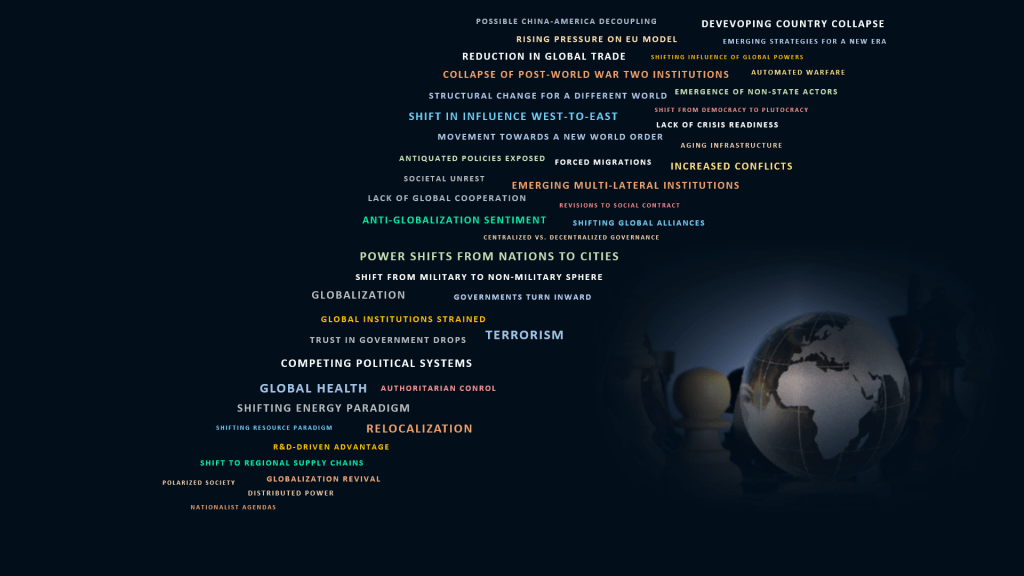
I have been of the opinion that the number of building blocks across multiple domains makes prediction impossible. As a result, understanding the future is about rehearsing it versus predicting it. That ambiguity makes many uncomfortable. Humans like certainty, but we live in a world that is very uncertain. Many will argue that this has always been the case. But it should be increasingly clear that periods like this emerging phase transition have only occurred a handful of times in human history. We want to rely on methods that have proven effective in the past. We find comfort in applying those methods to drive a degree of certainty. One need only look at these building blocks to see rehearsal is the only way to identify possible futures.
(more…) -
Everyday Robots
A recent article via Evan Ackerman takes a look at Alphabet’s Everyday Robots. Several videos are provided via the article (a couple are included below). He provides an entertaining analysis of each video and some perspective as well.
(more…)I’m a little bit torn on this whole thing. A fleet of 100 mobile manipulators is amazing. Pouring money and people into solving hard robotics problems is also amazing. I’m just not sure that the vision of an “Everyday Robot” that we’re being asked to buy into is necessarily a realistic one.
Evan Ackerman – Years Later, Alphabet’s Everyday Robots Have Made Some Progress -
The Age Of AI: And Our Human Future
(more…)This shift is neither inherently threatening nor inherently redemptive. Yet it is sufficiently different that it very likely will alter the trajectories of societies and the course of history. Few eras have faced a strategic and technological challenge so complex and with so little consensus about either the nature of the challenge or even the vocabulary necessary for discussing it.
The Age of AI: And Our Human Future – Henry A Kissinger, Eric Schmidt, Daniel Huttenlocher -
Leadership Advice From Futurist Kevin Benedict
Sharing this short video on leadership via colleague and Futurist Kevin Benedict.
-
RethinkX: An Action Plan For Humanity
In this eighth and final installment of the RethinkX rethinking humanity series, Tony Seba and James Arbib provide an action plan for humanity. The plan focuses on three things we must do: rethink, enable, and bridge. To do so, we must allow ourselves to think differently (rethink), through awareness, take action (enable), and guide humanity through the transition (bridge). The video series is based on the book Rethinking Humanity. I’d like to thank Tony Seba, James Arbib and RethinkX for providing us all with the awareness required to think differently and to act.
(more…) -
RethinkX: Crashing Up, Crashing Down – Two Dystopias
In this seventh installment of the RethinkX rethinking humanity series, Tony Seba and James Arbib describe the choices that lie ahead, as convergence across five foundational sectors drive a phase change: energy, transport, information, food, and materials. With this convergence, the old industrial system could collapse before the new production system emerges. One need only look at existing timing issues as the energy sector transitions. Supply of fossil fuel drops along with investment, while demand increases and clean sources of energy cannot meet demand. In a shift so profound, it may be impossible to imagine what it looks like. The power of this storytelling lies in its ability to illuminate possibilities and drive awareness – and with it, the hope for human action. Similar brilliant storytelling can be found in the new book AI 2041.
(more…) -
The Future Of Work In The Creation Age
I had the pleasure of opening the Creatio Accelerate event with a presentation on the future of work in the creation age. This macro-level view of societal change attempts to connect these changes to the future of work. The notion of a creation age is explored in detail by RethinkX and captured in a series of videos.
-
RethinkX: Humanity’s Choice – The Age Of Freedom
In this sixth installment of the RethinkX rethinking humanity series, Tony Seba and James Arbib describe a brand new possibility space fueled by convergence across five foundational sectors: energy, transport, information, food, and materials. This convergence enables reimagination in areas like feeding and powering society. In this emerging age of creation, global design converges with local production and is unconstrained by industrial age limitations. As abundance satisfies our needs at near zero marginal cost, the world moves towards unheard of prosperity. But our subway map tells us that every constructive path is accompanied by a destructive one. In a shift so profound, it may be impossible to imagine what it looks like. The power of this storytelling lies in its ability to illuminate possibilities and drive awareness – and with it, the hope for human action. Similar brilliant storytelling can be found in the new book AI 2041.
(more…) -
RethinkX: Humanity Today – The Great Transformation
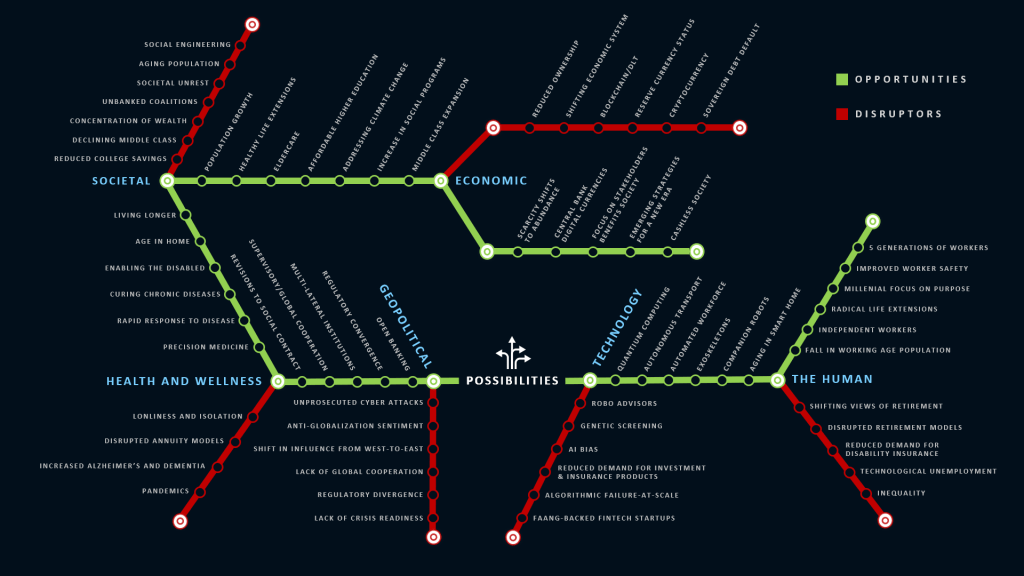
In this fifth installment of the RethinkX rethinking humanity series, Tony Seba and James Arbib describe humanity transformed by convergence across five foundational sectors: energy, transport, information, food, and materials. This convergence creates new possibility spaces representing both opportunity and disruption. I like to think of these spaces as a subway map that takes us in multiple directions. The green and red paths highlight the need for society to manage the path towards constructive outcomes. The warning signs are clear: our centralized ways of managing society are outdated.
(more…)

 Inside the Next Transition