
A series: When Systems Move Faster Than We Do
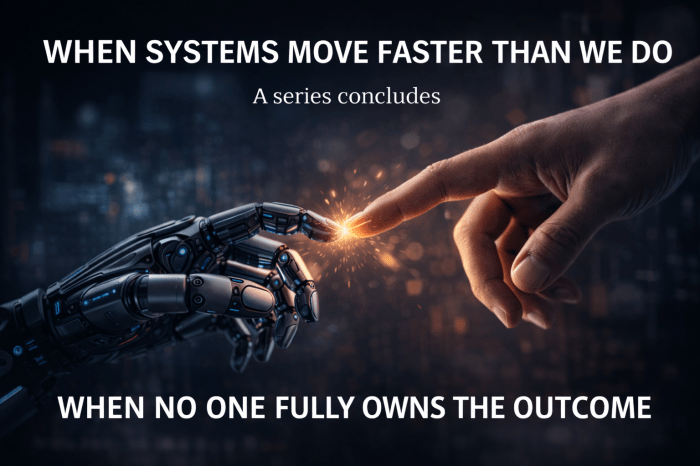
Across this series, we have followed a single pressure as it moved inward. In the first post, we examined what happens when intelligence outpaces human review and shared validation begins to thin. In the second, we saw how that acceleration moves into infrastructure, as environments stop waiting for instruction and begin acting automatically. In the third, we traced the consequences for institutions, where governance shifts from fixed rules toward continuous calibration and legitimacy begins to lag control. In the fourth, we carried that same substitution logic into the human domain, where people remain socially central while becoming operationally optional. What remains is responsibility.
Responsibility once depended on legibility. There was an identifiable actor, a visible decision, and a traceable sequence linking intent to outcome. Even when systems were complex, we assumed that someone decided, someone authorized, and someone could answer. Moral ownership rested on that structure. Without it, accountability could not anchor, and legitimacy could not stabilize.
Machine-paced systems alter those conditions. As intelligence operates continuously and environments respond in real time, outcomes increasingly emerge from interactions among models, data, thresholds, and automated processes. Decisions are not always discrete moments. They are embedded in design choices, training data, probabilistic assessment, and default configurations. By the time an institution reviews what occurred, the system has already adapted. The pause in which responsibility once crystallized becomes difficult to locate.
This does not eliminate responsibility; it redistributes it. Some of it shifts upstream into system architecture, where designers and policymakers set parameters that shape what is possible. Some of it shifts downstream into auditing, logging, compliance layers, insurance structures, and liability frameworks that assess consequences after the fact. Governance persists, but it increasingly operates as architecture rather than event. Accountability becomes layered and procedural rather than concentrated and personal.
There are real gains in this arrangement. Continuous systems can mitigate risk earlier, intervene before harm compounds, and adjust more quickly than episodic decision-making ever could. In domains such as health, finance, infrastructure, and security, waiting for full deliberation can amplify damage. Calibration, prediction, and constraint can reduce exposure and stabilize outcomes.
What destabilizes is not functionality, but ownership. When consequences arise from distributed processes rather than singular decisions, moral clarity thins. A platform refines its model. A regulator updates guidance. A vendor adjusts a threshold. A user interacts with a system shaped by all three. Each contributes, yet none fully commands the whole. Accountability exists, but it no longer aligns cleanly with the human expectation that someone should be able to say, “This was my decision.”
Over time, this shift reshapes how responsibility is experienced. Appeals move through procedures rather than conversations. Corrective action appears as model updates rather than admissions of fault. Public explanations emphasize system behavior rather than personal intent. The language of governance becomes technical, probabilistic, and architectural. Moral vocabulary does not disappear, but it struggles to attach itself to any single locus of control.
This tension cuts to the core of democratic legitimacy. Modern political systems were built on visible authority and identifiable responsibility under shared rules. Continuous systems operate through distributed calibration, where outcomes are the product of interacting components rather than discrete acts of will. Governance continues. Regulation adapts. Institutions remain active. Yet the clarity of ownership that once anchored trust does not fully return.
The decade does not end in collapse. It ends in equilibrium. Systems function. Institutions regulate. People participate. But responsibility is diffused across design, data, protocol, and process. Accountability frameworks expand even as moral ownership becomes harder to localize. The social expectation that every outcome has a clearly answerable author grows more difficult to satisfy.
This is where the pressure that began with speed ultimately lands. Intelligence outruns shared understanding. Action outruns deliberation. Governance outruns fixed authority. Human value loosens from necessity. Responsibility persists, but no one fully owns the outcome. Whether societies can sustain trust under those conditions is not a technological question. It is the defining political and moral question of this decade.
Over the course of this series, we traced a single pressure as it moved through our world. We began with knowing, where intelligence started to outrun human review. We followed that pressure into our environments, as systems began to act without waiting. We then saw institutions adapt, shifting from rule-based authority to ongoing calibration. We examined what happens when human roles remain socially central while becoming operationally optional. And now we arrive at accountability, where outcomes unfold faster than any one actor can fully authorize or explain them. The story has not been about technology alone, but about coordination under acceleration. As systems move faster than we do, control becomes more continuous, legitimacy more fragile, and responsibility harder to anchor. The decade ahead will not be defined by collapse, but by how well we learn to live inside that tension.
SERIES: When Systems Move Faster Than We Do
When Knowing Loses its Pace
When Environments Begin to Act
When Institutions Lose Fixed Authority
When Human Value Gets Rewritten
Discover more from Reimagining the Future
Subscribe to get the latest posts sent to your email.
 Reimagining the Future
When things change, people will ask who is responsible. We now rarely consider “The Gods” as the source of change. So when the change is positive, the answer might be “We are”. When the change is negative, the answer might be “They are”. Those two answers fit our social and cultural models better than a distributed and interactive source of the change. As people feel the increased pressure and constrained options, “They are” is becoming a more prevalent answer. We now experience the rumblings of violent reactions.
LikeLiked by 1 person
[…] my recent systemic change series, I explored how convergence across foundational domains — science, technology, economics, […]
LikeLike