
RECAP FROM THE SERIES SO FAR
In the first post, I described the sense that the world’s operating logic is turning over. In the second, I explored what that feels like in daily life — the tightening, the pressure, the sense that everything is connected. The third post revealed the pattern beneath these moments: a four-stage rhythm of accumulation, compression, instability, and reordering that has shaped every major transition in history.
This post turns to a deeper question. If these shifts are so powerful, what triggers them? The answer is rarely what we expect.
THE MYTH OF THE SINGLE CAUSE
We are taught to look for prime movers. The steam engine caused the Industrial Revolution. The printing press caused the Reformation. Electricity caused the modern world. These stories are clean, simple — and misleading. Breakthroughs happen all the time. Most are absorbed. They improve what exists without changing the underlying logic. A new tool spreads. An idea circulates. An institution reforms. Life continues — slightly better, slightly faster.
Civilization only changes shape when something deeper happens. When multiple domains stop moving separately and begin to move together. When science, technology, society, economics, geopolitics, philosophy, and the environment begin to interact, amplify, and reshape one another. That shift from independent motion to synchronized pressure is convergence. And convergence — not invention — is the engine of civilizational change.
WHY CONVERGENCE CHANGES EVERYTHING
Civilization can be understood as a set of deep conversations. During stable periods, these conversations stay in separate rooms. Science explores truth. Economics shapes value. Philosophy wrestles with meaning. Society negotiates norms. Progress happens, but each domain moves on its own timeline.
Then the walls begin to thin.
A discovery in science immediately alters what technology can build. A technological advance rearranges the economy. Economic pressure drives geopolitical realignment. Geopolitical shocks raise philosophical questions that societies must answer. The conversations overlap. Feedback loops form. The system becomes a single interacting field. Convergence is not faster change. It is integrated change.
THE THREE CIVILIZATIONAL LOOPS
Across the series, I describe three deep loops that govern how civilizations evolve. During stable periods, they hold together. During convergence, they collide.

When these loops synchronize, civilization coheres. When they drift, compression begins. When they amplify one another, convergence appears.
HISTORY’S CONVERGENCES
Every major transition becomes legible when viewed this way.
The Renaissance wasn’t an artistic moment. It was a partial convergence across several domains. Science began to challenge inherited assumptions. New technologies like the printing press accelerated the spread of ideas. Economic expansion reshaped incentives. Social structures loosened. Humanist philosophy redefined the role of the individual. Geopolitical competition among Italian city-states fueled experimentation. The printing press accelerated this shift; it did not cause it.
The Industrial Revolution wasn’t the product of a single machine. It was the intersection of scientific method, mechanical innovation, capital formation, demographic pressure, and geopolitical rivalry. Steam power mattered because economics, science, technology, and geopolitics were already converging around a new operating logic.
In every case, domains that had evolved separately began interacting. Their convergence produced a new structure for civilization.
WHY THIS MOMENT IS DIFFERENT
Across history, convergence has always been partial. Two or three domains might accelerate together. Four was rare. Full-spectrum activation—across all domains—has never occurred. Until now. For the first time, all seven domains are active and accelerating at the same time.
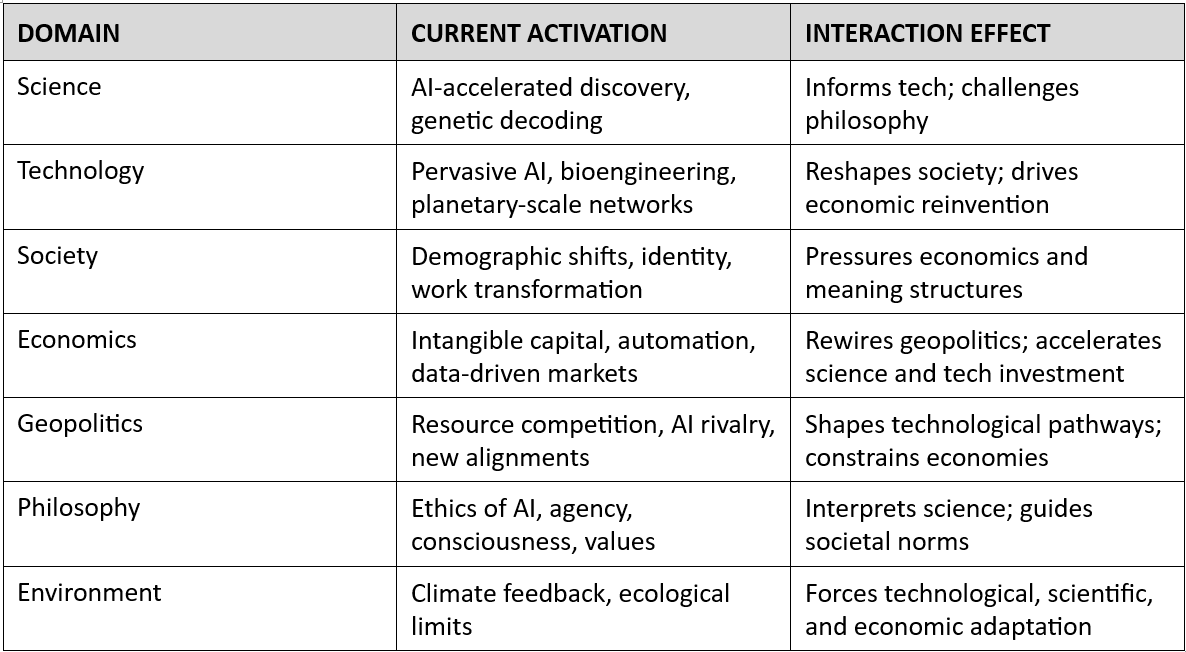
This is the first full-spectrum, simultaneous activation in human history. The system is no longer a collection of separate domains. It is one tightly connected, rapidly self-amplifying whole.
HOW THIS FEELS
This is why the world feels compressed. Why small events create outsized ripples. Why a breakthrough in one domain instantly affects all the others. Why the system feels tight. The pressure isn’t coming from one direction. It’s coming from every direction because the domains are now fully entangled.
WHAT DRIVES US TOWARDS A THRESHOLD
The deeper question is what gives convergence its power. If no single force can change the world, why do some periods accelerate toward thresholds while others stall? Before we can measure the pressure in the system, we need to understand the larger forces that push civilizations across turning points. That is where we turn next.
WHAT THIS MEANS FOR US
Understanding convergence changes how we interpret the world. It shifts attention from the loudest breakthroughs to the quiet intersections — where technology meets ethics, where economics meets ecology, where science meets meaning.
The future ahead won’t be driven by a single invention or idea. It will emerge from the interaction of all seven domains. And for the first time, we are all participants in that interaction — whether we realize it or not.
THE SERIES TO DATE


Leave a Reply