
This post marks the beginning of a new series on systemic change — an exploration of how civilizations transform at the deepest level. Over the coming weeks, we’ll trace the rhythm of history, examine the forces that drive reordering, and explore why this moment may be the first time in history when every domain of human life is active at once. Each post will build on the last, revealing how science, technology, society, geopolitics, economics, philosophy, and the environment are converging toward a new operating logic for civilization.
Every few centuries, civilization doesn’t just change — it reconfigures. The familiar patterns of life, work, and thought are replaced by new ones. These moments are not reforms or disruptions; they are turnovers in the system itself — times when humanity rewrites its operating logic. We are living through one of those moments now.
The Rhythm Beneath History
Across history, change has followed a repeating rhythm. Long periods of accumulation — when new tools, ideas, and institutions expand — eventually reach compression, as progress in different domains collides. Tensions mount, instability follows, and the system seeks balance through reordering. Each reordering becomes the foundation for the next age. With every turnover, the system grows more energetic — more connected, more complex, and harder to balance. History isn’t just movement; it’s the steady rise of systemic energy and the struggle to contain it.
The Record of Civilization’s Five Ages
Across the long arc of human history, certain moments stand apart — when the logic of civilization itself is rewritten. Each age captures one of those moments: a step change in how humanity organizes knowledge, power, and meaning. What begins as gradual accumulation eventually crosses a threshold, producing a new pattern of life that feels inevitable only in hindsight. The record of these five ages reveals how convergence has grown stronger with each turn, drawing more domains of life into the process of reordering.
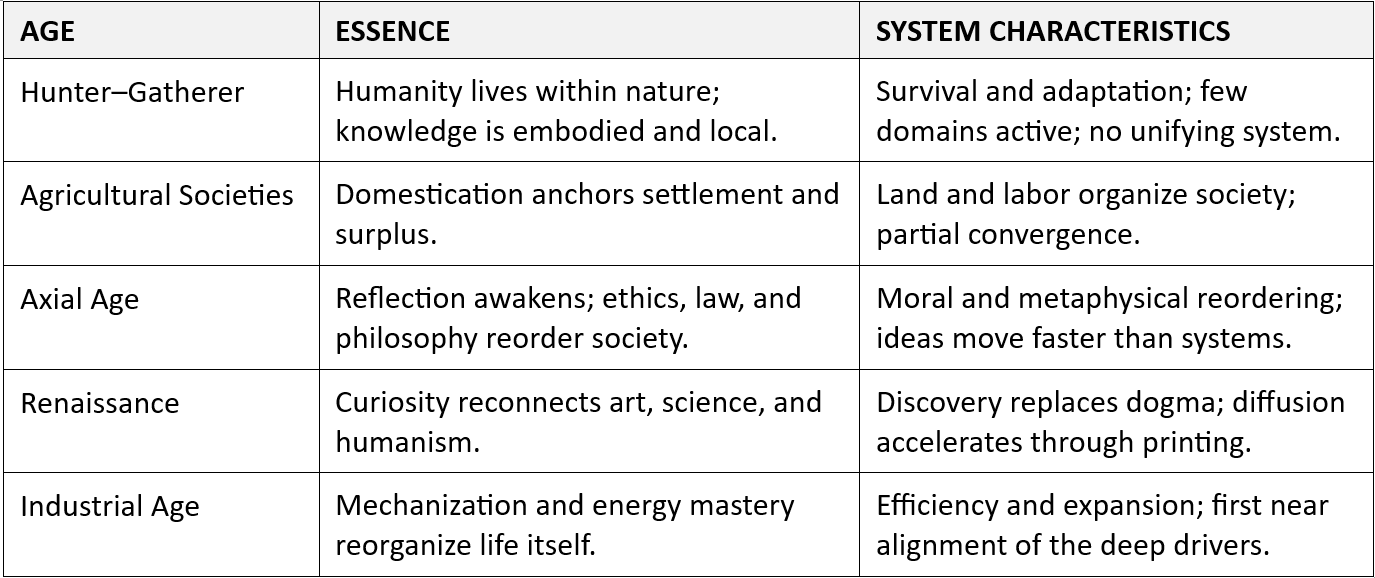
Through these five ages, convergence has intensified — the energy of civilization rising with each turn — yet none achieved full balance across its domains. The Industrial Age came closest, but philosophy and the environment lagged behind. Each turnover increased complexity, preparing civilization for the next threshold.
These patterns aren’t random. They can be mapped, even measured. In coming installments, we’ll explore how the rhythm of accumulation and reordering produces a quantifiable pattern across the ages, and what that pattern reveals about the pressures shaping this one.
The Three Deep Drivers of Reordering
Beneath every age run three deep forces that occasionally ignite together: domain convergence, where progress in one field amplifies others; general-purpose technologies, which restructure civilization itself; and knowledge diffusion, the speed at which discovery spreads and becomes behavior.
These forces have almost never aligned in history. Most centuries see only one or two active. The Industrial Age marked the first near-alignment — when science, technology, and economy converged around energy and machinery. That ignition built the modern world, yet several domains lagged behind.
Today, for the first time, all seven domains — science, technology, society, geopolitics, economics, philosophy, and environment — appear to be active together. And all three drivers are beginning to move toward synchronization at planetary scale. Alignment of this breadth has never been measurable before. In future posts, we’ll look at how this convergence can now be quantified — revealing, for the first time, the statistical signature of civilization-scale reordering.
Why Alignment Is So Rare
Across history, the forces that drive civilization’s great leaps almost never move in sync. Each follows its own rhythm. Convergence depends on culture and institutions, which evolve slowly. General-purpose technologies arrive suddenly, on their own unpredictable timelines. Knowledge diffusion — how fast ideas spread — relies on communication and trust, which usually lag behind invention.
Because these rhythms run at different speeds, they rarely line up. Most centuries have one or two active at a time — a burst of innovation here, a social awakening there. Only once before, during the Industrial Age, did they nearly align, and even then not across every domain.
That’s why history feels mostly stable punctuated by abrupt leaps. When these rhythms do briefly fall into phase, civilizations don’t just evolve — they turn over. The rarity of that synchronization is what makes our current moment extraordinary.
The Threshold Ahead
This alignment signals more than another technological leap. It marks the first full-system turnover in human history — the emergence of the Bio-Intelligent transition: a world where intelligence and biology become the organizing principle, and systems learn, adapt, and evolve in real time.
But systemic change is not destiny. It is a feedback process — growth meeting its own reflection. Every turnover asks a simple question: can the system reorganize before it breaks?
Looking Forward
The next post will explore how civilizations cross these thresholds — the physics of reordering itself — and how to recognize the signs when compression turns to release. Once systems begin to turn over, the rules of progress no longer hold; coherence, not speed, becomes the measure of survival.
Discover more from Reimagining the Future
Subscribe to get the latest posts sent to your email.
 Reimagining the Future
[…] opened this series by exploring why the world feels unsettled in ways that don’t fit the usual explanations. I […]
LikeLike
[…] the first post, I explored why so many parts of life feel unsettled at the same time: all seven domains of […]
LikeLike
[…] the first post, I described the sense that the world’s operating logic is turning over. In the second, I […]
LikeLike
[…] earlier posts introduced the sense that the world’s operating logic is beginning to shift, explored what compression feels like in daily life, and laid out the […]
LikeLike
[…] why the world feels dense, fast, and tightly connected. We explored the sense that something in the operating logic of civilzation is shifting. We looked at phase transitions, the four-stage pattern that repeats […]
LikeLike
[…] the first six posts, I built the foundation needed to understand how civilizations change. I explored the seven domains that shape collective […]
LikeLike
[…] When Systems Turn Over […]
LikeLike
[…] When Systems Turn Over […]
LikeLike
[…] When Systems Turn Over […]
LikeLike
[…] posts, we have been building a clearer picture of what it means to live in a world approaching a systemic turning point. We began by examining why today feels unusually active and uneven, then traced the deeper pattern […]
LikeLike
[…] When Systems Turn Over […]
LikeLike