
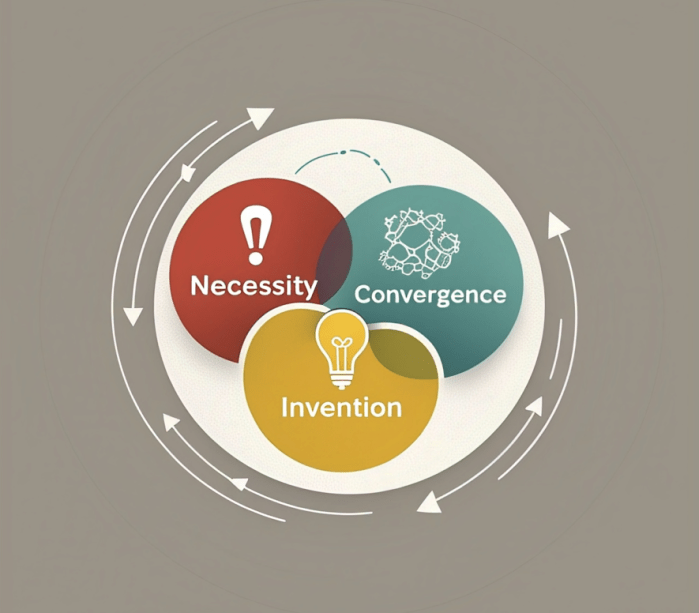
What if the very inventions that propel humanity forward also sow the seeds of our greatest challenges? History shows that progress is rarely a straight line. Instead, it moves in cycles: necessity sparks invention, and inventions converge to reshape society. From the steam engine’s role in the Industrial Revolution to the internet’s impact on globalization, each wave of transformation has brought profound change – economic shifts, new social structures, and unintended consequences. These disruptions, from rising inequalities to environmental crises, often take decades to address. As we stand on the brink of the next great convergence – whether in AI, biotechnology, humanoid robots, cyber, climate or health – we must ask – how can we harness innovation to create a more equitable and sustainable future?
THE INDUSTRIAL REVOLUTION: THE BIRTH OF THE MODERN ECONOMY
In the mid-18th century, much of Europe’s agrarian economy struggled under the weight of rapid population growth and limited agricultural output. Out of these mounting pressures arose transformative inventions – notably James Hargreaves’s Spinning Jenny (c. 1764), Richard Arkwright’s Water Frame (c. 1768), and Samuel Crompton’s Mule (1779) – each addressing the urgent need for faster, more efficient textile production. Initially, these machines relied on waterpower, but everything changed when James Watt’s improved steam engine converged with textile machinery. This synergy gave birth to the factory system, enabling manufacturers to move beyond riverbanks and scale up production at unprecedented speeds.
Manchester, England, became a symbol of this industrial surge: once a modest market town, it rapidly transformed into a booming textile hub. The factory system did not, however, elevate everyone equally. Factory workers, including children as young as six, endured long hours (12 to 14-hour shifts), hazardous conditions, and overcrowded housing. Social stress grew so severe that legislative interventions like the Factory Acts of 1833 and 1844 (which targeted child labor) and the Public Health Act of 1848 (aimed at urban sanitation) became inevitable. Meanwhile, the relentless burning of coal foreshadowed the environmental challenges that would unfold in the centuries to come.
From these intertwined forces of necessity, invention, and their convergence emerged the foundations of the modern economy. Yet the deeper lesson of the First Industrial Revolution is clear: unchecked progress can yield both astounding achievements and profound social inequities. As we confront modern-day disruptions – from AI to automation – this history is a powerful reminder that foresight and human action are as crucial as invention itself.
THE SECOND INDUSTRIAL REVOLUTION (1870–1914): A PIVOTAL TURNING POINT IN HUMAN HISTORY
By the late 19th century, rising populations, global trade expansion, and the need for vast infrastructures placed new demands on industrial societies. These pressures spurred a wave of inventions that converged to reshape the modern world. Mass steel production – made affordable by the Bessemer process – enabled the construction of skyscrapers, large-scale bridges, and intercontinental railways. Cities soared vertically and spread horizontally, powered in part by the electrification of factories and public spaces. With electric lighting extending the workday, industries operated around the clock, fueling rapid economic growth.
Simultaneously, the internal combustion engine revolutionized transportation, giving rise to automobiles, suburban neighborhoods, and a deeper reliance on fossil fuels. As rail networks expanded across vast distances, the need for synchronized schedules led to the adoption of standardized time zones, not only organizing transportation but also reshaping society’s perception of time itself – transforming it from a local, fluid experience to a rigid, measured construct that governed daily life. Meanwhile, new communication technologies such as the telegraph and telephone accelerated business, governance, and personal connections, weaving distant regions into an increasingly interdependent global system.
Yet, as in the first revolution, invention and convergence produced social and ethical dilemmas. Factories often operated under brutal conditions, exemplified by tragedies like the Triangle Shirtwaist Factory fire (1911), which exposed the human cost of rapid industrial expansion. These same innovations underpinned imperial conquests, intensified resource extraction, and ultimately powered the mechanized warfare of World War I.
In this Second Industrial Revolution, necessity once again met invention, and the virtuous cycle of convergence propelled societies to new heights. But it also revealed the dangers of unregulated growth and exploitation. As we wrestle with today’s digital revolutions and the shift to renewable energy, the lessons are clear: progress requires not only bold innovation but also the ethical, environmental, and social safeguards to ensure that its benefits are shared – and its perils are contained.
THE POST–WORLD WAR II BOOM: THE RISE OF CONSUMER CULTURE (c. 1945–1970s)
In the wake of World War II, the urgent necessity of rebuilding shattered economies and filling labor shortages spurred a new wave of technological innovation. Wartime advances in automation, computing, semiconductors, and logistics converged with mass-production techniques, creating an unprecedented engine of economic expansion. Factories that had once churned out military equipment were repurposed to produce everything from automobiles to household appliances, laying the groundwork for a modern consumer culture defined by abundance and convenience.
Against this backdrop, suburbs like Levittown, New York, became pioneering models of mass-produced housing. They offered affordable homeownership to millions, fueling demand for consumer goods while transforming the physical and social landscapes of postwar America. Meanwhile, the construction of the U.S. Interstate Highway System reinforced car dependency, linking new suburban enclaves to urban centers and reshaping national transportation forever. Television emerged as a dominant cultural force, forging shared narratives across vast audiences and amplifying the power of advertising.
Yet, as necessity met invention and these forces converged to drive remarkable prosperity, the costs of unbridled growth became increasingly apparent. Federal housing policies systematically excluded many Black families from homeownership opportunities, widening the racial wealth gap and perpetuating inequalities for generations. The relentless emphasis on car culture contributed to urban decline and environmental degradation, with air pollution crises affecting major cities. Rapid suburbanization, often executed with little regard for ecological balance, foreshadowed the mounting environmental concerns of the late 20th century.
This postwar boom, powered by the interplay of necessity, invention, and convergence, delivered unprecedented economic gains yet also deepened social and environmental rifts. As we confront today’s challenges – from digital transformation to the climate crisis – the lessons from this era ring clear: progress should be pursued boldly but tempered by foresight, equity, and sustainability. Only by recognizing both the opportunities and the risks of innovation can we ensure that tomorrow’s growth truly benefits everyone.
THE DIGITAL REVOLUTION: A WORLD REWIRED
As global markets expanded in the late 20th century, businesses and governments faced a new necessity: managing massive volumes of real-time data across continents. That urgency met innovative breakthroughs such as microprocessors (from the early 1970s), personal computers, artificial intelligence research, and, crucially, the internet – each invention reinforcing the others. The microprocessor made computing more affordable, personal computers unlocked new use cases for individuals and firms, and the internet connected billions of devices, transforming entire industries and shifting economic power toward a knowledge-based economy.
With the iPhone’s debut in 2007, mobile technology became truly ubiquitous, untethering digital commerce and remote work from physical locations. A single smartphone could now provide constant access to the internet, revolutionizing how people communicate, shop, and conduct business. Yet, as with all such convergences of necessity and invention, challenges emerged. Digital monopolies concentrated wealth and influence in a handful of tech giants, cybersecurity threats and misinformation proliferated, and the digital divide left marginalized communities behind in a rapidly evolving landscape.
The Digital Revolution thus exemplifies the double-edged nature of rapid progress. Unprecedented connectivity and economic opportunities came at the cost of new forms of inequality and privacy risks. As we enter the next wave of innovations – from 5G to AI-driven automation – this history reminds us that necessity and invention do not inherently guarantee equitable growth. Guided by ethical oversight and inclusive policies, we can strive to ensure that tomorrow’s digital tools empower all of society, rather than deepen existing divides.
THE COVID-19 ERA: THE MOST RECENT CONVERGENCE
When the COVID-19 pandemic struck, the world confronted an unprecedented necessity: stopping a rapidly spreading virus while keeping economies and societies afloat under lockdown. This urgency met invention head-on, accelerating mRNA vaccine technology – a field that had been studied for decades but was supercharged by immediate needs and global collaboration. The result was the fastest large-scale vaccine rollout in history, saving countless lives and reshaping future vaccine development.
At the same time, strict social-distancing measures forced businesses, schools, and healthcare systems to move online. Cloud computing and digital collaboration platforms converged with this necessity, enabling hundreds of millions worldwide to work, study, and receive medical care from home almost overnight. Telemedicine, in particular, emerged as a powerful tool for expanding healthcare access – one that promises to outlast the pandemic. Yet, these swift shifts exposed deep inequalities across the globe: many lacked the internet bandwidth, devices, or financial resources to adapt, while developing nations often lagged in both vaccine distribution and digital infrastructure, widening existing disparities.
Meanwhile, global supply chains, already strained by manufacturing shutdowns and shipping delays, revealed their fragility, leading to empty shelves and soaring prices. In this way, the COVID-19 era powerfully illustrates how necessity can spark transformative innovation, with new and existing technologies converging to rewire society at extraordinary speed. But it also highlights the dangers of an uneven playing field and the steep costs of reactive, rather than proactive, planning.
As we brace for future global challenges, the era’s most enduring lesson is clear: invention alone cannot guarantee equitable progress. By bridging divides, investing in public health and digital infrastructure, and strengthening global cooperation, we can strive to ensure that the next wave of innovation truly benefits all.
CONCLUSION: LEARNING FROM THE CYCLES OF PROGRESS
History reveals that human progress advances in cycles, each driven by urgent needs and shaped by inventions and innovations that converge to transform society. From the Industrial Revolution to the Digital Revolution, and most recently the COVID-19 era, every wave of progress has sparked remarkable breakthroughs – like mechanized production, global connectivity, and rapid vaccine development – while also exposing inequalities, environmental harms, and other systemic vulnerabilities. The lesson is clear: progress itself is not inherently fair; without foresight and deliberate actions, its benefits remain unevenly distributed, and its consequences can linger for generations.
The Industrial Revolutions ushered in new economic paradigms but underscored the costs of unregulated growth – exploited labor, resource depletion, and imperial expansion. The post-war boom brought unprecedented prosperity yet widened racial and economic divides. The Digital Revolution democratized information even as it concentrated power in the hands of a few. And the COVID-19 era proved the power of global collaboration and rapid innovation but also laid bare the fragility of our supply chains, healthcare systems, and digital infrastructure.
Now, as we approach the next great convergence – whether driven by AI, biotechnology, humanoid robots, cyber, health, or climate – we must heed history’s recurring caution: invention alone does not guarantee equitable outcomes. To ensure that tomorrow’s breakthroughs benefit everyone, we must invest in ethical oversight, preparedness, and inclusive policies that prioritize the well-being of all communities, rather than a privileged few.
Progress is both inevitable and malleable – its trajectory shaped by the choices we make now. We can either replicate the cycle of innovation outpacing social responsibility, or we can design a future that is just and sustainable. Let us choose wisely, guided by the lessons of the past and the urgent necessities of the present. I’ll dive deeper into our current era in the next post.
THE OTHER POSTS IN THIS SERIES
Part One: The Great Productivity Convergence: When Necessity Meets Innovation
Part Two: The Necessity-Invention-Convergence Framework
Part Four: Meeting Today’s Grand Challenges – The Next Wave of Convergence
Discover more from Reimagining the Future
Subscribe to get the latest posts sent to your email.
 Reimagining the Future
[…] The Converging Forces Of Progress: Necessity, Invention, And Systemic Outcomes […]
LikeLike
[…] Part One: The Great Productivity Convergence: When Necessity Meets InnovationPart Two: The Necessity-Invention-Convergence FrameworkPart Three: The Converging Forces Of Progress: Necessity, Invention, And Systemic Outcomes […]
LikeLike
[…] One: The Great Productivity Convergence: When Necessity Meets InnovationPart Three: The Converging Forces Of Progress: Necessity, Invention, And Systemic OutcomesPart Four: Meeting Today’s Grand Challenges – The Next Wave […]
LikeLike
[…] Two: The Necessity-Invention-Convergence FrameworkPart Three: The Converging Forces Of Progress: Necessity, Invention, And Systemic OutcomesPart Four: Meeting Today’s Grand Challenges – The Next Wave […]
LikeLike
[…] The Converging Forces Of Progress: Necessity, Invention, And Systemic Outcomes […]
LikeLike
[…] General Purpose Technologies and geopolitical dynamics. In a previous post, I described the role of Necessity, Invention and Convergence in driving the diffusion of general purpose technologies. Necessity drives invention, but true […]
LikeLike