TCS and the Clayton Christensen Institute have collaborated to produce a series of articles and whitepapers that explore the future of industries through the lens of a set of fundamental theories developed by Harvard Business School Professor Clayton Christensen (Mr. Christensen is a TCS Board member). The theories offer a form of what-if analysis that leaders can leverage to better understand the cause and effect between actions and results. These theories include Disruption Theory, the Theory of Jobs to Be Done, and Modularity Theory. In this case, the author focuses on the disruptive potential of innovation, and this first piece in the series tackles Disruption in the Banking Industry.
Inside the Next Transition
-
Future Sports: Connecting the Dots
Last week, I presented on the future of sports at a fund raiser for the Rutgers University Women’s Soccer team. A local Article on the topic captured the high-level themes, but for those interested, here is the full presentation along with two very good reports I tapped into from Delaware North on the future of sports: The Future of Sports 2016 Report and The Future of Sports 2015 Report.
-
Privacy and Corporate Responsibility

I joined another episode of Coffee Break with Game Changers on Wednesday of this week. A very good discussion on privacy and data. Here is a brief abstract.
The buzz: “You already have zero privacy – get over it” (Scott McNealy). We as individuals have welcomed Internet-connected, mobile devices to help us make daily decisions. But when we share data with companies, and they share it with their business partners, are their built-in and bolted-on data security capabilities enough to protect our personal information?
-
Discussing the Future of Sports
This story was posted this morning to promote a fund raiser that I am participating in on Tuesday evening, June 13th at 6:00 p.m. We will be discussing the future of sports, and its implications to fans, stakeholders, arenas, the athlete, humans, and the sports themselves. Here is an excerpt from the article by J.P. Pelzman and a glimpse into what I will be presenting.
This event will take place from 6 to 8 p.m. Tuesday night in the Brown Recruiting Pavilion behind the south end zone, with proceeds to benefit the Rutgers women’s soccer team. Details for the event can be found here.
Join us if you live in New Jersey.
-
CXOTALK: June 9th Episode

Update 6-9-17 3:00 pm: It was an absolute pleasure spending time with Anthony Scriffignano and Michael Krigsman discussing very important and difficult issues regarding our future. The rebroadcast is available here.
-
Our Emerging Future: Revised

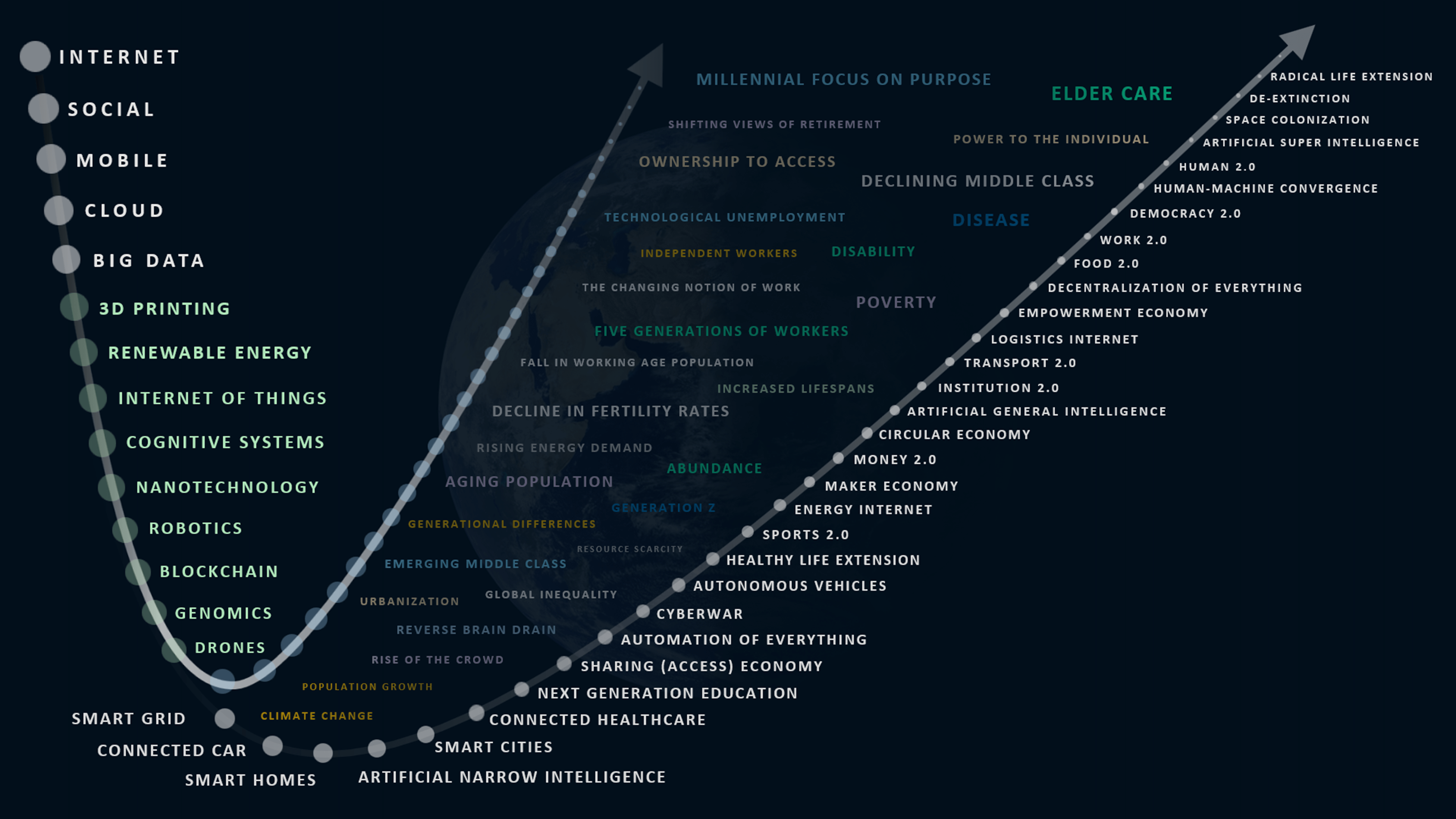
Several months have past without adding to the emerging future visual. In this post on Visualizing our Emerging Future, I described the origins of the visual and how it is being used. Two specific activities have prompted me to add two new scenarios to the visual:
-
Reimagining the Future: Week Two of the Online Course Launched
Week two of Reimagining the Future has just launched! Week one drew a large audience and generated great dialog. A big thank you to those who have participated so far. As discussed in the course, we must collectively take control of creating our future. Our hope is this course and related dialog are just one small step on that journey. There is still plenty of time to take the full course, you can enroll here.
-
Reimagining the Future Athlete
On June 13th, I will be presenting at a Rutgers Athletics Fund Raiser with a focus on the future of athletes and athletics. We will explore
1) Automation – robots replacing athletes, sensors and software replacing officiating
2) Performance – more data and machine learning lead to improved performance through better insights
-
Technology vs Humanity – The Future is already here
In a recently released video, Futurist Gerd Leonhard delivers his key messages in a powerful and passionate plea for balance between technology and humanity. This five minute video is a must see. Some of his key messages are:
Sector after sector, industry after industry, we are waking up to the fact that the future is already here. My note: after struggling to drive a level of urgency regarding the speed at which the future is approaching, leaders are now beginning to embrace a future-back mentality.
-
Dual Transformation
In a recent book titled Dual Transformation, the authors (Scott D. Anthony, Clark G. Gilbert, and Mark W. Johnson) focus on the challenging task of transforming the core while simultaneously creating a growth engine. They refer to it as dual transformation: Transformation A – repositioning the core, and Transformation B – creating the new. This complex tension is represented in this visual from our upcoming leadership course: Reimagining the Future: A Journey through the Looking Glass.
(more…) -
Disruption and the Future of Work

Join me on the June 9th episode of CXOTALK with Industry Analyst and host Michael Krigsman. We will be joined by Anthony Scriffignano, Chief Data Scientist, Dunn & Bradstreet. A quick description of the episode:
What are the implications of technology and new business models on the future of work? The impact of technologies such as artificial intelligence and robotics have profound implications for both companies, individuals, and society. At the same time, government policy on these issue lags technology and the impact on people. On this episode, a respected futurist and well-known data scientist explore these complicated and important issues.
-
Our Journey Forward: Thoughts from Futurists
I had the great fortune of working with three very accomplished futurists in the production of our upcoming course titled: Reimagining the Future – A Journey through the Looking Glass. SAP’s Susan Galer interviewed these futurists in support of the course launch on May 23rd. The SAP Post provides a glimpse into the course, with thoughts from futurists and industry leaders. Here are several quotes from the post.
-
Human Traits in an Exponential World
Our exponential world puts increasing pressure on our capacity to innovate and the speed and quality of idea flow. This dynamic coupled with the speed at which automation is likely to occur brings our right brain characteristics front and center. Creativity, imagination, big picture vision, emotional and social intelligence, empathy, and other human characteristics are critical to navigating in this emerging future. As automation accelerates, these human traits become even more critical. In a recent report by Citi on Technology at Work, the authors point to our propensity for social interaction, communication, and empathy being something machines can never replace.
(more…) -
Digital: We’ve Only Just Begun
“Digitization has barely started, and so has the accompanying upheaval”
– Jacques Bughin, Mckinsey
That’s a scary thought – but accurate. That thought comes from a recent Mckinsey Insights post titled: Think digital is a big deal? You ain’t seen nothing yet. Thanks to Heidi Schwende for sharing this article.
Their research finds that digital technologies and processes have penetrated only about 35% of an average industry, which says that a third of the products and operations that could be digitized have been. Yet this is more than thinking about digitizing the other 65% – it’s a moving target. The phrase “You ain’t seen nothing yet” captures that well. As the innovation accelerators that I describe in my Anchor Visual accelerate, digital is merely the foundation. A reimagined world is built on that foundation – and without it, organizations cannot participate in Reimagination. Here are other key insights from the Mckinsey post:
-
Reimagining the Future – A Journey Through the Looking Glass

I have spent the better part of two months filming an online thought leadership course focused on our emerging future. The free course will be available starting May 23rd. I had the pleasure of working with futurists Gerd Leonhard, Gray Scott, and Chunka Mui. In addition, I was joined by Element Fleet Management executive Michele Cunningham, as well as TCS CTO Ananth Krishnan, and BRP CIO Hassan El Bouhali.
A video promo of the course along with the course description are available here. I hope you take the time to journey with me through the looking glass. course summary and bios for my guests are also included below.
-
How will we Interact in the Future?
In recent post on the transformation of interaction, I talked about the changing ways in which we interact with our machines and each other. These changes combine with the emergence of ecosystems to complicate the experience journey. Well, if you saw my last post on our possible future, that journey could get very complicated. I’ve expanded my original visual to incorporate three additional categories of interaction, and some of what science and technology have in store (potentially) for our interaction paradigms. (more…)
-
A Glimpse into a Possible Future
I saw a glimpse into a possible future in a book titled Homo Deus, written by Yuval Noah Harari in 2016. Before his journey forward, the author explores the past. His conclusions challenged my core belief system in a very uncomfortable way. His arguments were logical and thoughtful (whether I agree with them or not), and based on a foundation of life science, algorithms, and biotechnology. This look forward once again raises the question of Ethics. The author himself makes this point when he says:
“The rise of AI and biotechnology will certainly transform the world, but it does not mandate a single deterministic outcome. All the scenarios outlined in this book should be understood as possibilities rather than prophecies. If you don’t like some of these possibilities you are welcome to think and behave in new ways that will prevent these particular possibilities from materializing.”
I’ve given the main themes of this possible future a label and provide a quick look using excerpts directly from the book. You decide for yourself if this future represents an enhanced or diminished humanity.
-
See the Future, Rehearse it and Adapt to the Inevitable Shifts
In my last post, I described a Sense and Respond model that sits at the heart of several activities, including scenario, opportunity, and risk analysis. As complexity and pace continue to intensify, uncertainty increases. To survive in this Emerging Future, we must embrace a framework for future thinking, and an organization that can adapt as it shifts. In essence, we must see the future, rehearse it, continuously monitor for shifts, and adapt as the shifts occur. A sense and respond model sits at the core of the framework – but represents the biggest cultural challenge.
-
Uncertainty Drives the need to Sense and Respond
“The rhythm of technology is changing the rhythm of business, and we’re all going to need to adapt” – Jeff Gothelf and Josh Seiden, Authors of Sense and Respond
Back in 2013, in a post on sense and respond systems, I talked about the drivers that would push organizations towards a sense and respond paradigm. There are no bigger drivers than volatility and uncertainty, and nearly four years since that post, that fact is becoming clearer. In a recent book by Jeff Gothelf and Josh Seiden, they elevate sense and respond to a position that is core to achieving an adaptive enterprise. They see feedback loops and a movement away from command and control as the enabling mechanisms that allow us to thrive in the digital age.
(more…) -
Who Owns Your Data?