I had the pleasure of doing a video interview with Kevin Benedict today, where we discussed a number of topics, including the recent book Machine, Platform, Crowd: Harnessing Our Digital Future. Kevin is from the The Center of Digital Intelligence. Our wide ranging discussion can be viewed here.
Inside the Next Transition
-
Machines, Platforms, and Crowds
Andrew McAfee and Erik Brynjolfsson – Authors of The Second Machine Age – wrote a new book which they launched in the middle of this year. Machine, Platform, Crowd: Harnessing Our Digital Future builds upon their first book, exploring three big trends that are reshaping the business world:
- The rapidly increasing and expanding capabilities of machines
- The large and influential young companies (Platforms) that bear little resemblance to the established incumbents in their industries, yet are deeply disrupting them
- The emergence of the crowd: the large amount of human knowledge, expertise, and enthusiasm distributed all over the world and now available
-
Taxing Robots
In this recent Article, Futurist Rohit Talwar explores the issue of robot taxes and long term unemployment. Although long, I recommend reading the entire article, but I captured some key points from the article below.
-
Belief Systems, Purpose, and Balance
At the Health Summit in D.C. two weeks ago, I was asked to articulate those things that leaders should consider as they navigate the complexity of our emerging future. The three that always top my list are:
- Resetting our intuition and belief system for a new era – think differently
- Shifting to a hybrid profit and purpose orientation
- Seeking a balance between innovation that enhances society and mitigating the risk of unintended consequences.
This two minute video captures that portion of our panel discussion.
-
Loneliness, Aging, Robots and Health
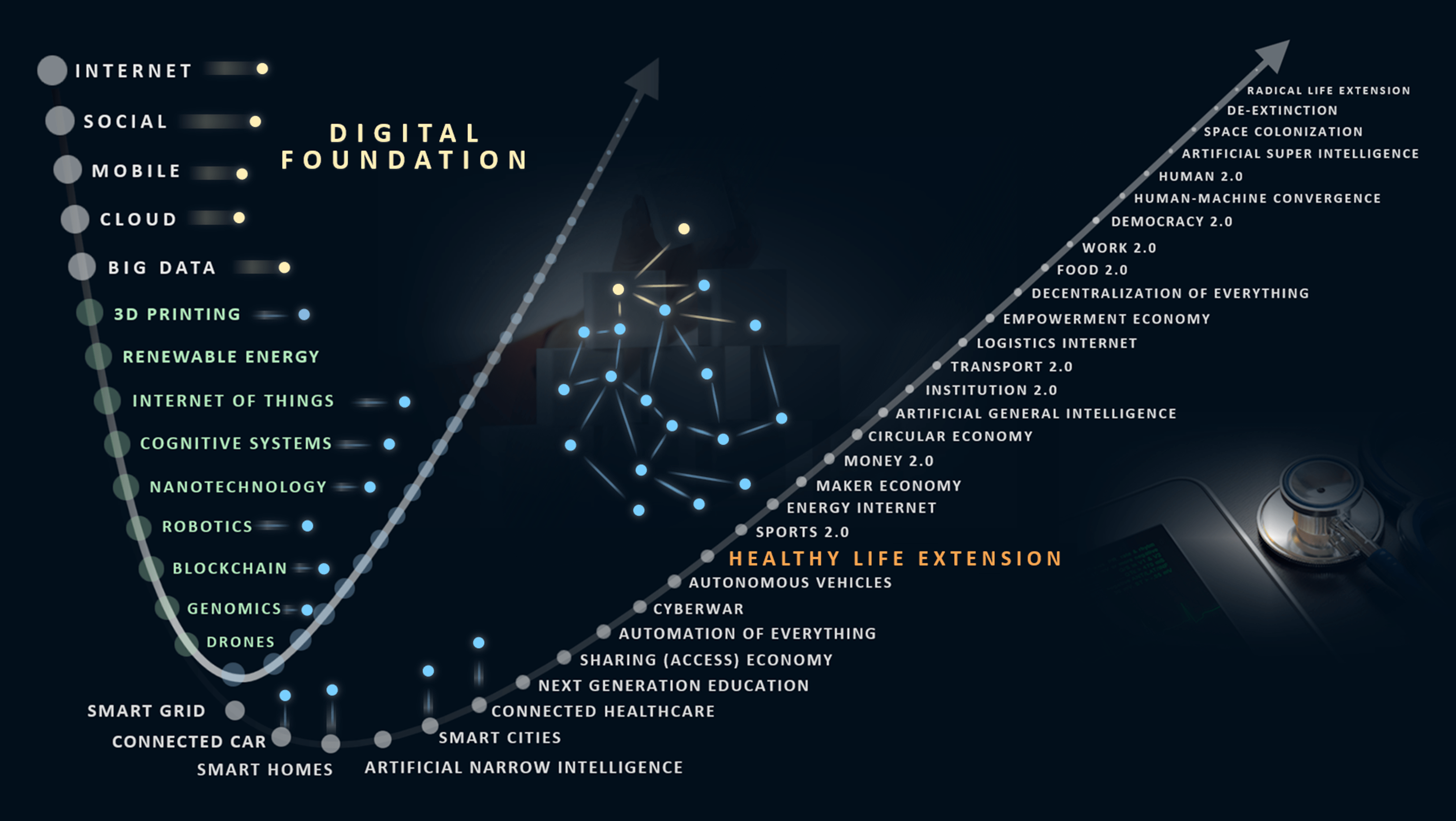
At the Health Summit in D.C. last week, I used this emerging future visual to describe the combination of building blocks that enable our healthy life extension – one of many emerging future scenarios. This two minute video captures that portion of our panel discussion.
One of the key issues that emerged during our panel dialog was the acceleration of aging and death associated with isolation and loneliness. Could robotic companions solve this problem? Do these advances – many that feel like science fiction – combine to solve the challenges that likely emerge as we live longer? Can Sophia be a robotic companion?
-
The Emerging Mobility Ecosystem
In segment four of my interview with Chunka Mui, we discussed the ultimate demise of our industry construct and the emergence of horizontal ecosystems that remove friction from our life experiences – one experience at a time. This platform-enabled transition can be witnessed in action today, as we watch the Mobility ecosystem form one piece at a time. We can no longer think of industries in isolation, as we witness the collision of various industries and a reconfiguration of the money flow – over $2.5 Trillion in car-related economic value. Chunka uses the example of the collision between the automotive and technology ecosystems to describe this phenomenon: the shift from cars with computers inside, to computers with wheels on them.
Chunka Mui is the managing director of the Devil’s Advocate Group, a consulting team that helps organizations design and stress test their innovation strategies. Mr. Mui published a popular book titled The New Killer Apps.
Segment four is a quick three minute video.
You can view segment one – Autonomous Vehicles: An Interview with Chunka Mui – here.
You can view segment two – Reimagining Our Driverless Future – here.
You can view segment three – The Ripple Effect – here.
-
Milken Institute Health Summit
I had the pleasure of participating in the Milken Institute Health Summit earlier this week. A truly inspiring two days at one of the best run conferences I’ve attended. Great discussions with Pepsi CEO Indra Nooyi, Senators Corey Booker and Ben Sasse, and World Bank Group President Jim Yong Kim. The details and a video of the panel discussion I participated in are included below.
ABSTRACT
One of the most important public health findings in the last two decades is that medical care is far from the only factor in how long people live and the quality of their health. A key step to improving health outcomes for older adults–and reducing the costs to the health-care system–is to better integrate health-care and supportive services with housing and transportation at local levels. This session explores effective methods and solutions that can drive change and result in healthier aging on a vast scale. How can we encourage more communities across the country to make the needs of their older residents a priority as they plan for the future? How do we improve the critical connections between housing, health care, technology, transportation, and urban planning?
MODERATOR: Anand Parekh, Chief Medical Advisor, Bipartisan Policy Center
SPEAKERS
Catherine Anderson, Senior Vice President, Policy and Strategy, United Healthcare Community and State
Frank Diana, Principal, Tata Consultancy Services
Omar Nagji, Lead, Health Partnerships, Lyft
Allison Silberberg, Mayor, Alexandria, Virginia
Pattie Dale Tye, Segment Vice President, Bold Goal, Humana
View the full panel discussion Here.
-
The Ripple Effect
In segment three of my interview with Chunka Mui, we discussed the ripple effect that occurs with emerging scenarios, in this case, the driverless car. Chunka Mui is the managing director of the Devil’s Advocate Group, a consulting team that helps organizations design and stress test their innovation strategies. Mr. Mui published a popular book titled The New Killer Apps.
What fascinates me about these scenarios is the sheer breadth and depth of societal impact. In this segment, Chunka Mui does a great job of describing this impact. Here is a seven minute animated version of our discussion that picks up where segment two left off:
-
8 Billion Acts of Innovation
I had the pleasure of talking to Taimour Zaman of 8 Billion Acts of Innovation today. They have a TV show focused on Artificial Intelligence, with some incredible stories about current innovation in the field.
The 8 Billion Acts of Innovation venture capital TV show is focused exclusively on artificial intelligence. Recently introduced in Toronto, Canada by investment visionaries Sai Mohammed and Taimour Zaman, AI companies present their business cases and compete for venture capital financing. It’s the only show of its kind in the world, now being viewed by over 3 million people.
$20+ Million of Funding per Show
The show’s panel of investors are senior ‘C-level’ executives whose job is to assess AI companies’ business and financial potential. The funds are put up by Curah Capital, a Toronto-based private venture capital firm involved in real estate and technology.
Mr. Mohammed and Mr. Zaman’s objectives for their show:
1) Worldwide popularity via expanded TV coverage
2) Attract top AI companies from across the world
3) Award ever-larger funding amounts, and
4) Develop financed-firms into celebrated successesWe covered a wide variety of topics in this short video.
-
Reimagining Our Driverless Future
In segment two of my interview with Chunka Mui, we picked up our conversation with the driverless car scenario. Chunka Mui is the managing director of the Devil’s Advocate Group, a consulting team that helps organizations design and stress test their innovation strategies. Mr. Mui published a popular book titled The New Killer Apps.
Key points of discussion were:
- If we eliminate auto fatalities, what happens to the need for auto insurance?
- How to think about the timing of the autonomous vehicle scenario
- The arms race towards the automotive ecosystem
- Eliminating 90% of human accidents is plausible
- Critical mass not needed to feel the impact of this scenario
- From predicting to rehearsing – a portfolio of options
- Understanding milestones, markers, obstacles and accelerants
- Understanding extreme scenarios
- Understanding the path of science and technology
Here is a six minute animated version of our segment two discussion that picks up where segment one left off:
You can view segment one here.
-
Autonomous Vehicles: An Interview with Chunka Mui
The convergence that is steering our emerging future manifests itself through a number of scenarios that drive multiple paradigm shifts. As the shifts themselves converge, they intensify the critical need for leaders to think differently about a world where the future arrives faster than people think. Some time ago, I had a great conversation with Chunka Mui regarding pace, the sheer number of shifts, and the need to think differently. We used the autonomous vehicle to explore the challenges of our emerging future. I will present the full discussion in five short segments, along with white board animation to visualize our dialog.
Chunka Mui is the managing director of the Devil’s Advocate Group, a consulting team that helps organizations design and stress test their innovation strategies. As a consultant on strategy and innovation, Mr. Mui has spent considerable time analyzing the autonomous vehicle scenario. He asked a question in his book The New Killer Apps about autonomous vehicles and what happens if traffic accidents are reduced by 90% as Google predicts. This simple question makes visible the broad and deep implications of these future scenarios. As society responds to their implications, new ecosystems emerge that alter our world. In this case, the vehicle is one of numerous components of an emerging mobility ecosystem that is defined by the responses that are playing out right now.
Here is the first of the five segments:
-
A Future Thinking Canvas
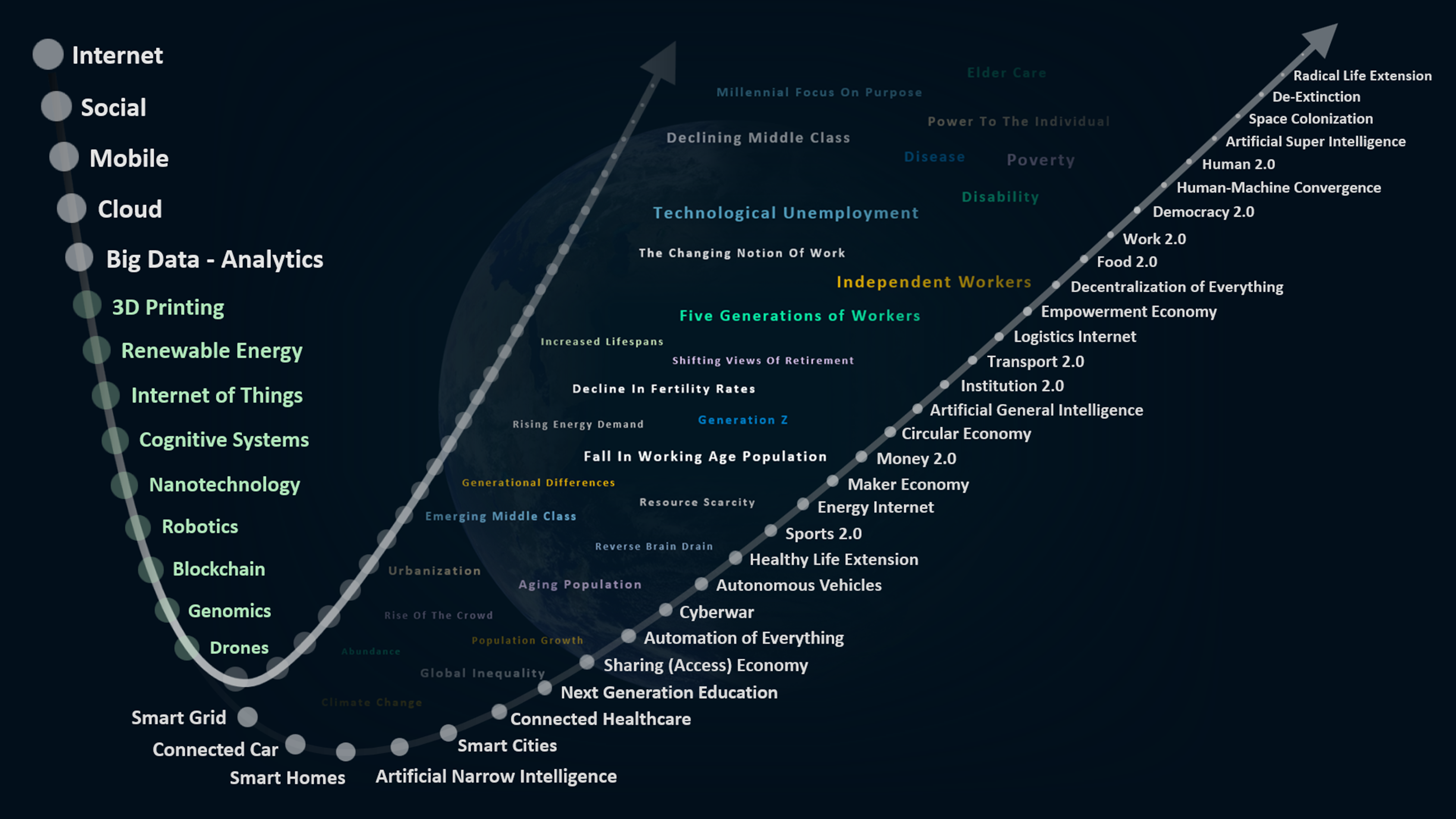
Our exponential pace is due in part to the overwhelming number of building blocks available to innovate. Understanding how these building blocks combine provides a glimpse into possible futures. In this visual, dots connect to portray the building blocks that are likely to extend our healthy lives – a key emerging future scenario.

-
Transforming for the Digital Age
Digital transformation means different things to different people. As I strive to change mindsets, I am sensitive to these distinct perspectives and the individual filters applied to terms like digital and transformation. In my view, Digital has been more narrow than holistic, while in some organizations ERP implementations are considered transformation. So, does digital transformation represent the narrow use of digital technology to improve some aspect of our organization? Or, is it the wholesale change of a set of structures, institutions and paradigms built for a different era? Although I have mostly abandoned the phrase, when I do use it, I mean the latter.
Let’s call it what it is, starting with the term transformation. To truly transform means to change from one nature, substance, form, or condition into another. I’d maintain that the pace of change has made the archaic nature of our industrial era structures, institutions, and management paradigms very apparent. Therefore, to transform in this sense means to change from the nature, form and substance of our industrial past, to a state that is viable for our digital future. Digital is foundational: the building block for which this future state is built upon. Therefore, for clarity sake, a better way to describe digital transformation is:
TRANSFORMATION FOR THE DIGITAL AGE: a change in the nature, substance, and form of our industrial past, to a future state that allows us to thrive in our emerging digital future.
(more…) -
Next Generation Education
The World Economic Forum estimates 65 per cent of children today will end up in careers that don’t even exist yet.
“Individuals and companies that succeed in the future will be those who adopt the philosophy of lifelong learning,” says Nigel Heap, managing director of Hays UK and Ireland. “Businesses that facilitate the resources, tools and time to support learning will not only have employees who are more engaged, but their business will be better placed to face challenges and remain innovative.”
From the Future of Learning
I’ve attempted to link innovation and our well-being via a visual that I’ve shared previously in this forum. It allows us to envision our emerging future and leverage story telling techniques to describe it in ways that become actionable. One of the most critical aspects of this emerging future in my humble opinion is the future of learning and education.
Reimagining Education
Our education system must prepare individuals for the world that is, not the one that was. It must ensure that those educated embody the qualities and competencies essential to life in a society very different than our industrial past. Among them are: creativity, critical thinking, innovative thinking, curiosity, social intelligence, a collaborative spirit, adaptability, entrepreneurial spirit, connecting dots, and knowing how to ask the right questions. Our need for life-long learning and unlearning drives us to reimagine education and transform through combinatorial innovations that leverage AI, Mobile, Cloud, Virtual Reality, Augmented Reality, Big Data, and more. Some of the facets of next generation education include:
-
What are your thoughts about the Future?
I had the pleasure of developing an online thought leadership course focused on our emerging future back in May of this year. I had the added pleasure of working with futurists Gerd Leonhard, Gray Scott, and Chunka Mui, along with several industry leaders. The free Thought Leadership Course is available through May of next year. The course has been invaluable to me, as it provided a platform for dialog about our emerging future. I was thrilled with the thought provoking dialog that occurred through our moderated forum. For all those that participated thank you.
During the two week course, several poll questions were positioned to help us understand how the community is feeling about critical topics like ethics, our economy, and the likely transformative period that lies ahead. Here are the questions and their responses. There is plenty of time to take the course and add your voice to the conversation.
-
A Shift to Purpose and Well-Being
Singularity University has been talking about purpose for some time now. They describe a focus that is audaciously big and aspirational, causing significant transformation to an Industry, community, or the planet. There is a clear “why” behind the work being done, something that unites and inspires action. They call this a Massive Transformative Purpose.
A focus on purpose has a motivating effect with the potential to trigger incredible outcomes. A proven approach in high-growth organizations according to Singularity University, with a focus on purpose in common across the 100 fastest growing organizations. In an era that challenges much of our belief system, an aspirational quality of purpose is a mechanism that helps us think differently. Shared passion within communities and shifting generational views of mission-driven work can fuel the fires of purpose. An organizational focus on purpose is a vehicle for attracting and retaining top qualified talent. A purpose that is aspirational and focused on creating a different future is what ignites passion in individuals and groups; it’s what engages people’s hearts and minds to work together to realize their goal. Breakthroughs in science and technology can be linked to the deeply unifying and motivating ability of purpose. Setting out to solve big problems brings purpose and meaning to work. The more we organize around purpose, the better the outcomes and the more fulfilled we will be with our work.
-
The Singularity: Connecting Dots
I have found that the metaphor “Connecting the Dots” is a good way to think about the emerging future. With the sheer number of dots emerging, and the pace at which they advance, we are challenged both by the number of dots, and the speed at which they emerge and Intersect. These dots are combining to form virtuous cycles; complex chains of events that reinforce themselves through feedback loops. Visualizing both the connections and the cycles is one approach to finding the signal through the noise.
-
Mary Meeker: Internet Trends 2017
Mary Meeker recently delivered her now famous Internet Trends Report for 2017. She covered:
- Global Internet Trends
- Online Advertising and Commerce
- Interactive Games
- Media and Distribution Disruption
- The Cloud and Accelerating Change Across Enterprises
- China Internet and the Golden Age of Entertainment and Transportation
- India Internet
- Healthcare Digital Inflection Point
- Global Public / Private Internet Companies
-
The Future Ain’t What It Used To Be
For those that have taken the thought leadership course focused on our emerging future, thank you. For those that may have interest, the course will run for foreseeable future. In this post from last year, I summarized the key messages from the course. It has been updated to reflect the progression of our emerging future.
Yogi Berra is credited for once saying that the future ain’t what it used to be. What a perfect way to describe what is coming: a complete change in the way we think about the future. Our journey to the future begins with a look back. A convergence of multiple forces during a special century following the U.S. Civil War established the standard of living in developed economies. Some believe that we will never see a convergence of forces as dramatic and impactful as that which occurred during this period. I pulled this wheel together to capture that convergence across the various areas of our well-being, leveraging the work of economist Robert J. Gordon. I captured his thinking in a recent post titled Revolution and the Innovation Wheel.
-
The Timing of Future Scenarios
Timing. It’s one of the most difficult facets to consider when thinking about the future. We know that convergence across societal, political, economic, science and technological forces is creating many future scenarios. We also know that enablement is happening at an exponential pace. Some believe (present company included) that the coming macro-level tipping point is likely to impact humanity on a scale only experienced twice in human history (hunter-gatherer to agriculture and agriculture to industrial). There will be many micro-level tipping points on the journey towards an automated society – and the timing of those tipping points is impossible to predict.