
Recap from Last Post
I opened this series by exploring why the world feels unsettled in ways that don’t fit the usual explanations. I introduced the idea of systemic change: moments when multiple parts of civilization become active at the same time, pushing and amplifying one another. I described today as a phase of compression, where pressures build across domains faster than old structures can absorb them. This post will bring that idea down to everyday experience. What do phase transitions feel like in normal life?
A Quiet Build-Up Before the Snap
Most of the time, change moves in a straight line. A workplace reorganizes, a neighborhood evolves, a new tool or idea slowly becomes part of daily life. We barely notice these shifts because they follow a familiar rhythm.
Then there are the other moments — the ones that feel different. Pressures don’t just add up; they begin to converge. Patterns grow tighter. Small things escalate quickly. The world feels “packed,” even if nothing dramatic is happening. It’s the same calm-before-the-boil moment you see when a pot of water sits still right up until it begins to steam.
You can feel this build-up long before you can describe it. It shows up in subtle frustrations: the calendar that keeps spilling over, the workday that becomes harder to predict, the sense that yesterday’s routines no longer fit today’s reality.
The Physics of Social Change
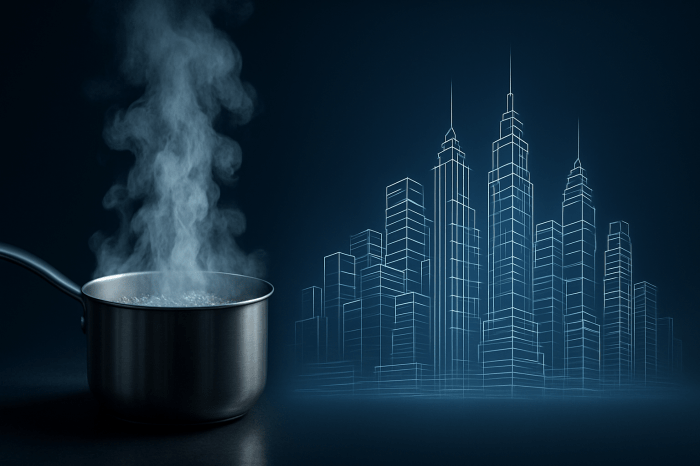
In physics, a phase transition occurs when pressure or heat builds to a point where the system can no longer remain in its current state. Ice melts. Water turns to steam. For long stretches, nothing appears to change. Then, at the threshold, everything reorganizes at once.
Civilizations behave the same way. Long periods of gradual change give way to shorter intervals where relationships, norms, and institutions shift rapidly. Pressures that once felt separate — technological, social, economic, environmental — start to reinforce one another. A trigger that would have produced a small ripple a decade ago can suddenly produce a wave.
Linear Change vs. Phase Transition
To make this clearer, here’s how the two patterns differ:
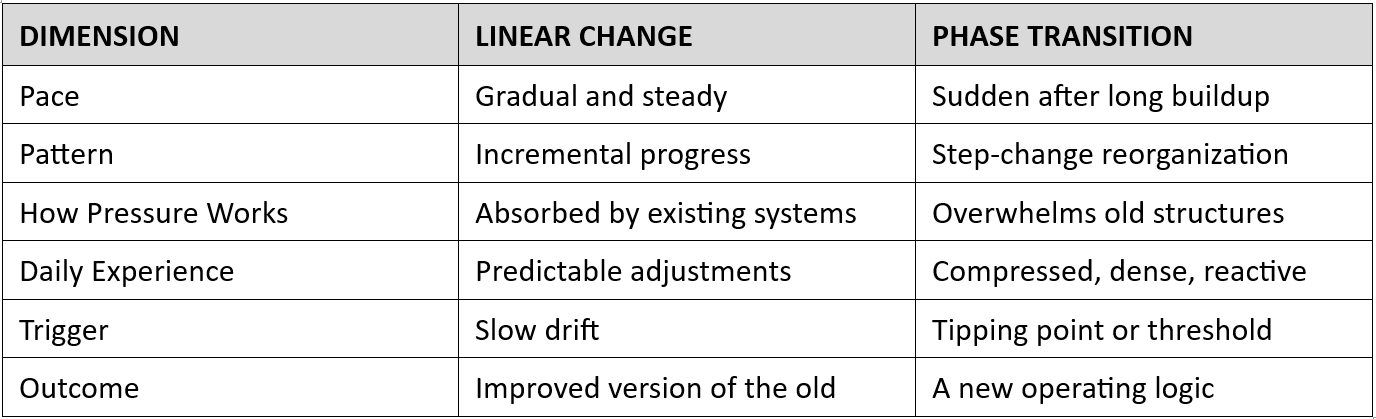
Phase transitions feel dramatic not because everything collapses, but because everything rearranges.
What Compression Feels Like Day to Day
When a system nears a threshold, people experience it in ways that are surprisingly familiar:
- Days feel full even when nothing major has changed
- Routines break more easily
- Problems spread faster across unrelated parts of life
- Institutions feel slower or out of sync
- Conversations repeat the same question: “Why does everything feel harder to plan?”
This is the everyday texture of compression. It’s not chaos. It’s density. Here’s a practical way to see the connection between system behavior and personal experience:
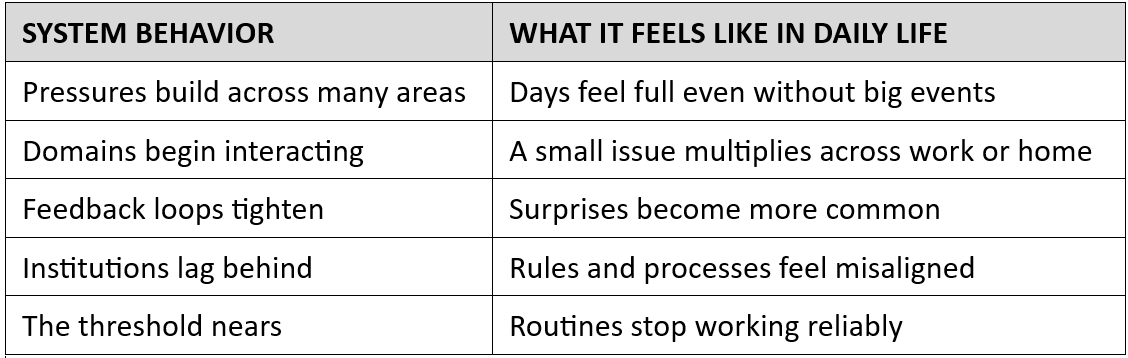
Compression is simply the point where everything sits closer together.
Why Thresholds Don’t Announce Themselves
One of the tricky things about phase transitions is that they rarely start with a dramatic moment. They begin with long, quiet accumulation. A system absorbs pressure until it can’t. Then the relationships inside the system change form.
You see this in everyday places:
- A school system slowly adds digital tools until the mix becomes too complex to manage with old routines.
- A business grows more interdependent until small workflow issues suddenly create major bottlenecks.
- A community adapts to change for years until one event forces a rapid renegotiation of how it works.
None of these are signs of collapse. They’re signals that the system is operating at the edge of its old design.
How to Recognize the Threshold
Thresholds show up not as dramatic failures, but as patterns that repeat across different parts of life. Here are some common signals:
- Workflows run near capacity even on “normal” day
- Minor disruptions ripple outward instead of staying local
- Coordination takes more effort than it used to
- Simple problems now require multi-step solutions
- Decisions feel more consequential because the system is tightly coupled
- People describe life as “faster,” “fuller,” or “more reactive”
These are the signals of a system preparing to reorganize.
Why This Moment Feels Different
Looking back across history, phase transitions share a consistent pattern: multiple forces begin moving together, and their interactions matter more than the forces themselves. That is what we’re experiencing now. Technology accelerates. Demographics shift. The planet grows more volatile. Economies become deeply interdependent. Knowledge spreads instantly. Culture fragments and reforms. These pressures don’t move one at a time; they move together, tightening the system. This isn’t just faster change. It’s compressed change — the precondition for a shift in the underlying logic of how the world works.
Everyday Scenes of Compression
To anchor this further, here are three relatable examples.
A school district adopts more technology each year. Teachers spend more time coordinating across systems. Students navigate platforms that don’t quite fit together. The system works — until one more change forces a wholesale rethink of how learning flows.
A mid-sized business scales quickly. Teams become more interdependent. Small missteps start to create larger slowdowns. The organization isn’t failing; it’s outgrowing its structure.
A neighborhood experiences population turnover. The mix of expectations, traditions, and needs hits a point where small disagreements turn into bigger conversations about identity and priorities. It’s not conflict — it’s renegotiation.
These are ordinary phase transitions. You feel them before you name them.
What Compression Prepares Us For
Compression is not the end of a system. It’s the moment before its next form. If linear change is about improving what already exists, a phase transition is about rearranging how things relate to each other — how we produce, coordinate, decide, and make meaning. The next stage is not predetermined. But compression tells us that the old patterns won’t hold forever. The system is searching for a new configuration.
Coming Next: The Pattern Behind These Shifts
In the next post, I’ll step back and look at the larger rhythm that sits underneath moments like the one we’re living through. Big shifts in history—whether in cities, industries, or entire civilizations—tend to follow a similar sequence. Pressure builds, systems tighten, a moment of instability appears, and the structure eventually reshapes itself.
This isn’t about predicting the future. It’s about understanding the pattern that keeps showing up whenever the ground starts to move. Seeing that arc makes the present moment easier to interpret and gives context for what may come next.
THE SERIES TO DATE
Discover more from Reimagining the Future
Subscribe to get the latest posts sent to your email.
 Reimagining the Future
[…] at the same time: all seven domains of civilization are active and amplifying one another. In the second post, I described the tightening that happens before major shifts — the compression that makes events […]
LikeLike
[…] the first post, I described the sense that the world’s operating logic is turning over. In the second, I explored what that feels like in daily life — the tightening, the pressure, the sense that […]
LikeLike
[…] posts introduced the sense that the world’s operating logic is beginning to shift, explored what compression feels like in daily life, and laid out the four-stage pattern that has shaped every major […]
LikeLike
[…] explored the sense that something in the operating logic of civilzation is shifting. We looked at phase transitions, the four-stage pattern that repeats across history, and the seven domains that structure […]
LikeLike
[…] the first six posts, I built the foundation needed to understand how civilizations change. I explored the seven domains that shape collective life, the forces that move within them, the […]
LikeLike
[…] Why Everything Feels Like It’s Changing At Once […]
LikeLike
[…] Why Everything Feels Like It’s Changing At Once […]
LikeLike
[…] Why Everything Feels Like It’s Changing At Once […]
LikeLike
[…] Why Everything Feels Like It’s Changing At Once […]
LikeLike
[…] Why Everything Feels Like It’s Changing At Once […]
LikeLike