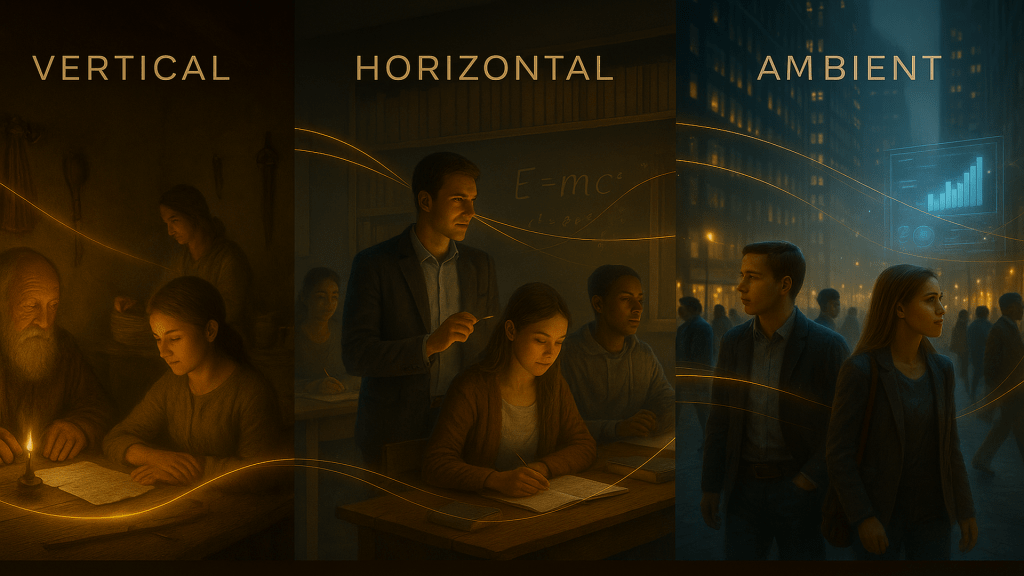
For most of human history, learning was vertical. Knowledge flowed downward, generation to generation, through families and traditions. A farmer taught his child the rhythms of the land, a craftsperson trained an apprentice at the workbench, a parent passed on rituals of faith and culture. The family was the classroom, and survival depended on what could be remembered and repeated.
That changed with the rise of horizontal learning. The invention of writing, the spread of books, and the creation of schools and universities allowed knowledge to move sideways—between peers, across communities, and eventually around the world. In this model, learning became collaborative and cumulative. A student could learn not only from their family, but from teachers, classmates, and the collective wisdom of institutions. Today, digital platforms extend this horizontal flow to every corner of the globe, making it possible to learn nearly anything from nearly anyone.
But horizontal learning came with a trade-off. As knowledge expanded, so did specialization. Disciplines became narrower, expertise more siloed. The polymath – those rare individuals who connected across fields – grew rarer. Modern society often rewards depth at the expense of breadth, leaving the big-picture connections underserved.
Now we may be entering a third phase: ambient learning. Instead of knowledge flowing downward (vertical) or sideways (horizontal), learning begins to surround us. It is embedded in daily life, supported by AI, sensors, and connected environments. Imagine walking through a city where augmented reality layers guide your understanding, or workplaces where intelligent systems coach you in the moment of need. In an ambient world, learning is continuous, context-aware, and personalized – less about sitting in classrooms and more about navigating living ecosystems of knowledge.
Definition of Ambient Learning: Ambient Learning is a systemic shift where learning is no longer bound to schools, classrooms, or formal instruction. Instead, it becomes seamlessly embedded in the environments, technologies, and social systems people interact with daily. Knowledge flows continuously – through workplaces, communities, cities, media, and personal devices – so that learning feels natural, contextual, and omnipresent, much like electricity powers daily life without being noticed. Ambient Learning also includes embodied mentors – context-aware holograms and projected tutors (real or synthesized) that appear where and when learning is useful, turning any environment – living room, shop floor, museum – into a moment of guided discovery.
This shift has profound implications. It suggests the possibility of reviving something we lost: polymathic thinking. In an ambient environment, AI can shoulder the burden of depth, freeing humans to move more fluidly across disciplines. Instead of rare geniuses stitching ideas together, we may all become partial polymaths – capable of connecting dots across fields with the help of distributed intelligence.
The story of education, then, is not just about schools or technologies. It is about the way knowledge itself moves:
- Vertical: inherited through families.
- Horizontal: shared across institutions and peers.
- Ambient: embedded everywhere, always on.
Understanding this arc helps us prepare for what comes next: a world where learning is not an event, but an atmosphere – one that surrounds and shapes us every moment of our lives.


Leave a Reply