
History doesn’t just repeat itself because we forget the facts. It repeats because we lose the wisdom of those who lived through it. When the last voices of a generation fade – those who endured war, depression, migration, or reinvention – we lose more than stories. We lose anchors. We lose quiet guidance in moments of moral fog. We lose the ability to ask: “What would you have done?”
But what if we didn’t have to?
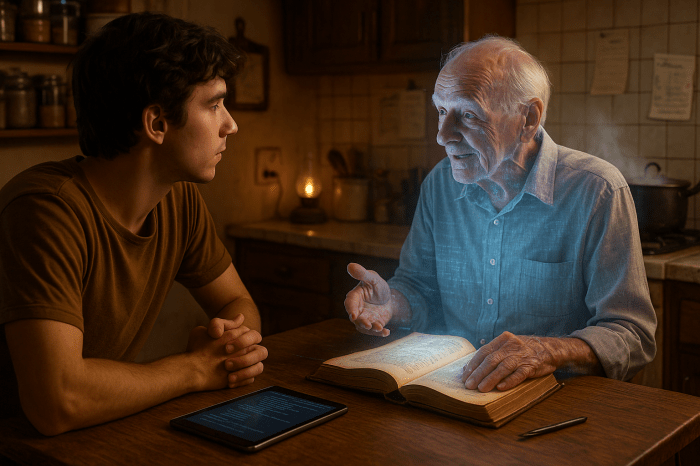
Imagine if your grandfather’s voice, life lessons, values, and humor were preserved in a digital twin – not a gimmicky avatar, but a living interface built from his voice recordings, stories, and reflections. After he passes, you could still ask him questions. You could revisit the conversations you never got to have. “How did you stay hopeful during the war?” “What mattered most when the world was uncertain?” These aren’t questions for history books. They’re questions for the people who shaped us – whose absence we feel most when the world is on edge.
Digital twins have long been thought of as tools for machines, buildings, or supply chains. But what if they became stewards of culture, identity, and ancestral knowledge? In this future, AI is not a replacement for human experience – it’s a carrier of it. It enables us to rehearse the past, not just record it. It gives the next generation a chance to listen – to really listen—to those who came before them. It’s not immortality. But it’s continuity.
Nowhere is this more poignant than in the world of food. Recipes passed down by voice or muscle memory – how to feel when the dough is ready, when the spices bloom, how to serve a dish with dignity – often vanish in a single lost generation. Communities around the world are beginning to digitize and preserve their culinary traditions, not just with text, but with audio, video, and cultural nuance. AI models trained on elder voices, regional flavor profiles, and ancestral techniques can recreate dishes that don’t just taste authentic – they feel like home. This is more than nostalgia. It’s cultural resilience in edible form.
In this world, food becomes a bridge to memory, and digital twins become more than simulations. They become a defense against amnesia. Against the loss of values, identities, and the subtle survival strategies that families have refined over centuries. When we capture the wisdom of elders – not just what they did, but how they thought – we begin to bend the arc of history in a new direction. We stop blindly repeating. We start remembering forward.
Because the question isn’t whether AI can learn. It’s whether we choose to teach it the things worth remembering.
Discover more from Reimagining the Future
Subscribe to get the latest posts sent to your email.
 Reimagining the Future