
I introduced the notion of pressure points and catalysts in an earlier post. Here are the results of my analysis.
Introduction
The trajectory of human civilization is not merely a linear progression but a complex interplay of forces that build, converge, and occasionally erupt into periods of profound transformation. Understanding these dynamics requires a framework centered on Pressure Points and Catalysts – concepts crucial to comprehending how global systems evolve and redefine themselves.
This framework encompasses seven interrelated domains critical to systemic analysis: Science, Technology, Society, Geopolitics, Economy, Environment, and Philosophy. Each domain interacts dynamically with the others, influencing the overall trajectory of global transformation.
Each domain has a distinct yet interrelated role, forming the analytical foundation for systemic foresight:
- Science provides the foundational understanding and discovery of phenomena, shaping our knowledge base and opening avenues for innovation.
- Technology translates scientific discoveries into practical tools and solutions, dramatically altering our capabilities and reshaping societies.
- Society reflects human behaviors, cultural dynamics, and social structures, influencing and being influenced by systemic pressures and transformations.
- Geopolitics governs international relations, power dynamics, and conflicts, significantly impacting global stability and the ability to respond collectively to crises.
- Economy underpins resource allocation, wealth distribution, and financial stability, critically affecting society’s resilience and adaptability to systemic stresses.
- Environment encompasses ecological systems and natural resources, whose health fundamentally determines humanity’s sustainability and survival.
- Philosophy addresses ethical considerations, values, and worldviews, guiding decisions about the future direction of humanity amidst complex systemic challenges.
Generative Pressures create new possibilities, foster innovative solutions, and provide momentum toward addressing existing crises, representing the system’s adaptive capacity. These pressures often act as counterbalances to fracturing pressures, offering resilience and renewal, even amid escalating systemic stress.
Together, these domains create a comprehensive framework essential for analyzing, anticipating, and strategically responding to systemic pressures and transformative catalysts.
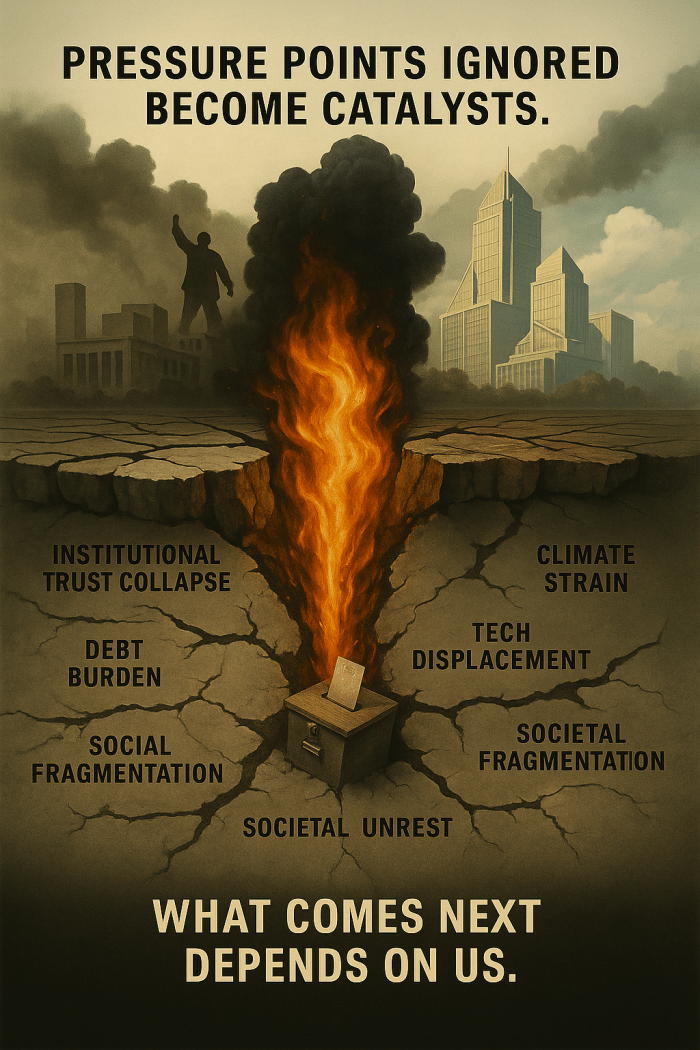
Defining the Dynamics: Pressure Points and Catalysts
At its core, this framework posits that change arises from the interplay of Pressure Points and Catalysts.
Pressure Points are ongoing, accumulating stresses that progressively erode the resilience and stability of global systems, ultimately leading to systemic instability. They represent persistent forces that build over time rather than singular, sudden events. Pressure points create systemic fragility by constraining policy flexibility, fragmenting social cohesion, and disrupting established norms. Their cumulative nature means their combined effect can exceed the sum of individual impacts, leading to “systemic stress”.
Pressure points are further categorized into two primary types:
Fracturing Pressures are forces that actively break down existing systems, erode trust, and diminish social cohesion. Their disruptive and destabilizing impacts lead to fragmentation, conflict, and a reduction in adaptive capacity. Notably, the erosion of “trust” acts as a multiplier of other fracturing pressures, complicating consensus-building and crisis responses.
Catalysts are extraordinary, high-impact events resulting from the accumulation of systemic pressures. These events trigger rapid, profound shifts, fundamentally redefining institutions and marking the emergence of a new systemic state. Catalysts are not random but are predictable consequences of chronic stress accumulation. They represent significant inflection points where the old order is fundamentally replaced or dramatically reconfigured.
The distinctions between Pressure Points and Catalysts can be summarized as follows:
- Nature: Pressure points are continuous, accumulating forces (e.g., ongoing debt, climate change). Catalysts are discrete, transformative events (e.g., economic collapse, geopolitical conflict).
- Temporality: Pressure points build gradually over years. Catalysts occur at specific moments within a potential “timing window.”
- Impact: Pressure points gradually weaken system resilience. Catalysts trigger rapid, profound, often irreversible transformations.
- Relationship: Pressure points increase the likelihood of catalysts. Catalysts manifest as outcomes of accumulated pressures.
The presence of both fracturing and generative pressures within the same timeframe creates a dynamic tension, suggesting the future is not predetermined decline but a contested space where outcomes depend on the interplay of these opposing forces.
Historical Manifestations of Pressure Points and Catalysts
History demonstrates numerous instances where accumulated pressures culminated in significant catalysts:
The First Industrial Revolution emerged as a catalyst driven by mounting pressures such as population growth, limitations of manual labor, and rising demands for goods. This revolution, propelled by innovations like the steam engine, redefined economies, industries, and societal structures, marking a systemic reset.
The Second Industrial Revolution similarly acted as a catalyst, responding to pressures such as inefficient production processes and the rising demand for agricultural productivity. Innovations like the Haber-Bosch process fundamentally transformed agriculture, industry, and global population dynamics.
World War I represented a systemic reset triggered by accumulated pressures, including geopolitical rivalries, imperialistic ambitions, and complex alliances. The catalyst was the assassination of Archduke Franz Ferdinand, which ignited widespread conflict and led to profound shifts in global governance and societal norms.
The catalyst event of the Great Depression was the stock market crash of 1929, a direct result of pressures like rampant speculation, excessive debt, and a fragile banking system. This event initiated sweeping economic reforms and restructuring.
World War II was catalyzed by unresolved pressures from World War I, economic instability, and the rise of authoritarian regimes. Specific catalyst events, such as the invasion of Poland and later the attack on Pearl Harbor, triggered global conflict and ultimately reshaped international relations and economic structures.
The Re-emergence of Pressure and Catalyst Dynamics (2025–2030)
From 2025 to 2030, we witness intensifying systemic pressures, potentially culminating in transformative catalysts. These pressures and catalysts span multiple domains:
Fracturing Pressure Points
- 2025: Institutional Trust and Social Cohesion Fracture, Debt and Economic Stagnation, Tech Disruption in Labor and Privacy, Climate and Environmental Shocks
- 2026: Escalating Climate Disasters, Geopolitical & Cyber Conflict Surge, Technological/Economic Inequality, Social Unrest and Identity Polarization
- 2027: Global Recessionary Spiral, Major International Crisis, Accelerated Environmental Tipping, Cultural/Ethical Crisis
- 2028: Systemic Supply-Chain and Trade Fragmentation, Fiscal/Financial Shockwave, AI and Robotics Ubiquity, Extremist Polarization Peaks
- 2029: Major Climate Catastrophe, AI Governance Crisis, Election Turmoil and Systemic Distrust, Global Migration Crisis
- 2030: Cascade of System Failures
Generative Pressure Points
- 2025: Early Experiments Offer Hope, Communities Step In as Systems Fail
- 2026: Solutions Patch Together from the Bottom Up, People Rebuild Trust Locally
- 2027: New Possibilities Emerge in Small Places, Big Questions Spark Ethical Action
- 2028: Networks Built on Trust Begin to Grow, Unlikely Alliances Take Root
- 2029: Discoveries Applied to Grand Challenges, New Builders Replace Broken Systems
- 2030: People Redesign How Decisions Are Made, Systemic Reinvention Emerges
Generative pressures represent the potential seeds for new paradigms, significantly influencing whether catalysts lead to breakdown or positive transformation.
Catalyst Events (2025–2032)
- Sustained Societal Unrest (2026–2030): As institutional trust collapses, economic pressures mount, and identity-based fragmentation deepens, sustained societal unrest becomes a flashpoint. Mass mobilizations, general strikes, civil disobedience, and escalating protest movements – especially when catalyzed by trigger events such as police violence, contested elections, or environmental crises – can destabilize governance structures. If widespread and prolonged, such unrest can precipitate regime changes, constitutional crises, or systemic shifts in governance models. When compounded by other pressures, it becomes a high-impact, system-resetting catalyst.
Catalysts emerge from peak accumulated pressures, marking transformative events:
- Major Economic Collapse (2028–2030): Driven by debt crises, recessionary spirals, fiscal shocks.
- Geopolitical War/Alliance Breakup (2026–2029): Resulting from geopolitical tensions and cyber conflicts.
- Technological Disruption Event (2029–2031): Triggered by transformative AI or biotech events.
- Environmental Tipping-Point Catastrophe (2029–2032): Culminating from escalating climate impacts.
- Pandemic/Biocrisis or Public Health Break (2025–2027): Linked to biotech advancements and global connectivity vulnerabilities.
Interpreting Systemic Dynamics and Future Implications
One of the most persistent patterns in human history is our tendency to ignore visible pressure points. Despite clear signs of stress – whether in the economy, environment, society, or geopolitics – these signals are often dismissed, downplayed, or deferred until they accumulate to a breaking point. This behavior is rooted in human nature and reinforced by systemic inertia. Normalcy bias, short-term thinking, political gridlock, and institutional rigidity often prevent proactive responses to emerging pressures. As a result, what could have been manageable becomes unmanageable, and catalysts emerge not as surprises, but as the inevitable consequences of ignored warnings.
This historical dynamic helps explain why catalysts are rarely avoided. The signs are there, but our systems – and often our mindsets – are not designed to respond to slow-building complexity. Instead, pressure accumulates until a catalyst forces systemic realignment. This pattern repeats not because the catalysts are unforeseen, but because the pressures leading to them were seen and still left unaddressed.
At the same time, generative pressure points have always emerged alongside fracturing ones. The invention of the steam engine during the First Industrial Revolution, advances in science and medicine during global conflict, or the rapid growth of renewable energy technologies today – all represent the system’s capacity for renewal and adaptation. However, these generative forces have historically proven insufficient to prevent catalysts from unfolding. Their existence provides the raw material for rebuilding, but not necessarily the mechanisms for averting systemic collapse.
Generative pressures, in essence, are seeds of transformation – but without deliberate cultivation, institutional support, and strategic foresight, they often fail to counterbalance the momentum of systemic stress. This underscores the importance of not only identifying generative forces but building the capacity to integrate and scale them before catalysts emerge. Recognizing the interplay of Pressure Points and Catalysts across domains enables strategic anticipation rather than reactive management. Understanding systemic interdependencies helps identify leverage points for intervention, building resilience against escalating challenges.
Visualizations such as possibility chains and catalyst timelines can enhance understanding, clarifying systemic interactions.
Conclusion
This framework emphasizes that the future is not random but shaped by present trends. By anticipating systemic vulnerabilities and potential catalysts, decision-makers can proactively build resilience, influencing whether upcoming transformations lead to decline or renewal. Ultimately, proactive governance and informed strategic planning foster greater stability in an increasingly volatile and complex world.
Discover more from Reimagining the Future
Subscribe to get the latest posts sent to your email.
 Reimagining the Future
Important artic
LikeLike