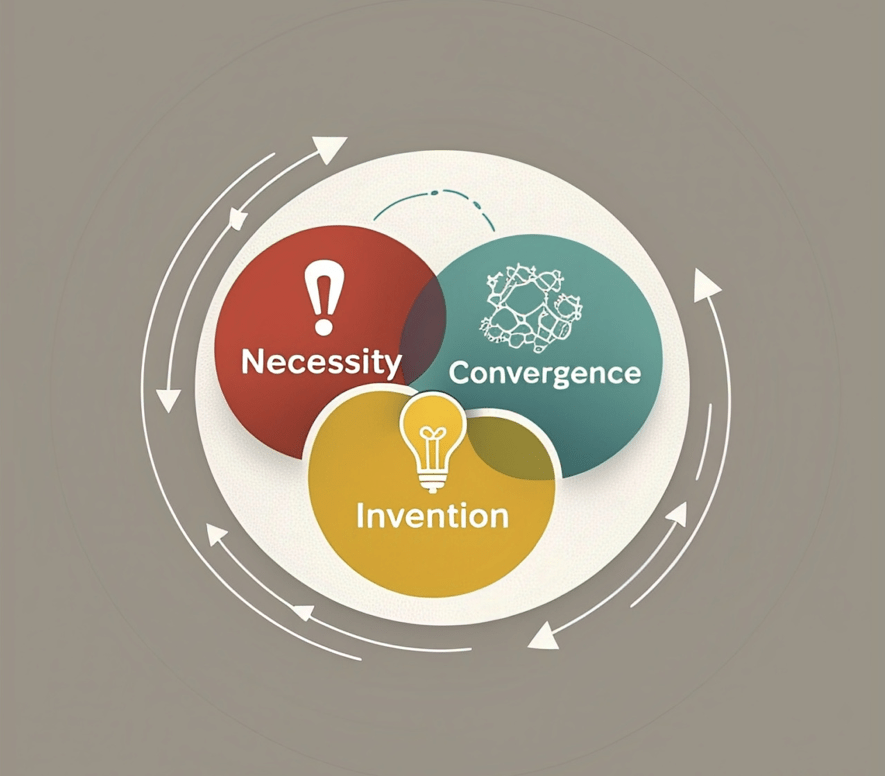
Throughout this four-part series, we’ve seen how necessity sparks invention – and together, they transform our society in profound ways. Today, our world faces an array of urgent challenges, from climate change and demographic shifts to economic and geopolitical instability, cybersecurity threats, and healthcare crises. These pressures are igniting a fresh wave of convergence, where inventive and innovative responses to pressing needs are poised to reshape our future. As we enter this transformative era, the cycle of necessity and invention reminds us that bold, purpose-driven invention and innovation is our best path forward.
Building on These Lessons: A Convergence Narrative for Our Future
Looking ahead, the convergence of necessity and invention offers powerful tools to tackle our grand challenges. Consider climate change: the urgent need to reduce emissions is driving innovations in renewable energy, carbon capture, and smart grid technologies. These solutions are not isolated; they converge to form a sustainable energy ecosystem. Solar and wind power now integrate seamlessly with smart grids that optimize energy distribution, while carbon capture systems work in tandem with industrial processes to offset emissions. Cities like Copenhagen are already pioneering this integrated approach, targeting carbon neutrality by 2025.
Similarly, demographic shifts – such as aging populations and rapid urbanization – are prompting a convergence of advanced robotics, AI, and telemedicine. In Japan, where nearly 30% of the population is over 65, robotic caregivers and AI-powered diagnostics are merging with telehealth platforms to ensure that even densely populated urban areas can deliver timely, efficient care. This integrated response not only addresses labor shortages but also elevates the quality of life for aging communities by creating interconnected support systems.
Amid rising economic volatility and growing geopolitical instability, the promise of convergence offers both opportunities and risks. For example, blockchain technology combined with AI-driven analytics is reshaping global financial systems by eliminating intermediaries, enhancing fraud detection, and promoting decentralized, transparent transactions that resist manipulation by powerful state or corporate actors. Concurrently, advanced digital security protocols powered by AI are being deployed to safeguard critical infrastructure – from energy grids to communication networks – against cyber threats in an era of heightened geopolitical tensions.
This synergy has the potential to stabilize global markets and build trust across borders by creating a more secure and resilient digital environment. By fostering transparency and accountability, these convergent technologies can help mitigate the impacts of economic shocks and reduce vulnerabilities that often lead to geopolitical strife. However, without rigorous ethical oversight and robust policy frameworks, these innovations could exacerbate power imbalances, fuel cyber warfare, and even trigger automated warfare – where lethal decisions are made by machines – further destabilizing regions.
The challenge is clear: to harness these transformative tools through international collaboration and ethical governance so that they serve as stabilizing forces – supporting economic recovery and geopolitical resilience – instead of deepening global divides. History shows that when necessity fuels invention, their convergence reshapes society. Yet, as with past transformations, this new convergence must be guided by ethical oversight and equitable policies. Just as the Industrial Revolution brought both prosperity and deep social inequities, the emerging convergence of AI, robotics, renewable energy, and other breakthrough technologies must be designed to benefit everyone – not just a select few. Governments can invest in digital infrastructure for underserved communities, while businesses prioritize inclusive design.
Imagine a world where smart cities, powered by renewable energy, seamlessly integrate healthcare, transportation, and education into a resilient, interconnected ecosystem; where AI and robotics empower aging populations to live independently; and where blockchain secures our financial systems against cyber threats. This is the promise of convergence – a future that is sustainable, resilient, and equitable. The future is not something we inherit; it is something we create together through invention, innovation, collaboration, and a shared commitment to progress. Let us act now to ensure that this convergence drives progress for all.
THE OTHER POSTS IN THIS SERIES
Part One: The Great Productivity Convergence: When Necessity Meets Innovation
Part Two: The Necessity-Invention-Convergence Framework
Part Three: The Converging Forces Of Progress: Necessity, Invention, And Systemic Outcomes


Leave a Reply