
In an era of rapid change, the traditional understanding of literacy has become increasingly insufficient. Historically, literacy was defined simply as the ability to read and write – fundamental skills that enabled individuals to participate in society. However, as Alvin Toffler wisely pointed out, the definition of literacy in the 21st century has expanded far beyond these basic abilities. Today, true literacy encompasses the capacity to continuously learn new skills, let go of outdated knowledge, and acquire fresh perspectives. This shift reflects the profound changes in our world, where scientific and technological advancements, societal shifts, geopolitical tensions, and economic uncertainty are constantly reshaping the demands placed on individuals.
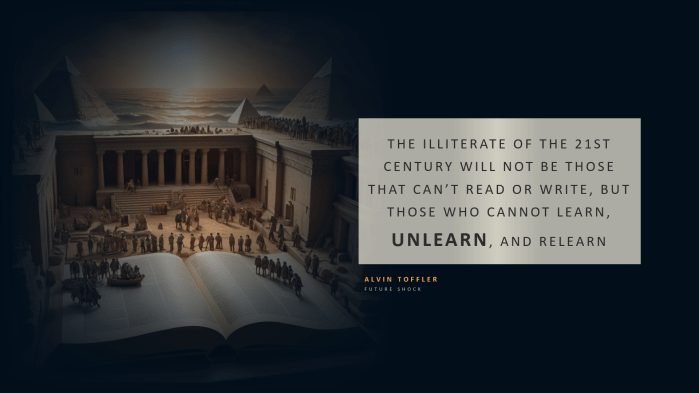
In this dynamic landscape, the ability to “learn, unlearn, and relearn” has become a critical skill set. While learning new information is an essential part of this process, it is the other two components – unlearning and relearning – that truly define the modern learner. Unlearning involves challenging long-held beliefs or methods that may no longer serve us, while relearning is about adopting new perspectives that better align with the present and future. This mindset is crucial as we navigate the disruptive forces of our modern era. The pace of invention, from artificial intelligence to the changing global economy, demands that we not only acquire new knowledge but also adapt our thinking to stay relevant.
Toffler’s vision aligns with Ray Dalio’s perspective on the importance of understanding the broader patterns that shape our world. Dalio, in his book Principles for Dealing with the Changing World Order, emphasizes that “the most important lessons don’t come from one’s lifetime.” This observation reflects his belief that to truly understand and navigate the complexities of the present, we must look beyond our personal experiences and study the historical patterns that emerge across generations. According to Dalio, history provides us with invaluable lessons, as it reveals recurring cycles of prosperity, decline, conflict, and renewal. While an individual’s lifetime captures only a narrow slice of history, examining these long-term trends enables us to recognize larger forces at play in society, from economic shifts to geopolitical transformations.
Dalio’s extensive analysis of historical cycles demonstrates that the rise and fall of great powers, the shifts in economies, and the transformations in social orders are influenced by discernible principles. By studying history, we can understand the conditions that lead to success or failure – economic vitality, military strength, technological innovation, and social cohesion are some of the factors that shape these cycles. For example, Dalio’s examination of past financial crises shows how excessive debt accumulation can lead to economic collapse, providing important insights for today’s policymakers. Similarly, by understanding the triggers of past geopolitical conflicts, we can better navigate the complex diplomatic challenges that arise in an increasingly multipolar world.
Dalio’s work encourages us to adopt an intergenerational view of history. This perspective highlights that the most valuable lessons are those that transcend our immediate experience, offering insights into the fundamental drivers of human behavior and societal change. In a world where technological disruption and global power shifts dominate the conversation, Dalio suggests that a long-term view of history is essential for navigating the complexities of the modern era. By examining historical patterns, we gain the wisdom necessary to make informed decisions and avoid repeating the mistakes of the past.
The integration of these two ideas – the need to be adaptable and the importance of learning from history – offers a comprehensive approach to thriving in today’s world. In order to succeed in a rapidly changing society, we must not only acquire new skills and knowledge but also be willing to discard outdated practices and open ourselves to new ideas. This process of learning, unlearning, and relearning is critical to our ability to cope with the challenges of a possible tipping point on the horizon. At the same time, by studying historical cycles and understanding the broader forces that shape our world, we gain the perspective necessary to anticipate future challenges and navigate an uncertain future with wisdom.
Ultimately, the combination of unlearning and learning from historical insight equips us with the tools to shape a future that reflects the lessons learned from both the past and the present. As we face the complexities of the modern world, we must remember that while science and technology may evolve, the fundamental challenges of human behavior and societal change remain consistent. By embracing a mindset of continuous learning, unlearning, and relearning, and by studying the broader patterns of history, we can better navigate the uncertainties ahead. In this way, both Toffler’s and Dalio’s insights encourage us to develop a literacy that is not just about acquiring information but about cultivating the flexibility and perspective necessary to thrive in a world of constant change.
In addition to Alvin Toffler’s and Ray Dalio’s perspectives on unlearning and the wisdom of historical cycles, two additional works, The Fourth Turning by William Strauss and Neil Howe, and The Fourth Turning Is Here by Neil Howe, offer further valuable insights into understanding the generational dynamics at play in today’s rapidly changing world. These books explore the recurring patterns of societal change that follow a cyclical, generational rhythm, adding depth to the notion that historical understanding is crucial for navigating the present and future.
Strauss and Howe’s The Fourth Turning presents the theory that history moves in predictable cycles, each lasting roughly 80 to 100 years, divided into four “turnings” or generational phases. The “Fourth Turning,” according to their model, is a period of crisis – often marked by societal upheaval and the restructuring of institutions – that inevitably follows the “First Turning” (a period of renewal), “Second Turning” (an awakening), and “Third Turning” (an unraveling). Their theory posits that as one cycle closes, a new crisis emerges, forcing societies to confront long-standing problems and reshape their future.
In many ways, this aligns with the thoughts of Toffler and Dalio, who argue that our rapid pace of change and growing uncertainty signals a period of transition that demands both a fresh perspective and a deep understanding of past cycles. Strauss and Howe’s concept of the “Fourth Turning” suggests that we are living through a time of generational crisis – a time when the existing social order is breaking down and a new one must be constructed. This period is not just about the emergence of new technologies or the upheaval of industries, but also a time when older structures and beliefs are challenged, compelling society to reassess its values, institutions, and even the roles of individuals within the collective. This societal “restructuring” requires individuals and leaders to be adaptable, to unlearn old habits, and to relearn how to thrive in a new reality.
Neil Howe’s The Fourth Turning Is Here takes this idea even further, arguing that the Fourth Turning is not just an abstract concept but an ongoing, real-time crisis that is actively reshaping the world today. Howe points to growing polarization, economic instability, and cultural divides as signs that we are already in the midst of this generational turning. His analysis suggests that we are seeing a period of intensified conflict – whether in politics, economics, or culture – that reflects the tensions of a society in crisis. Just as Toffler emphasizes the need for unlearning and adaptability, and Dalio stresses the importance of understanding historical cycles, Howe’s argument underscores the urgency for individuals to not only adapt but also take an active role in shaping the next phase of history. The Fourth Turning, as Howe frames it, challenges individuals and institutions to step into leadership roles and provide solutions that will guide society through the crises ahead.
The insights from The Fourth Turning and The Fourth Turning Is Here build upon Toffler’s call for unlearning and Dalio’s emphasis on learning from historical patterns. The books suggest that we are not merely witnesses to change but active participants in it, tasked with navigating a time of crisis and transformation. To truly succeed in this environment, we must embrace both a mindset of flexibility and a historical lens that understands the cycles of human society. The ability to learn, unlearn, and relearn – while understanding the cyclical nature of history becomes a powerful framework for addressing the challenges of the present and anticipating the demands of the future.
In this light, our literacy in the 21st century must go beyond the acquisition of knowledge and include the capacity to understand where we are in the historical cycle. Whether we are in the midst of a technological revolution or a cultural crisis, the lessons of the past – those learned from both the rise and fall of empires and the recurring cycles of societal change – offer invaluable guidance. By embracing this intergenerational wisdom and cultivating the adaptability to navigate crises, we can position ourselves not only to survive but to thrive in an increasingly complex and unpredictable world.
As we face the future, the integration of unlearning, historical insight, and a deep understanding of generational cycles offers a holistic approach to facing the inevitable crises and transformations that lie ahead. Toffler’s emphasis on unlearning, Dalio’s focus on long-term historical patterns, and Strauss and Howe’s cyclical view of societal change all converge on one key point: the ability to unlearn, relearn, adapt, and leverage the wisdom of history is essential for those who wish to navigate and shape the future in the face of constant change.
Discover more from Reimagining the Future
Subscribe to get the latest posts sent to your email.
 Reimagining the Future
[…] breakthroughs. It involves anticipating disruptions, nurturing a culture of continuous learning and unlearning, and ensuring that innovation empowers rather than disenfranchises. Above all, it calls for […]
LikeLike
[…] pressures. Recognizing what to let go of – and when – becomes essential. The process of unlearning should therefore not merely be a reaction to collapse but a deliberate step toward building a more […]
LikeLike