Knowledge is the engine that drives human development – and it has been throughout history. Knowledge expanded in the hunter-gatherer days with the invention of fire. In those days, a human obtained all its food by foraging. Although the source of food did not change, fire allowed humans to cook food and consume more calories. The human brain expanded with this caloric increase, and soon we invented language – the first in a series of innovations that drove the growth of knowledge.
Tag: Technology
-
Visualizing Our Emerging Future – Revised
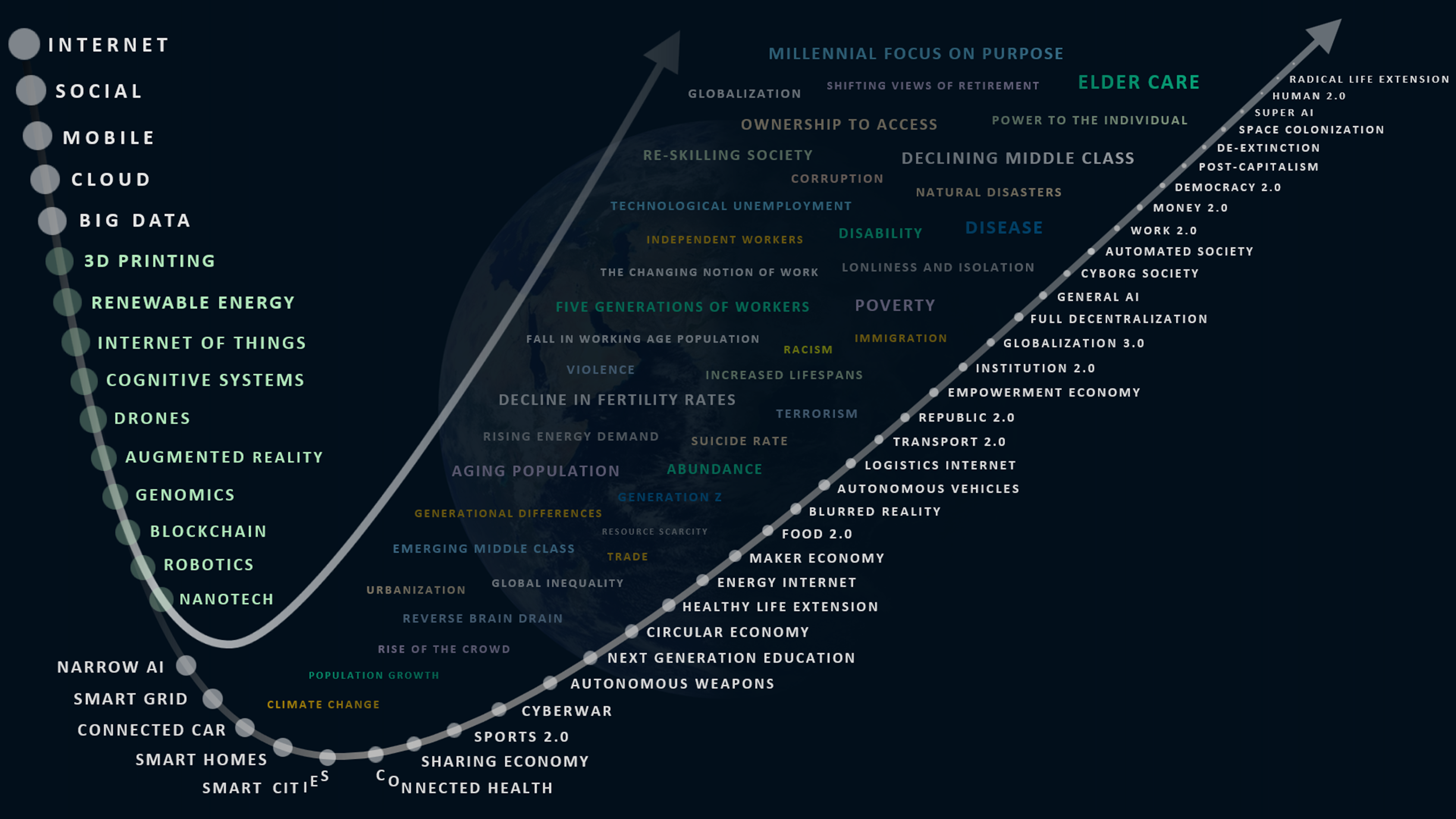
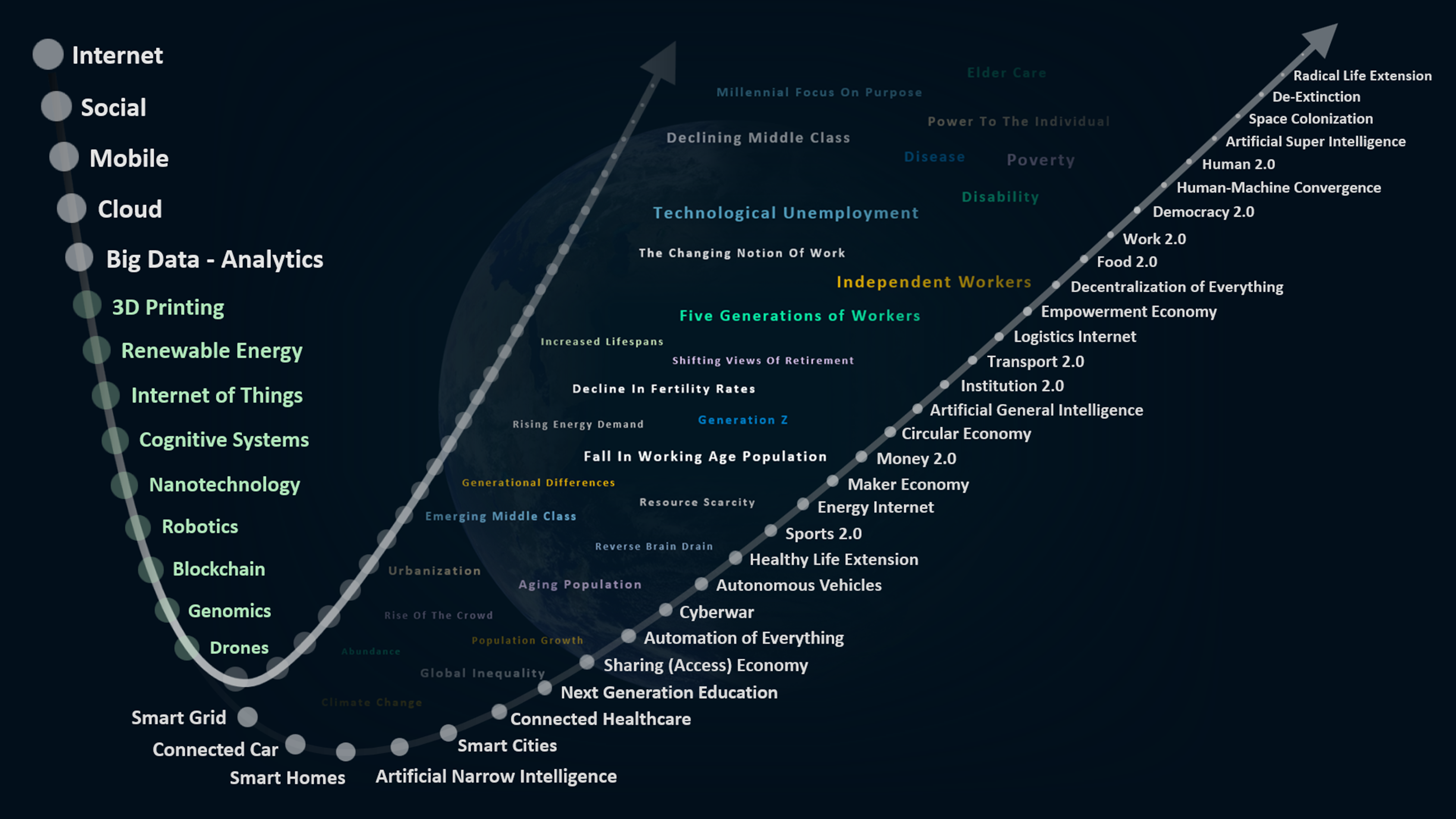
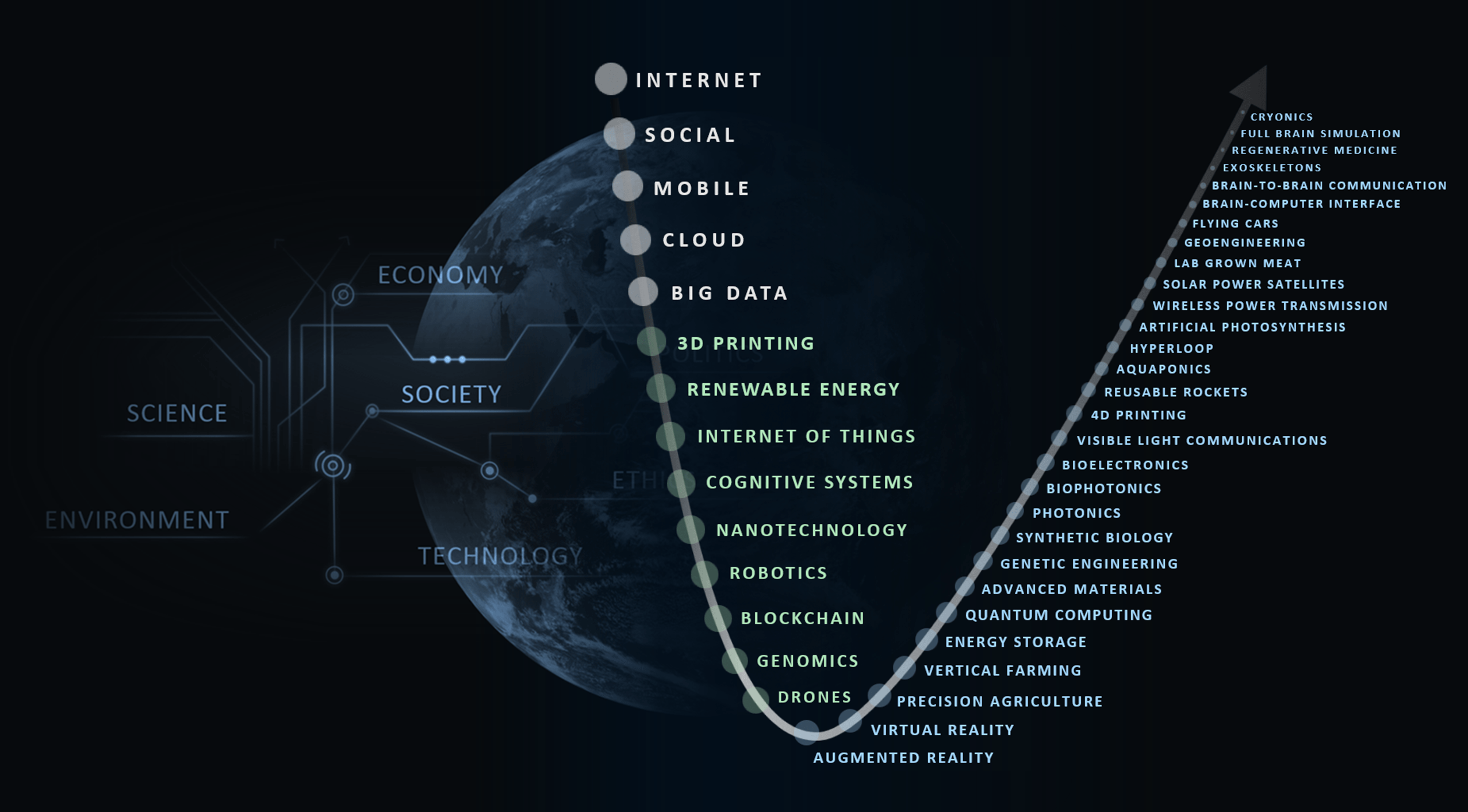
As our emerging future shifts continuously, our challenge is to shift with it. The number of building blocks that combine continues to explode, challenging our ability to track its complexity. I’ve used a visual representation of this challenge – and I see older versions floating around – so I am updating it via this post. When I use the visual in presentations, I build towards it to avoid its overwhelming nature (which I believe accurately reflects the overwhelming nature of the challenge). I will replicate the approach here by building towards the full visual.
Convergence across aspects of science, technology, economic forces, politics, society, our environment, and a growing conversation around ethics, is creating a highly uncertain world. At the heart of the pace dynamic is the exponential progression of science and technology – reflected in the first piece of the visual.
-
Video Playlist Highlights Changes in the World of Sports
After producing a short video on the Future of Sports, the reimagining the future team curated a video playlist that explores potential changes in the world of sports – influenced by various advances in science and technology. The short introductory video above provides a link to the playlist.
-
YouTube Channel Launch
The journey to the future is gaining more attention for both the opportunity it presents, and the fear of unintended consequences. Dialog and proactive action are critical to shaping this emerging future in human-centric ways – a story line that is nicely articulated in a new book titled Shaping the Fourth Industrial Revolution. I am a firm believer that shaping the future requires a different mindset. As stated in the book, we must all adopt a zoom-in and zoom-out strategy: zooming in to acquire an understanding of the characteristics and potential disruptions of specific advances in science and technology; and zoom out to see the patterns and combinations that emerge.
-
Harness All Possibilities
I had the pleasure of presenting at a recent function sponsored by Harness All Possibilities (HAP). The organization Founder – Rhonda Eldridge – has embarked on the following mission:
The fast pace of innovation, technology, geopolitics, socio-economics and demographic factors is driving disruption in industry – for both the employer and the employee. HAP’s purpose is to build a sense of connectedness while you embrace a transformational shift of your awareness and skill sets to prepare for 21st century engagement.
-
An Uncertain Future
I have used this Emerging Future visual to demonstrate the overwhelming number of combinations that will conspire to create our future. The science and technology foundation converges with societal, political, economic, and environmental forces to build towards a very uncertain future. A future that I believe represents the third massive tipping point in human history.
This very short animated video describes the visual.
-
The Emerging Mobility Ecosystem
In segment four of my interview with Chunka Mui, we discussed the ultimate demise of our industry construct and the emergence of horizontal ecosystems that remove friction from our life experiences – one experience at a time. This platform-enabled transition can be witnessed in action today, as we watch the Mobility ecosystem form one piece at a time. We can no longer think of industries in isolation, as we witness the collision of various industries and a reconfiguration of the money flow – over $2.5 Trillion in car-related economic value. Chunka uses the example of the collision between the automotive and technology ecosystems to describe this phenomenon: the shift from cars with computers inside, to computers with wheels on them.
Chunka Mui is the managing director of the Devil’s Advocate Group, a consulting team that helps organizations design and stress test their innovation strategies. Mr. Mui published a popular book titled The New Killer Apps.
Segment four is a quick three minute video.
You can view segment one – Autonomous Vehicles: An Interview with Chunka Mui – here.
You can view segment two – Reimagining Our Driverless Future – here.
You can view segment three – The Ripple Effect – here.
-
A Future Thinking Canvas
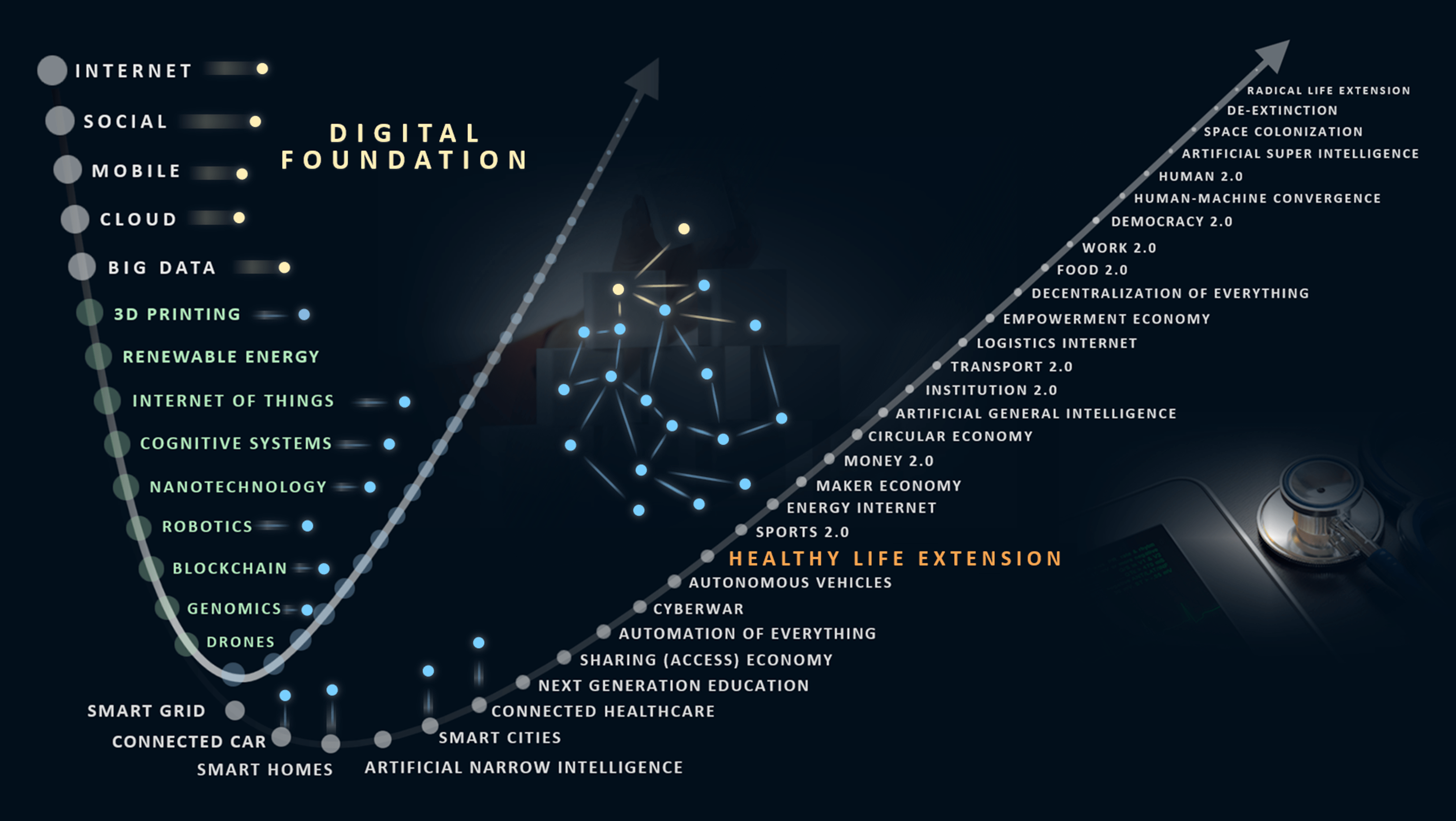
Our exponential pace is due in part to the overwhelming number of building blocks available to innovate. Understanding how these building blocks combine provides a glimpse into possible futures. In this visual, dots connect to portray the building blocks that are likely to extend our healthy lives – a key emerging future scenario.
-
What are your thoughts about the Future?
I had the pleasure of developing an online thought leadership course focused on our emerging future back in May of this year. I had the added pleasure of working with futurists Gerd Leonhard, Gray Scott, and Chunka Mui, along with several industry leaders. The free Thought Leadership Course is available through May of next year. The course has been invaluable to me, as it provided a platform for dialog about our emerging future. I was thrilled with the thought provoking dialog that occurred through our moderated forum. For all those that participated thank you.
During the two week course, several poll questions were positioned to help us understand how the community is feeling about critical topics like ethics, our economy, and the likely transformative period that lies ahead. Here are the questions and their responses. There is plenty of time to take the course and add your voice to the conversation.
-
The Timing of Future Scenarios
Timing. It’s one of the most difficult facets to consider when thinking about the future. We know that convergence across societal, political, economic, science and technological forces is creating many future scenarios. We also know that enablement is happening at an exponential pace. Some believe (present company included) that the coming macro-level tipping point is likely to impact humanity on a scale only experienced twice in human history (hunter-gatherer to agriculture and agriculture to industrial). There will be many micro-level tipping points on the journey towards an automated society – and the timing of those tipping points is impossible to predict.
-
Reimagining the Future: Week Two of the Online Course Launched
Week two of Reimagining the Future has just launched! Week one drew a large audience and generated great dialog. A big thank you to those who have participated so far. As discussed in the course, we must collectively take control of creating our future. Our hope is this course and related dialog are just one small step on that journey. There is still plenty of time to take the full course, you can enroll here.
-
Technology vs Humanity – The Future is already here
In a recently released video, Futurist Gerd Leonhard delivers his key messages in a powerful and passionate plea for balance between technology and humanity. This five minute video is a must see. Some of his key messages are:
Sector after sector, industry after industry, we are waking up to the fact that the future is already here. My note: after struggling to drive a level of urgency regarding the speed at which the future is approaching, leaders are now beginning to embrace a future-back mentality.
-
Reimagining the Future – A Journey Through the Looking Glass

I have spent the better part of two months filming an online thought leadership course focused on our emerging future. The free course will be available starting May 23rd. I had the pleasure of working with futurists Gerd Leonhard, Gray Scott, and Chunka Mui. In addition, I was joined by Element Fleet Management executive Michele Cunningham, as well as TCS CTO Ananth Krishnan, and BRP CIO Hassan El Bouhali.
A video promo of the course along with the course description are available here. I hope you take the time to journey with me through the looking glass. course summary and bios for my guests are also included below.
-
See the Future, Rehearse it and Adapt to the Inevitable Shifts
In my last post, I described a Sense and Respond model that sits at the heart of several activities, including scenario, opportunity, and risk analysis. As complexity and pace continue to intensify, uncertainty increases. To survive in this Emerging Future, we must embrace a framework for future thinking, and an organization that can adapt as it shifts. In essence, we must see the future, rehearse it, continuously monitor for shifts, and adapt as the shifts occur. A sense and respond model sits at the core of the framework – but represents the biggest cultural challenge.
-
Visualizing our Emerging Future
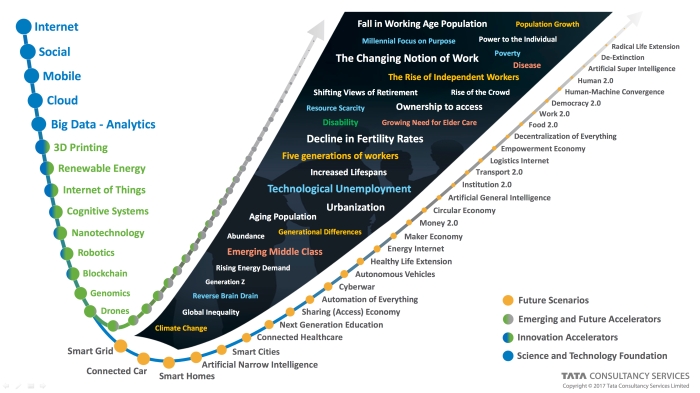
As the pace of science, technology, and societal change accelerates, a vision of our future is emerging. Many future scenarios are viewed as science fiction, or thought to have timelines that are too far into the future to worry about. I hold a firm belief that these timelines are collapsing and future scenario analysis is critical both at a business and societal level.
I have used this visual as a driver of future scenario analysis. It has been captured and utilized in workshop and events. It is described in a post on Connecting Dots, which I view as a critical leadership trait.
-
Coffee Break with Game Changers: An Innovation Explosion
On November 30th, I had the pleasure of participating in another Game Changers show. I was joined by Futurist Gerd Leonhard and SAP Innovation executive Timo Elliott. The show was expertly moderated by Bonnie D. Graham, starting with her positioning of the topic: “Impossible is not a fact. It is an opinion” (Muhammad Ali). A unique clustering of inventions in the century after the U.S. Civil War improved the American and European standard of living – human well-being – more than any period before or after, with advances in everything from food and energy to health and work. Can our current innovation explosion have a similar impact despite unintended consequences?
-
Balancing the Opposing Forces of Innovation

The unabated exponential progression of science and technology has driven a staggering pace of innovation. The building blocks are mostly there, allowing creative minds to combine them in ways that attack the world’s most difficult challenges.
-
Connecting Dots
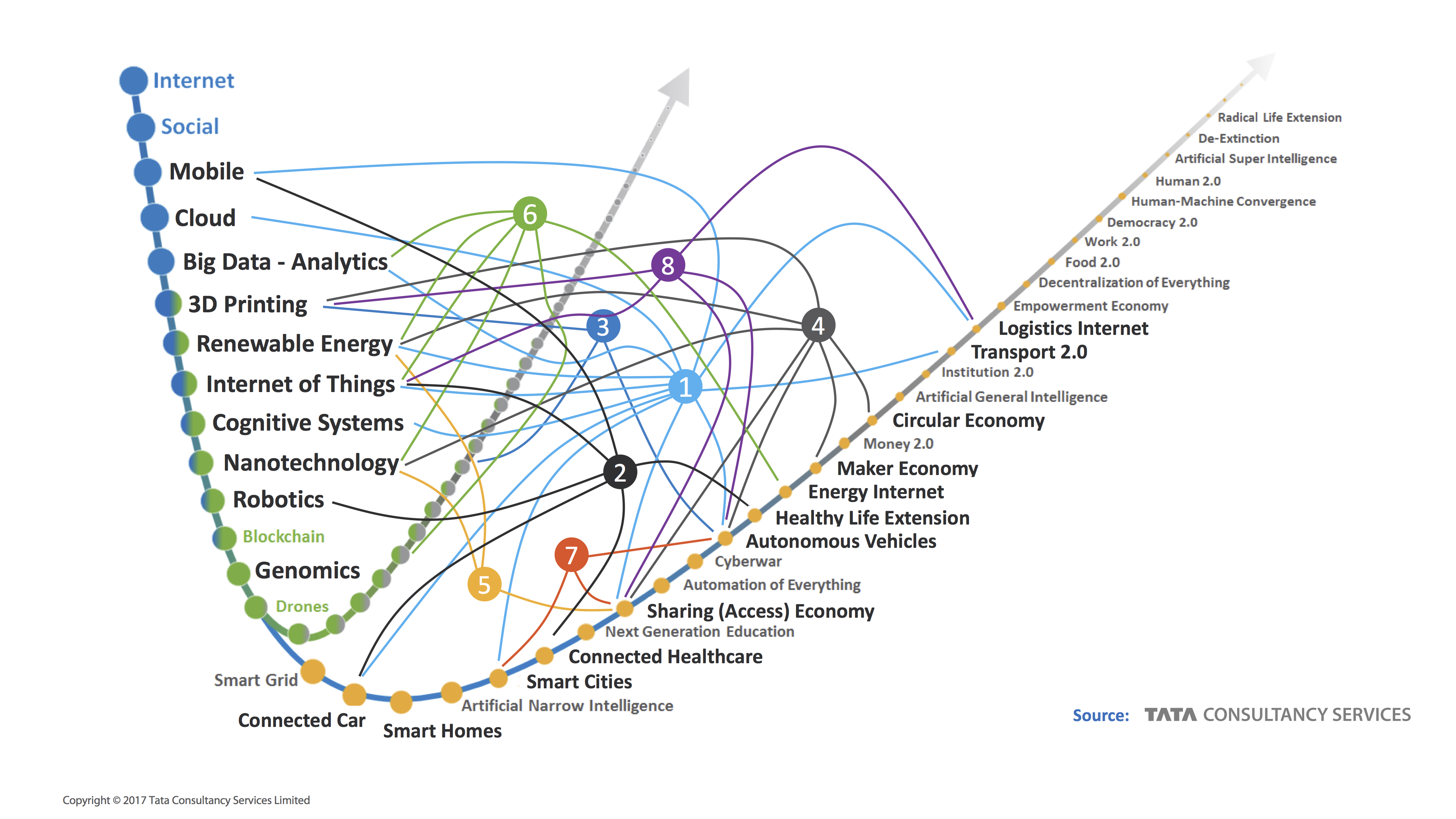
I participated in a radio show yesterday brought to you by Coffee Break with Game Changers. The show was hosted by Bonnie D. Graham and is now available on-demand here. When asked about a leadership trait required to effectively navigate our exponential future, I echoed something I have positioned many times via this Blog: Connecting Dots. The speed dimension that has accelerated our pace will put those dots in constant motion – so it’s a continuous state of connecting that makes this more challenging than our forward looking efforts of the past. The foundation for this argument was positioned in my post describing how Disruptive Power Lies at the Intersections. This visual from that post leverages my anchor visual on our emerging future.
-
Technology and Ethics
Some in the Futurist community are focused on technology and ethics. Gerd Leonhard has been particularly vocal on the topic. I’ve dedicated a section of my keynote to what I believe will be a growing dialog. I use this slide to pose a question to the audience:
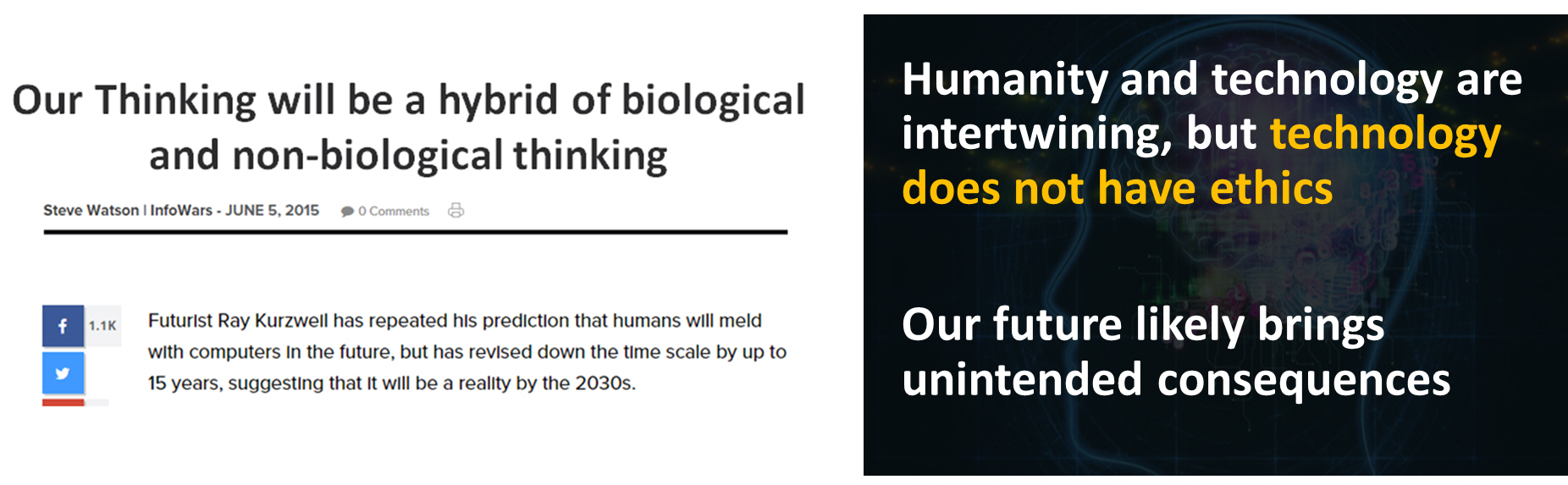
The example provided above comes from Ray Kurzweil, famous Futurist, Inventor and author. In an appearance at last years Exponential Finance conference, Kurzweil said this:
“Our thinking will be a hybrid of biological and non-biological thinking. We’re going to gradually merge and enhance ourselves. In my view, that’s the nature of being human – we transcend our limitations. We’ll be able to extend (our limitations) and think in the cloud. We’re going to put gateways to the cloud in our brains.”