Future thinking has often focused on a three-horizon framework that allows for the continued advancement of core business, while planning for emerging opportunities. I believe the challenge these days is time compression associated with rapid advancement. When someone says to me: “I’m not worried about five years from now”, my reaction is always the same. What looks to be five years out is likely only 18 months away: A phenomenon I describe in this piece on Acceleration.
Category: Our Emerging Future
All aspects of our emerging future
-
Optimist or Pessimist?
In late 2016, having just finished reading The Rise and Fall of American Growth, I was thinking about an underlying theme of the book – the views of techno-optimists versus those of techno-pessimist. In the context of the books narrative, the techno-optimist believes that future innovations will indeed drive a resurgence of growth – albeit at the expense of jobs. The pessimist sees no return to growth and believes our best innovations are behind us. Two years ago, I posed a question via a Post: Are you a techno-optimist or techno-pessimist?
-
Dots in a Complex System are Connecting Rapidly
In their now popular book on The Second Machine Age Andrew McAfee and Eric Brynjolfsson describe one of the forces behind our accelerating pace. This force could be key to understanding the dynamics of our environment; the number of potentially valuable building blocks is exploding around the world, and the possibilities are multiplying like never before.
-
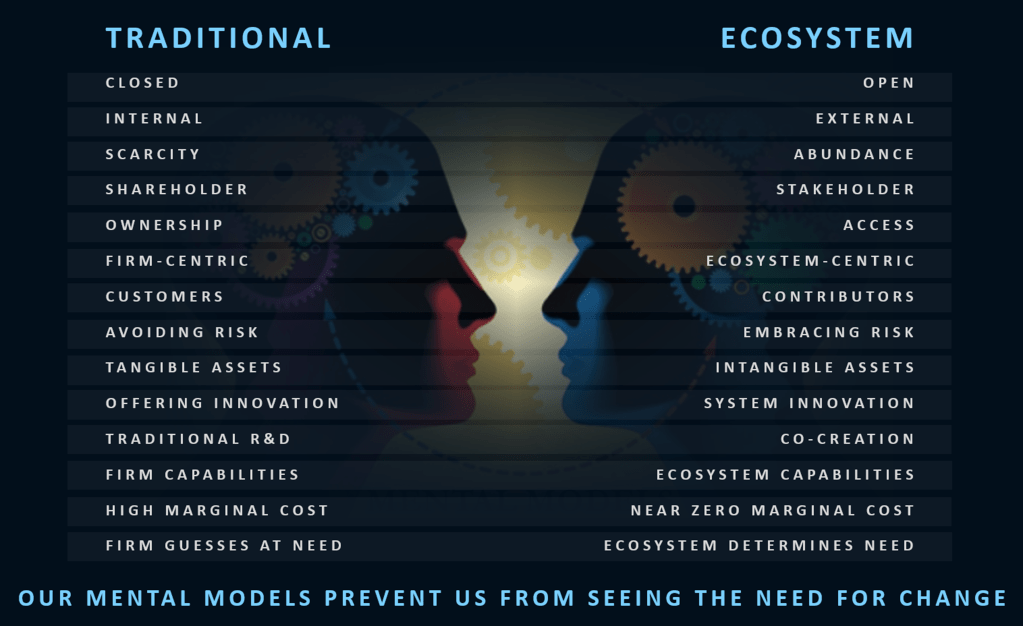
Unlearning May be our Biggest Challenge
The illiterate of the 21st century will not be those that can’t read or write, but those who cannot learn, unlearn, and relearn – Alvin Tofler, Rethinking the Future.
As we all become life long learners, unlearning could be our biggest challenge. Our mental models prevent us from seeing the need for change. We are creatures of the only world we have individually known. Even if you are one hundred years old, the mental models established after humanities second Tipping Point dominate your thinking. They form our intuitions and belief systems.
-
The Future of Work

I just added another very good book to the Book Library: The Future of Work: Robots, AI, and Automation. Author Darrell M. West looks at a world in which our current views of work change. He explores the implications to our social contract and the policy decisions so critical to revising that contract for a new era. Structural change – which Mr. West explores in the book – has long been a tenet of my work. The future of many of our institutions will either change by our proactive acknowledgement that they must change – or they will be undermined.
The conversation so nicely positioned by our author is one that must happen at all levels of leadership. This does not have to be a Utopian versus Dystopian discussion. Rather, like the major disruptive periods of our past, leaders need to lead.
-
Birth Rates, Workers, and Volatility
I wrote about a recent analysis conducted by Bain & Company in an earlier post on the Turbulent 2020s and what it means for the 2030 and beyond. An interesting related exchange on Twitter focused on the impact of birth rates on the core issues of demographics, automation, and growth.
-
Game Changers: Designing the Future of Humanity
Today on Coffee Break with Game Changers, Bonnie D. Graham hosted a show focused on designing the future of humanity. You can listen to the rebroadcast here. The session abstract is included below, as well as a Twitter stream that provides insight into the topic and our discussion. The show participants included: Bonnie, Masha Krol, Ian Gertler, Maricel Cabahug and myself.
-
Supply Chain of the Future: Humans Optional?
As science and technology continue their rapid advance, traditional constructs are challenged; Supply chains are no exception. Here is a brief video that highlights many of the advances that transform how we think about supply chains in the future. As it wraps up, a curated set of videos that touch on several of these advances is provided. Special thanks to Bill Quinn, Rose Castellon-Rodriguez, and Kevin Mulcahy for producing the video.
Be sure to visit the Reimagining the Future YouTube Channel to explore additional topics.
-
The Great Reset
We face the task of understanding and governing 21st-century technologies with a 20th-century mindset and 19th-century institutions – Klaus Schwab: Shaping the Fourth Industrial Revolution.
In a video titled “The Great Reset”, economist Tyler Cowen uses a great metaphor of canaries in coal mines to describe the warning signals that seem like local events – but actually represent greater and broader stress. He uses several recent examples to highlight the growing stress in the system and the potential for a great reset in the future. Regardless of your belief system – it is hard to argue with the underlying logic. Whether we view this as the Fourth Age in human history, a third major Tipping Point, or a Great Reset, structural change is inevitable. This short seven minute video drives this point home.
-
The Fourth Age
Byron Reese recently authored a book titled The Fourth Age. I thoroughly enjoyed this fascinating look at history, and the focus on possible futures. In looking at the future, Mr. Reese explores the reasons that experts disagree on the path of these possible futures. He asks: why do Elon Musk, Stephen Hawking, and Bill Gates fear artificial intelligence (AI) and express concern that it may be a threat to humanity’s survival; and yet, why do an equally illustrious group, including Mark Zuckerberg, Andrew Ng, and Pedro Domingos, find this viewpoint so far-fetched as to be hardly even worth a rebuttal? The answer as described by the author lies not in what we know – but what we individually belief. This theme throughout the book is an interesting piece of self-reflection. See how you would answer the questions posed by the author.
-
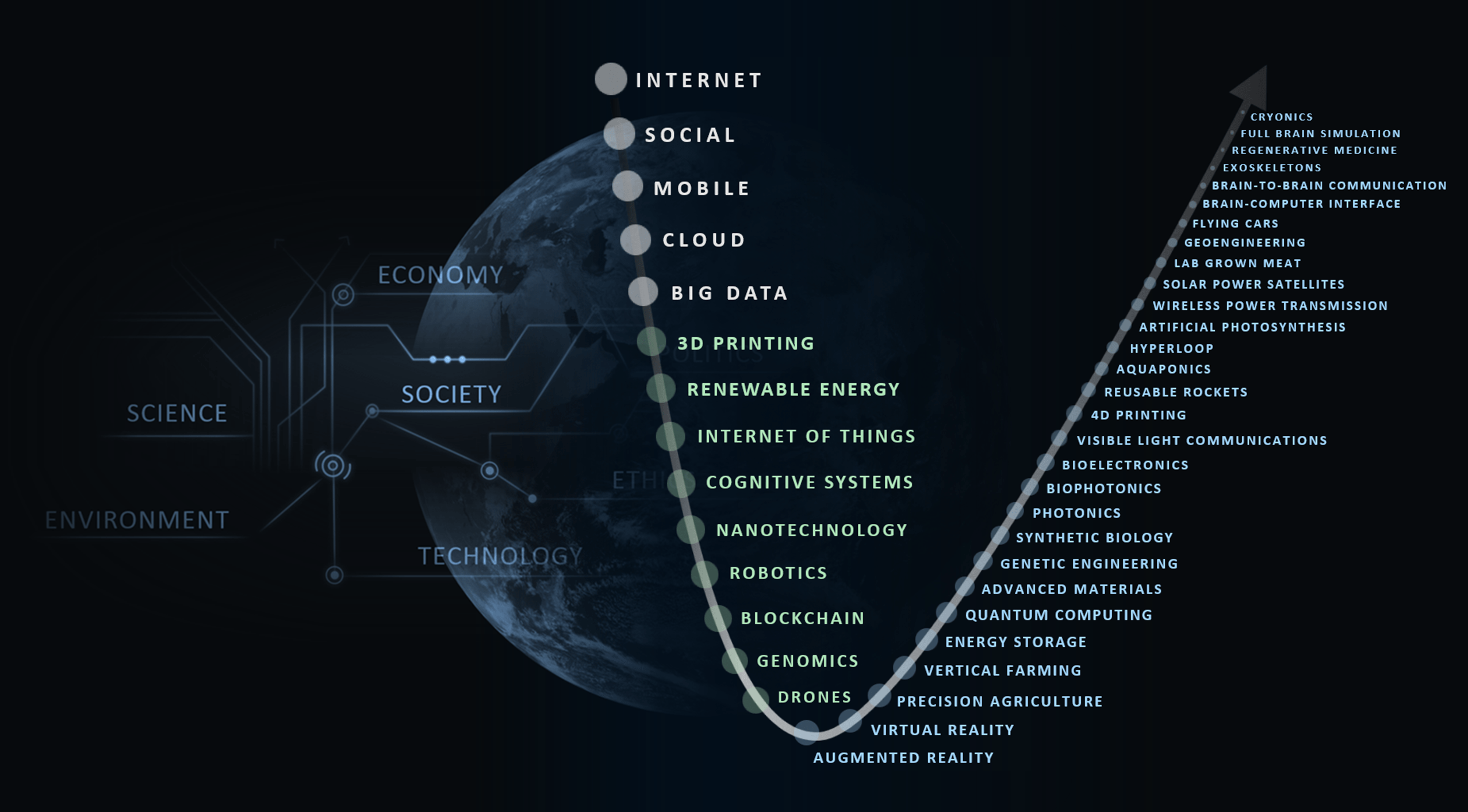
Visualizing Our Emerging Future – Revised
As our emerging future shifts continuously, our challenge is to shift with it. The number of building blocks that combine continues to explode, challenging our ability to track its complexity. I’ve used a visual representation of this challenge – and I see older versions floating around – so I am updating it via this post. When I use the visual in presentations, I build towards it to avoid its overwhelming nature (which I believe accurately reflects the overwhelming nature of the challenge). I will replicate the approach here by building towards the full visual.
Convergence across aspects of science, technology, economic forces, politics, society, our environment, and a growing conversation around ethics, is creating a highly uncertain world. At the heart of the pace dynamic is the exponential progression of science and technology – reflected in the first piece of the visual.
-
Ecosystem Models are Key to Future Strategies
Our structures and institutions are increasingly challenged by rapid innovation in science and technology. As Klaus Schwab stated in his book Shaping the Fourth Industrial Revolution, we face the task of understanding and governing 21st-century technologies with a 20th-century mindset and 19th-century institutions. One such institution is our vertically-oriented industry structure. We are in the early stages of An Ecosystem Evolution, where the boundaries between industries are completely blurred. The creation and capture of value is increasingly horizontal in nature, ultimately giving Rise to a Finite Set of Ecosystems.
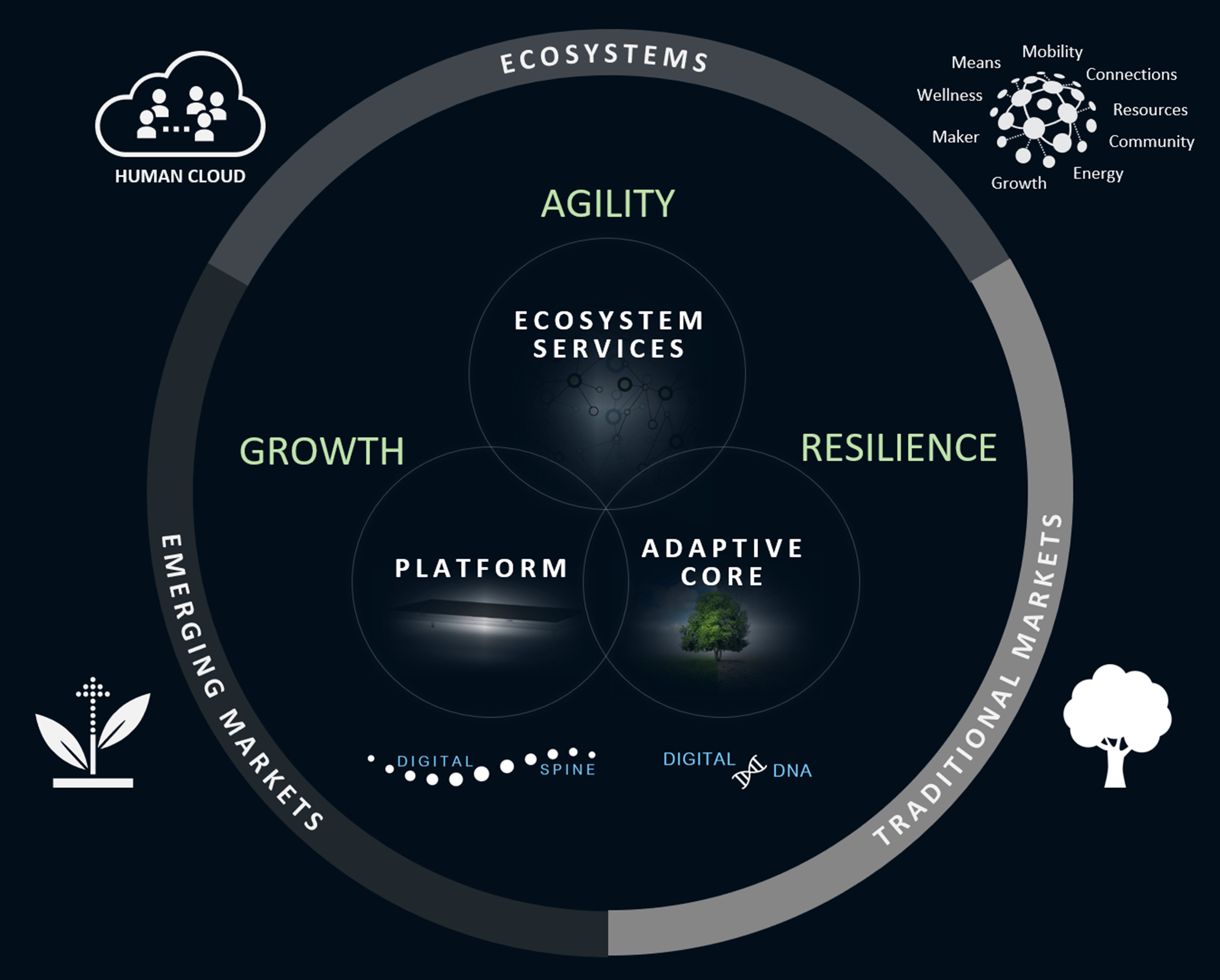
As this shift occurs, our strategies are iterative in nature and guided by a constantly evolving view of emerging ecosystems. At the heart of this work lies Ecosystem Models. These models provide a range of possibilities inherent in emerging ecosystems, and identify three critical facets:
-
The Strategic Foundation
In my last post, I explored the evolution of business in the industrial age. This Fourth Iteration of Business establishes resilience on a foundation of automation and intelligence. Resilience may be more important than the productivity gains that are sure to be realized as we progress towards Business 4.0, providing the capacity to recover quickly as the pace of shifts accelerates. This visual represents a strategic foundation for Business 4.0.

-
The Fourth Iteration of Business in the Industrial Age
The evolution of business in the industrial age has mirrored the progression of three industrial revolutions; moving us from its first iteration to our current form. The emerging Fourth Industrial revolution ushers in another shift, culminating in something that likely looks much different than its predecessors. A brief look at this journey shows us the linkage:
Iteration One: The first industrial revolution introduced mechanization and had significant impacts on business and the labor force. Business in this period was transformed, as the steam engine enabled us to replace human and animal-based muscle with machines.
Iteration Two: Several forces converged during the second revolution to elevate our standard of living. The post-war period that followed was defined by a high level of consumption that drove business in the mass production era. Henry Ford famously said: “Any customer can have a car painted any color that he wants so long as it is black.”
Iteration Three: The third industrial revolution revolved around information technology, electronics, and communications, ushering in a period of computerization and automation. Businesses were once again transformed through significant gains in productivity and a shift away from Henry Ford era standard products to more customization.
-
The Turbulent 2020s and what it Means for 2030 and Beyond
In a recent insights report, authors Karen Harris, Austin Kimson and Andrew Schwedel look at macroeconomic forces and their impact on labor in 2030. The Collision of Demographics, Automation and Inequality will shape the 2020s – a collision that is already in motion. By 2030, the authors see a global economy wrestling with a major transformation, dominated by an unusual level of volatility. Here’s a summary of these three forces:
AN AGING WORKFORCE
As the global workforce ages rapidly, our authors forecast a slowing of U.S. labor force growth to 0.4% per year in the 2020s, thereby bringing an end to the abundance of labor that has fueled economic growth since the 1970s. Even as longer, healthier lives allow us to work into our sixties and beyond, it is not likely to offset the negative effects of aging populations. This labor force stagnation will slow economic growth, with negative side effects including surging healthcare costs, old-age pensions and high debt levels. On the positive side, supply and demand dynamics could benefit lagging wages for mid-to-lower skilled workers in advanced economies through the simple economics of greater demand and lesser supply – but that leads to their second major force: automation.
-
At the Heart of Digital Transformation
To transform is to change in form, appearance, structure, condition, nature, or character. It is an overly used word that can be made to fit several narratives. Yet, given its definition, the dynamics of what is sure to be a volatile and complex future should compel us all to transform. I believe however, that the narrative must change. This is not a technology discussion, and it is not a digital discussion (although digital is the reason we are here). Rather, it is discussion of likely structural shifts that alter our beliefs and intuitions. These shifts will fundamentally change the way we think about organizations.
-
The Automation of Everything
In a Post from 2014, I explored the path of automation and a possible economic impact between $14 and $30 trillion. Almost four years later, my focus has shifted from economic to societal impact. How far will we take automation? Will automation augment us, freeing us from mundane and redundant tasks, or will it replace us? Is automation limited to those characteristics we typically associate with our left brain – or will it encroach upon our right brain characteristics?
These questions currently have no answer – just speculation. How far the slider in the visual below goes, drives a profound difference in the ultimate implications to society. The obvious area of impact is the future of work – if we do indeed realize decentralized autonomous organizations. Do our right brain characteristics become much more important in this future world, and do they represent a safe haven? I show three very impactful examples in presentations that would have us question whether or not machines can be creative, compassionate, and eventual companions.
-
Artificial Intelligence and Jobs
This very good opinion piece addresses a subject that is gaining more attention and driving more dialog. Will artificial intelligence destroy jobs? Author Kai-Fu Lee has an opinion:
“It will soon be obvious that half of our job tasks can be done better at almost no cost by AI and robots. This will be the fastest transition humankind has experienced, and we’re not ready for it”
-
Video Playlist Highlights Changes in the World of Sports
After producing a short video on the Future of Sports, the reimagining the future team curated a video playlist that explores potential changes in the world of sports – influenced by various advances in science and technology. The short introductory video above provides a link to the playlist.

