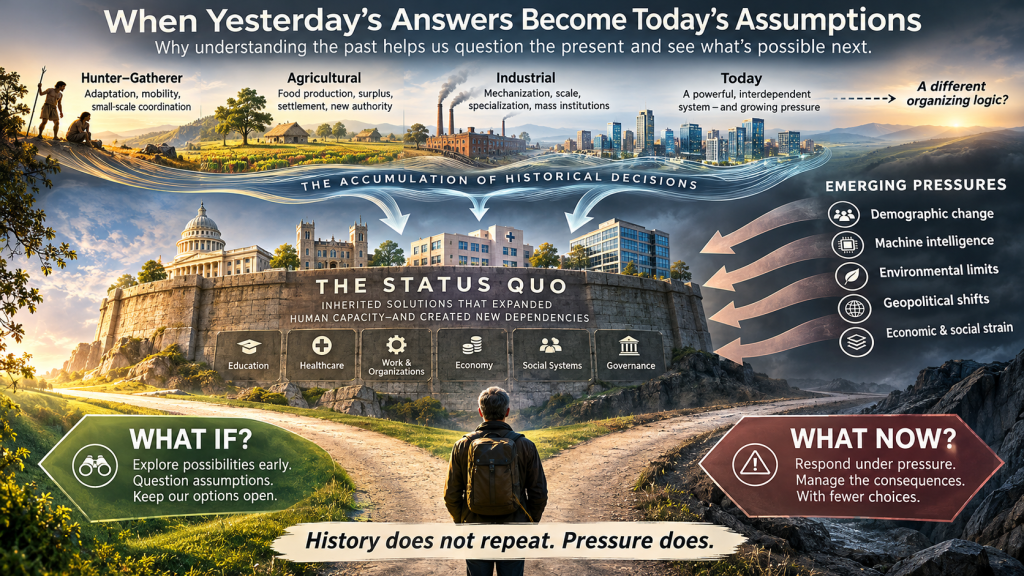
One of the hardest things for us to question is the world we have always known. We grow up inside institutions, learn the rules that make them work, and eventually come to accept those arrangements as the natural order of things. Schools organize learning in familiar ways. Companies divide work into functions and hierarchies. Governments operate through established agencies and responsibilities. Our financial, healthcare, and social systems follow patterns that have been reinforced across generations. We rarely stop to ask why they work this way. They are simply the structures we inherited, and because they have been part of our lives for so long, we tend to assume they will remain that way.
I have been thinking about this while reading Mark Leonard’s Surviving Chaos: Geopolitics When the Rules Fail. Leonard examines a world in which established geopolitical arrangements are losing their ability to organize international relations. His argument reaches beyond the familiar discussion of competing powers and shifting alliances. He challenges the tendency to believe that the structures we have known will continue to define the world ahead. One passage particularly caught my attention. Describing the forces reshaping geopolitics, Leonard observes that much of their power comes from “the accumulation of historic decisions.” It is a simple observation, but one that connects closely to how I have come to think about systemic change.
History is often treated as something that happened before us, a sequence of events, discoveries, conflicts, and accomplishments that explain how we arrived at the present. I see it somewhat differently. History is still operating around us. The decisions made by earlier generations created the institutions, infrastructures, economic arrangements, and beliefs that shape our lives today. Those decisions solved real problems and expanded human capacity in extraordinary ways. But they also created dependencies and constraints. Over time, the solutions became established practices, those practices became institutions, and the institutions became part of what we consider normal. Eventually, we stop seeing them as choices made under particular historical conditions and begin treating them as permanent features of civilization.
Consider the transition from hunter-gatherer societies to agriculture. It did not happen through a single decision to redesign human civilization. Environmental conditions, population dynamics, accumulating knowledge, and new ways of producing food gradually altered what communities could do. Agriculture supported larger settlements, new relationships around land and surplus, greater specialization, and different forms of political and social authority. These changes unfolded unevenly over thousands of years, and older ways of living persisted alongside newer ones. Yet the consequences were profound. Humanity gradually developed a different way of organizing life. What began as responses to changing conditions eventually became structures that later generations inherited.
The industrial transition followed a different path but illustrates a similar pattern. New energy sources, mechanization, expanding scientific knowledge, and changing economic relationships altered the conditions under which people lived and worked. Factories, cities, transportation networks, specialized institutions, and mass production became central features of modern society. The systems that emerged produced enormous gains in productivity, prosperity, and human capability. But they also established assumptions about how work should be organized, where people should live, how expertise should be distributed, and how institutions should coordinate activity. Much of what we now call the status quo is the accumulated result of that transformation. It is not a natural law. It is an inherited answer to problems faced by earlier generations.
The history of knowledge offers another revealing example. In medieval Western Europe, authority over knowledge was concentrated within an interconnected structure of religious institutions, monarchies, universities, and established scholars. These authorities influenced what was taught, which sources were considered legitimate, how knowledge circulated, and how it could be used. The Renaissance, followed by the Reformation and Scientific Revolution, progressively challenged that arrangement. Printing expanded access, established texts faced renewed examination, and observation and experimentation gained importance as foundations for scientific knowledge. The transformation took centuries and did not eliminate institutional authority. It changed the relationships among those producing knowledge, those validating it, and those empowered to act upon it. What once seemed like the established way of knowing was no longer the only way.
This brings me back to Leonard. He contrasts two approaches to navigating change: the architect, who begins with a picture of the world as it should be and attempts to construct it, and the artisan, who pays closer attention to the forces already in motion and adapts as conditions evolve. Drawing on the philosopher François Jullien, Leonard uses the contrast between stone and water to help explain this distinction. Stone represents a fixed form. Water responds to the conditions it encounters, finding routes around obstacles rather than insisting that the landscape conform to a predetermined design. The metaphor does not explain every aspect of political or social change, but it offers a useful way to think about the future. We often devote enormous energy to preserving established structures without spending enough time understanding the forces moving around and through them.
This is where my own work on systemic change connects with Leonard’s perspective. I have long argued that history does not repeat, but pressure does. As conditions change, pressures build within systems designed around earlier realities. People and institutions absorb those pressures for a time, often through adjustments that seem manageable in isolation. Eventually, some of those arrangements become harder to sustain. The pressure may find release through new technologies, changing behaviors, policy adjustments, institutional redesign, or entirely different ways of organizing activity. Not every pressure produces a systemic transition, and no particular outcome is guaranteed. But when pressures begin moving across multiple parts of society, reinforcing one another and challenging the assumptions beneath established structures, we may be witnessing something more consequential than ordinary change.
We can see this in the demographic challenges facing many societies. Pension systems, healthcare arrangements, labor markets, and family support structures developed under particular assumptions about population growth, working lives, retirement, and caregiving. Those assumptions were not unreasonable when the systems were established. But declining fertility, longer lives, changing family structures, and workforce pressures are altering the conditions under which they operate. Families absorb more responsibility, employers struggle to replace experienced workers, and governments face difficult questions about how existing commitments will be sustained. We often respond by trying to make each part of the inherited system work a little better. Sometimes that is enough. But persistent pressure should also make us question whether the underlying arrangement continues to fit the world around it.
Artificial intelligence presents another version of this challenge. We have spent centuries building institutions around the production, distribution, and validation of human knowledge. Our educational systems, professions, research organizations, and businesses reflect assumptions about expertise that have served us well. Now machines are beginning to participate in activities that once depended almost entirely on human cognitive capability. In my recent newsletter, When the Laboratory Starts to Learn, I explored how artificial intelligence is beginning to participate in experimental processes, helping select experiments, coordinate laboratory activity, and use measured results to inform what should be tested next. Human judgment and scientific accountability remain essential, but the development raises a deeper question. What happens to the authority structure of knowledge when machines become participants in the process of generating it? Improving laboratory productivity is one thing. Changing the organization of scientific inquiry is potentially something much larger.
These examples reveal a recurring problem. We tend to evaluate emerging capabilities through the assumptions of the systems we already know. We ask how artificial intelligence can make current jobs more productive, how automation can improve existing processes, or how policy changes can help established institutions perform better. Those are necessary questions, but they may not be sufficient. We are often trying to solve tomorrow’s problems using organizational assumptions inherited from yesterday. The danger is not that those assumptions were wrong when they emerged. Many were extraordinarily effective. The danger comes when their past success makes them difficult to question, even as the conditions supporting them begin to change.
This is the deeper reason I have emphasized the importance of moving from What Now to What If thinking. In a post I wrote several years ago, I discussed the value of asking questions about possible futures before events force us into a reactive posture. What If questions encourage us to challenge assumptions, imagine different arrangements, and rehearse possibilities while choices remain available. What Now questions often arrive when the pressure has already become difficult to ignore. The institution is struggling, the familiar response is no longer sufficient, and leaders are searching for an immediate answer. Both questions have their place. The difference is how much room we still have to choose when we begin asking them.
But What If thinking should not become an exercise in unconstrained imagination. Its greatest value comes when it is connected to forces we can already observe. What if demographic change requires a different relationship between work, retirement, and care? What if machine intelligence changes how we establish expertise rather than simply making experts more productive? What if the greatest challenge facing organizations is no longer improving individual functions but coordinating capabilities across boundaries? And what if the structures we continue trying to preserve are themselves becoming part of the pressure we are experiencing? These questions do not assume the answers. They help us recognize that arrangements we consider permanent may actually be choices that can be reconsidered.
That is also why I have focused increasingly on the pathways between today’s pressures and tomorrow’s possible conditions. A future scenario can describe a different world, but it does not necessarily explain how we get there. The important movement occurs in between, through the workarounds people adopt, the burdens that shift, the constraints that become visible, and the choices that gradually establish new expectations. As these responses accumulate, some pathways become easier to follow while others become harder to pursue. Eventually, temporary arrangements can become the next status quo. Seeing that process early creates what I call decision space: the opportunity to influence which responses take hold before they become difficult to reverse.
There is an important human dimension to this as well. Our resistance to questioning established arrangements is not simply a failure of imagination. The status quo provides stability, continuity, and a sense of competence. People build careers around it. Institutions develop expertise within it. Communities organize their lives around the expectations it creates. Challenging those assumptions can feel like questioning the value of everything that came before. But recognizing that an arrangement may no longer fit does not require us to dismiss what it accomplished. It requires us to understand the conditions that made it successful and ask whether those conditions are changing. We can respect the achievements of the past without assuming their structures must define the future.
Leonard’s book is primarily concerned with geopolitical order, while my work examines the broader possibility of changes in the organizing logic of the human system. Those are different levels of analysis. Yet the connection is meaningful. His emphasis on the accumulation of historical decisions reminds us that the world we inhabit did not simply appear. His contrast between architects and artisans challenges us to pay closer attention to forces already moving rather than assuming that existing structures can contain them indefinitely. And his argument reinforces something that history has taught us repeatedly: the systems we inherit can be remarkably durable without being permanent.
Perhaps the greatest value of looking backward is that it reminds us how unfamiliar today’s familiar world once was. Agriculture, industrial production, mass education, modern scientific institutions, and the organizational structures surrounding them all emerged through long periods of experimentation, adaptation, conflict, and changing human needs. The people living through those transitions did not possess a clear picture of the system that would eventually emerge. They were responding to the conditions of their time, just as we are responding to ours. Their choices helped create the world we now take for granted.
We cannot know whether the pressures converging around us will produce a transition comparable to those earlier transformations. But we can examine the evidence that inherited arrangements are being tested, recognize where new burdens are appearing, and remain open to the possibility that the next answer may look very different from the last one. History gives us a reason to question what feels permanent. What If thinking gives us a way to explore what might be possible. And understanding the pathways through which pressure seeks release gives us a better chance to act before those possibilities narrow.
The real challenge is not simply to imagine a different future. It is to recognize that the world we consider normal was once a possibility too. The sooner we understand that, the less likely we are to mistake yesterday’s answers for the limits of tomorrow.
I explore this in greater detail in My Book.


Leave a Reply