
Across every domain I have explored – from education and energy to health, governance, and human longevity – one pattern keeps reappearing whenever society encounters a General Purpose Technology. These are the rare breakthroughs that do not simply make us more efficient but fundamentally restructure how civilization operates. Language, writing, the printing press, the steam engine, and electricity each changed not only what we did, but who we became. Artificial intelligence may join that lineage.
To understand how such transformations unfold, I often draw on Ajay Agrawal’s Power & Prediction 4-stage model, which describes the predictable path every general-purpose technology follows as it moves from novelty to infrastructure. The sequence begins with a Current State, where the world functions as it always has. It then shifts to Point Solutions, where the new capability substitutes for existing tools and yields small, local improvements. From there, Broader Applications emerge as the technology begins to connect systems and alter workflows. Finally comes System-Level Change, when the entire structure is redesigned to align around the new enabling force. Electricity followed this pattern. So will artificial intelligence – not through the addition of smart gadgets, but through a re-imagining of the city itself.
Most of today’s urban environments still occupy the first stage of this evolution: the Reactive City. Data may be plentiful, but it lives in silos. Traffic networks, energy grids, water systems, and emergency services act independently, guided more by habit than by intelligence. Cities respond after problems appear, much as steam-powered factories once relied on manual adjustments. Efficiency is limited by human reaction time.
As artificial intelligence finds its way into municipal operations, cities enter the Assisted City phase. Here we see the first substitutions – adaptive traffic lights, predictive maintenance, digital permitting, and AI-enhanced surveillance. These applications bring value, but they rarely change the city’s underlying architecture. The analogy is the early electric factory that simply replaced a steam engine with a motor while keeping the same layout. Power is new, but the logic remains old. Intelligence assists; it does not yet orchestrate.
The next stage marks the beginning of real transformation. As data flows converge across departments, cities evolve into Coordinated Systems. AI no longer focuses on isolated efficiencies but starts to anticipate and influence conditions across the whole. Digital twins simulate the urban ecosystem; energy, mobility, and governance share predictive models. A storm forecast triggers pre-emptive adjustments in drainage and traffic flow. Heatwave projections reallocate energy before demand peaks. In this phase, the city begins to think ahead. Decision-making moves from hindsight to foresight, and reaction gives way to preparation.
Eventually, intelligence becomes ambient – invisible, continuous, and everywhere. Streets, buildings, and utilities operate as one cognitive organism, anticipating needs and influencing outcomes in real time. Governance shifts from command to calibration. Infrastructure becomes self-healing and self-balancing. This is the final stage of the model – System-Level Change – the point at which AI ceases to be a layer added to the city and becomes the medium through which the city itself operates. It is the cognitive equivalent of full electrification: a world redesigned around intelligence rather than merely upgraded by it.
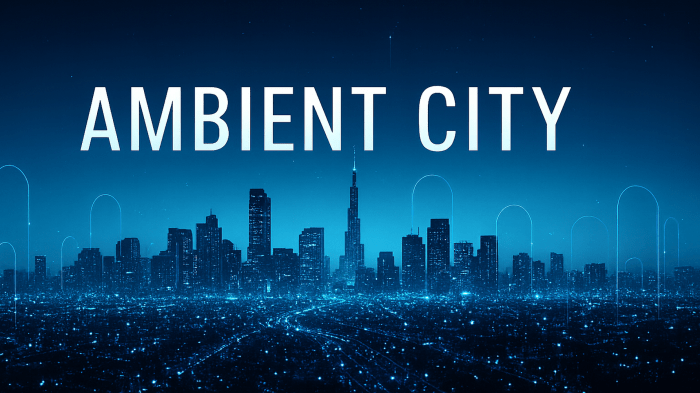
In this Ambient City, technology fades from view. Mobility adapts before congestion forms. Energy flows to where it will soon be needed. Health, safety, and learning are supported continuously rather than episodically. Public spaces sense context and respond in ways that nudge citizens toward wellbeing and sustainability. People no longer “use” smart systems; they live within an intelligent ecosystem that anticipates their needs and optimizes for collective good. AI becomes the new current of civilization – a silent force shaping outcomes rather than reacting to them.
Electricity once freed cities from darkness; AI will free them from delay. The Ambient City represents the moment when urban intelligence becomes both anticipatory and participatory – distributed through space, time, and experience. The city no longer responds; it influences. It no longer optimizes; it orchestrates. And with that, another general-purpose technology completes its cycle: from applied intelligence to ambient cognition, from smart infrastructure to living infrastructure.
History reminds us that technologies of this magnitude do not transform the world through insertion; they do so through reinvention. The electric city was not a gas-lit city with bulbs added – it was a redesigned organism built around a new kind of power. The same is true of intelligence. When it becomes infrastructure, the city itself begins to think.
Discover more from Reimagining the Future
Subscribe to get the latest posts sent to your email.
 Reimagining the Future