
In times of profound change, the ability to connect dots across disciplines becomes essential. As the world faces converging forces across science, technology, society, economics, geopolitics, the environment, and philosophy, the polymath reemerges – not as a relic of the past but as a necessity for navigating the future.
Last year, I explored the polymath phenomenon and how our evolving world may be giving rise to a new kind of intelligence – polyintelligence. That post traced the lives of polymaths like da Vinci, Goethe, and others who shaped eras of discovery and disruption. If you haven’t read it, I encourage you to revisit that foundation here: Genius Across the Ages.
What we are experiencing today is not simply another technological cycle – it is a systemic shift. To make sense of that shift, we must look to history, and the eras where polymathic thinking played a central role in societal advancement.
ERAS OF THE POLYMATH

Across history, periods of transformative change were often shaped by individuals and groups who could move between domains. These were not just experts in one field, but broad thinkers – artists who were scientists, philosophers who were engineers, and innovators who could move between disciplines with ease. These moments created fertile ground for both discovery and disruption.
The table below represents these eras of polymathic influence, highlighting the societal context of each and the relevance of systemic thinking.
Table: Polymath Eras and the Systemic Lens
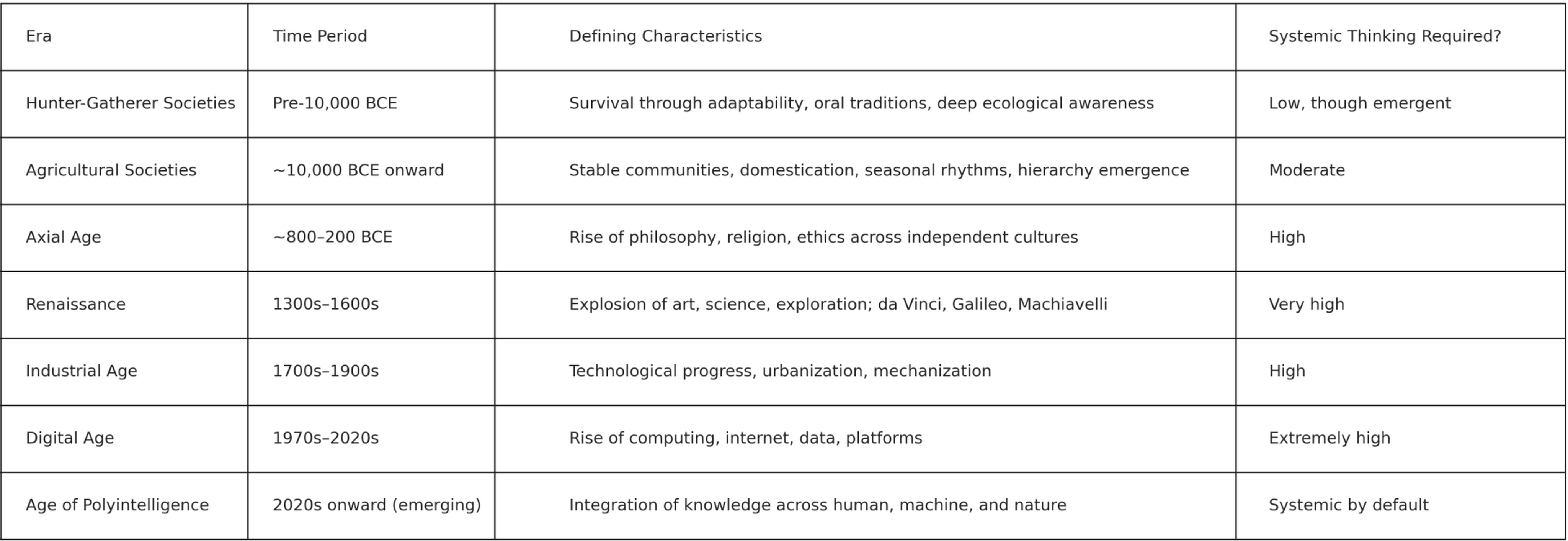
Each era saw moments of acceleration – periods where those who could see the whole and move between parts made the greatest impact. We now find ourselves entering a new era, shaped by AI, synthetic biology, quantum computing, climate disruption, and philosophical questions about what it means to be human.
THE SYSTEMIC LENS AND THE MODERN POLYMATH
The systemic lens has become a key narrative in my work – an approach that recognizes how forces across disparate domains shape the present and future. It requires moving beyond linear cause-effect thinking into multi-layered, interconnected models of change. In today’s world, this isn’t optional. It’s foundational.
This systemic mindset is precisely what polymaths have brought throughout history. They see the edges of multiple domains and trace connections others miss. In an age where disciplines are fusing – where economics cannot be separated from climate, and technology cannot be separated from philosophy – we need more individuals who think this way.
But this is not just about individual genius. Today, polymathic capability must scale across organizations. Teams, leaders, and institutions must adopt this mindset to navigate the complexity ahead. The future won’t be shaped by specialists alone, but by collaborative networks of domain-spanning thinkers who can move with agility and coherence through a world of disruption.
REHEARSING THE FUTURE WITH POLYINTELLIGENCE
The rise of AI presents both challenge and opportunity. On one hand, it can narrow human thinking if used only for efficiency. On the other, it can become a collaborator – a catalyst in the emergence of polyintelligence: a state where human intuition, machine cognition, and nature combine to explore broader possibility spaces.
This is the next polymathic leap. From da Vinci’s workshop to the algorithmic landscapes of today, the common thread is the capacity to navigate change at the level of systems.
CLOSING THOUGHT
As we move deeper into this age of systemic transformation, the polymath is not a nostalgic figure of the past. It is a mindset we must all cultivate. History is clear: eras of profound change demand polymathic thinkers. This era, shaped by AI, climate, governance tensions, and social fragmentation, may be the most demanding yet.
And so, the call is not to become a Renaissance figure in the classical sense – but to reclaim the ability to connect, question, imagine, and integrate. This is the path forward in an age of convergence.
Discover more from Reimagining the Future
Subscribe to get the latest posts sent to your email.
 Reimagining the Future