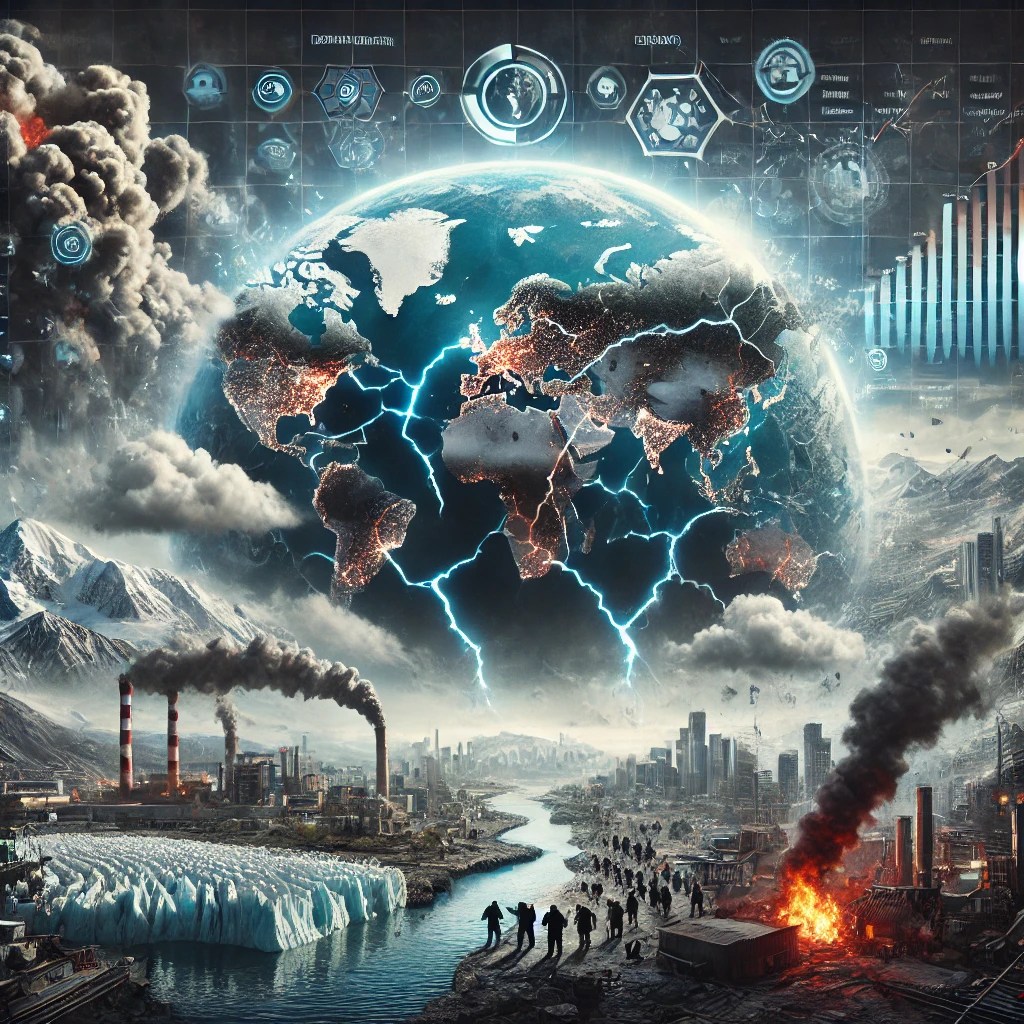
Every year, the World Economic Forum’s Global Risks Report offers a critical snapshot of the forces shaping our world. The 2025 edition paints a picture of escalating tensions, deepening fractures, and an accelerating transformation of our societal foundations. As we navigate an increasingly complex landscape, the report underscores the necessity of adaptability, resilience, and the capacity to thrive – what I call the ART of navigating uncertainty.
More than ever, this year’s report validates the idea that we are in a period of convergence – where geopolitical instability, technological disruption, societal shifts, economic volatility, environmental stress, and philosophical reorientation are colliding in ways that will redefine our future. Below, I’ve categorized the major risks identified in the report under the seven core convergence domains that I frequently discuss: science, technology, society, geopolitics, economy, environment, and philosophy.
SCIENCE: THE DOUBLE-EDGED SWORD OF DISCOVERY
The rapid acceleration of breakthroughs in AI, biotech, and genetic engineering has introduced immense opportunities but also profound risks. The report warns of adverse outcomes of frontier technologies, particularly in biotechnology and synthetic biology, where the potential for unintended consequences – from genetic modification to biosecurity risks – remain high. The intersection of AI and biotech raises ethical concerns about access, equity, and governance.
As I’ve noted before, we are not simply in an era of digital transformation – we are experiencing a second scientific revolution, one in which great invention, rather than incremental innovation, is reshaping the world. However, without a coherent framework for ethical oversight, the potential for these advancements to fuel societal disparities and even existential risks is significant.
TECHNOLOGY: ACCELERATION, POLARIZATION, AND RISK
Technology’s transformative power continues to redefine industries and societies. However, the report highlights three key concerns:
- Misinformation and disinformation are ranked as the most severe short-term risk, exacerbating societal polarization and geopolitical instability.
- Cyber espionage and warfare have become pervasive threats to national security, corporations, and individuals.
- AI and automation risks – while promising increased efficiency – pose significant challenges related to job displacement and ethical governance.
This aligns with my perspective that general-purpose technologies, such as AI, undergo an evolutionary path that moves from incremental improvements to system-wide transformations. We are entering a phase where these technologies are no longer confined to niche applications but are beginning to fundamentally reshape decision-making processes at scale.
SOCIETY: FRAGMENTATION AND POLARIZATION
One of the starkest findings in this year’s report is the rise of societal polarization as a top-tier risk. The world is experiencing deepening ideological divisions, fueled by economic inequality, social media echo chambers, and geopolitical instability. Other key societal risks include:
- Inequality, which is identified as one of the most interconnected risks, drives economic instability and governance failures.
- Erosion of human rights and civic freedoms, a sign of democratic backsliding in many regions.
- Involuntary migration or displacement, driven by conflict, climate change, and economic distress.
We are witnessing a fraying of the social contract, reminiscent of the early 20th century. Just as the Great Depression and post-war periods forced a rethink of governance and economics, we are entering another era where institutions must either adapt or risk obsolescence.
GEOPOLITICS: A FRAGMENTED AND CONFLICT-PRONE WORLD
Geopolitical risks dominate the near-term outlook, with concerns over state-based armed conflict and geoeconomic confrontations rising sharply. The report notes:
- An increase in state-based conflicts, as seen in Ukraine, the Middle East, and Sudan.
- Geoeconomic fragmentation, with trade wars, resource nationalism, and economic decoupling threatening global stability.
- Censorship and surveillance, as governments tighten control over digital spaces, exacerbating trust deficits.
The world is not only becoming more multipolar but also more unstable. As I’ve written before, the rise of competing governance models and economic blocs signals a shift from a U.S.-led global order to a more fragmented, contested landscape.
ECONOMY: SUPERCHARGED UNCERTAINTY
Economic risks are deeply interconnected with societal and geopolitical challenges. Key risks in the 2025 report include:
- Economic downturn and inflation, which remain persistent global concerns.
- Debt crises, particularly in emerging markets, are exacerbating financial instability.
- Labor shortages and workforce disruptions, driven by demographic shifts and automation.
These align with my shifting views on retirement and the need to rethink work in an era of longevity. What if, in the near future, workforce participation is redefined by adaptability rather than age? Could virtual work platforms help mitigate labor shortages while redefining economic productivity?
ENVIRONMENT: A TICKING CLOCK
Environmental risks continue to dominate long-term projections. The report warns of:
- Extreme weather events, which remain the most severe risk for the second consecutive year.
- Critical changes to Earth systems, with potential tipping points that could become irreversible.
- Natural resource shortages, including water and food insecurity, driving conflict and migration.
This underscores why I advocate for shifting the conversation from merely solving grand challenges to addressing them – recognizing that these issues require ongoing, adaptive strategies rather than one-time fixes.
PHILOSOPHY: THE BATTLE OVER VALUES AND ETHICS
While often overlooked, philosophical shifts underpin many of the emerging risks. The 2025 report indirectly touches on this through:
- The role of AI in shaping truth and trust, raising fundamental questions about epistemology.
- Ethical dilemmas in genetic engineering and human enhancement, challenging the very definition of humanity.
- Polarization in governance philosophies, as different political models vie for legitimacy in a changing world.
As I’ve long argued, the next era of human progress will be shaped not just by technological breakthroughs but by the ethical frameworks we construct to govern them. Without shared principles, we risk deepening fractures in both domestic and global governance.
GLOBAL RISKS RANKED BY SEVERITY OVER THE SHORT AND LONG TERM
The Global Risks Report 2025 ranks the most severe risks over both short-term (2 years) and long-term (10 years) horizons.
Short-Term (2025-2027)
- Misinformation and disinformation
- Extreme weather events
- Societal polarization
- Cyber espionage and warfare
- State-based armed conflict
- Inequality
- Involuntary migration or displacement
- Erosion of human rights and civic freedoms
- Geoeconomic confrontation
- Pollution
Long-Term (2035)
- Extreme weather events
- Critical change to Earth systems
- Biodiversity loss and ecosystem collapse
- Natural resource shortages
- Misinformation and disinformation
- Adverse outcomes of AI technologies
- Inequality
- Cyber espionage and warfare
- Societal polarization
- Pollution
Final Thoughts: A Call to Action
The Global Risks Report 2025 validates what I have long believed – while we cannot predict the future, we can rehearse it. By understanding convergent forces, addressing vulnerabilities, and embracing adaptability, we can position ourselves not just to withstand uncertainty but to shape the future we want to see.
The decade ahead will be defined by the choices we make today. Will we be architects of resilience or casualties of fragmentation? The answer lies in how well we prepare for the risks and possibilities ahead.
 Inside the Next Transition
Leave a comment