[…] several domains, the world has experienced a Tipping Point. As I described in a recent post on Learning from History, the point in history that experienced the most convergence occurred in the late 19th and […]
[…] explore these themes, I launched a Poll focused on catalysts. A look at history is very instructive, as several dynamics from that period have the potential to emerge once again […]
[…] multiple domains to take action. Much like the Domain Convergence that occurred during our most Transformative Period in History, convergence is required if we are to take the correct path towards human […]
[…] really like this quote from Winston Churchill. In a previous post on Learning from History, I was trying to say the same thing. One of the key learnings in looking back to our most […]
[…] advancements and scenarios is a full-time job. I have spent the better part of one year focused on History – as I look for evidence of similar periods in the past. That work has been very instructive. […]
[…] The Economist’s Hour. I find every journey to the past instructive, and my hope is we can Learn from History. This book chronicles the role of the Economist, their foray into political waters, and their […]
[…] by China. Another book that instructs from a historical context – providing possible Guidance as we look forward. A great look into why communism and socialism failed, how they are linked, and […]
[…] great advantages. He provides the code to understanding the future, which is hidden in the Lessons of History. Those that follow my work know that I am a big believer in this type of Convergence. Mr. Baldwin […]
[…] to apply historical reasoning to the future. I have invested considerable time in understanding the Cycles of History and how they help us better understand the future. As Future Thinking becomes an increasingly […]
[…] progression that the global community failed to manage. A social and economic upheaval that History has shown us before. But this time, the combination of biotechnology and information technology can […]
[…] However, global thinkers are asked to provide their views in times of crisis, and a perspective on a post-pandemic society is no exception. This recent Article provides a view from twelve different global thinkers, and while relying on the opinions of individuals informs us, history provides a lens that may be very instructive. In The Fourth Turning, the author describes the cycles of history, where each piece of the cycle is approximately 20 years in duration – adding up to a long life of 80 years. The book illuminates the past, explains the present, and reimagines the future. It offers an utterly persuasive prophecy about how the past will predict the future. Considering the headwinds that we face as a society; the book predicted a crisis that reshapes the social order prior to 2030 – much like it has throughout history. So before I summarize the predictions in the article, I want to look back one hundred years to see if there is something to be Learned from History. […]
[…] However, global thinkers are asked to provide their views in times of crisis, and a perspective on a post-pandemic society is no exception. This recent Article provides a view from twelve different global thinkers, and while relying on the opinions of individuals informs us, history provides a lens that may be very instructive. In The Fourth Turning, the author describes the cycles of history, where each piece of the cycle is approximately 20 years in duration – adding up to a long life of 80 years. The book illuminates the past, explains the present, and reimagines the future. It offers an utterly persuasive prophecy about how the past will predict the future. Considering the headwinds that we face as a society; the book predicted a crisis that reshapes the social order prior to 2030 – much like it has throughout history. So before I summarize the predictions in the article, I want to look back one hundred years to see if there is something to be Learned from History. […]
[…] article really resonated with me, as I am a firm believer in Learning from History. Something that I believe we are failing miserably at. I highly recommend the full […]
[…] launched this Poll on the catalysts that drive human action. As I mentioned back then, one of our Lessons from History was the presence of catalysts that drove actions that ultimately shaped our future. The major […]
[…] For those of us alive today, our core beliefs, the way we live, and our notion of work are rooted in the way it has been for the last 250 years. To us, it has always been this way. When a transformative era emerges, we struggle to imagine a different way of doing things – even when the emerging future is begging us to think differently. One great example lies in the future of work. As we struggle to envision a world where work is no longer required, we fail to realize that History is very Instructive. […]
[…] explore these themes, I launched a Poll focused on catalysts. A look at history is very instructive, as several dynamics from the past have the potential to emerge once again […]
[…] History is therefore indeed instructive. The authors do a great job of weaving history into their perspective, and in troubling ways, as every leading civilization has followed this path to collapse. This is what we face as a society. We will continue in our efforts to force an antiquated organizing system on top of a new system of production. Will Catalysts emerge to reverse this historical response? Can we appreciate our man-made constructs for what they are – variables not constants? For a deeper look into these questions, I highly recommend the book. I’ll close with this from the authors: […]
[…] (AI), viewing rapid advancements in AI as the sputnik moment of our times. Realizing we can Learn a Great Deal from History, Mr. Kanaan effectively applies it to our current situation. The book does a great job of […]
[…] (AI), viewing rapid advancements in AI as the sputnik moment of our times. Realizing we can Learn a Great Deal from History, Mr. Kanaan effectively applies it to our current situation. The book does a great job of […]
[…] Development. We may be in a better position to do so now then we have in quite some time. In fact, History tells us that the last time we experienced a period of great human development spanned the century […]
[…] article leverages one of my favorite approaches to understanding the future – Learning from History. We travel through the early nineteenth century and the factory-driven blue collar worker […]
[…] Conversations about work take many forms these days. Is remote work here to stay? What will a hybrid work model look like? Will we need to work in the future? In the short term, the pandemic has driven a focus on different models of working. In the long term, the polarized discussion centers on the impact of automation. That discussion is explored in incredible detail in a recent book titled Work: A Deep History, from the Stone Age to the Age of Robots. Anthropologist and author James Suzman sets out to answer several questions. He does so by looking at the history of work and the lessons we can learn. […]
[…] post of this multi-post series I explored convergence. While convergence shaped our current world, History tell us it was the presence of catalysts that drove human action. An overwhelming amount of […]
[…] is critical as we look towards the future. Readers of my Blog know that I believe we have a lot to learn from history. In his analysis of this 140-year period, Mr. DeLong shows us how the events of earlier periods […]
[…] Wave have each underscored the critical need for human action. But as I described in a post on the Lessons from History, it takes catalysts to drive actions that ultimately shape our future. A combination of […]
[…] readers of my Blog know, I find this look backward to see forward approach extremely insightful. Understanding points of failure – in this case within […]
[…] of societies weave together to create the fabric of our collective past. Here again, history is very instructive. Robert D. Kaplan delves into the complexities of the Greater Middle East, […]
[…] or poorly regulated technological augmentation could deepen inequality. Such concerns are valid. History shows we often react too slowly. Yet that doesn’t imply an inevitable dystopia. We see early […]

 Reimagining the Future
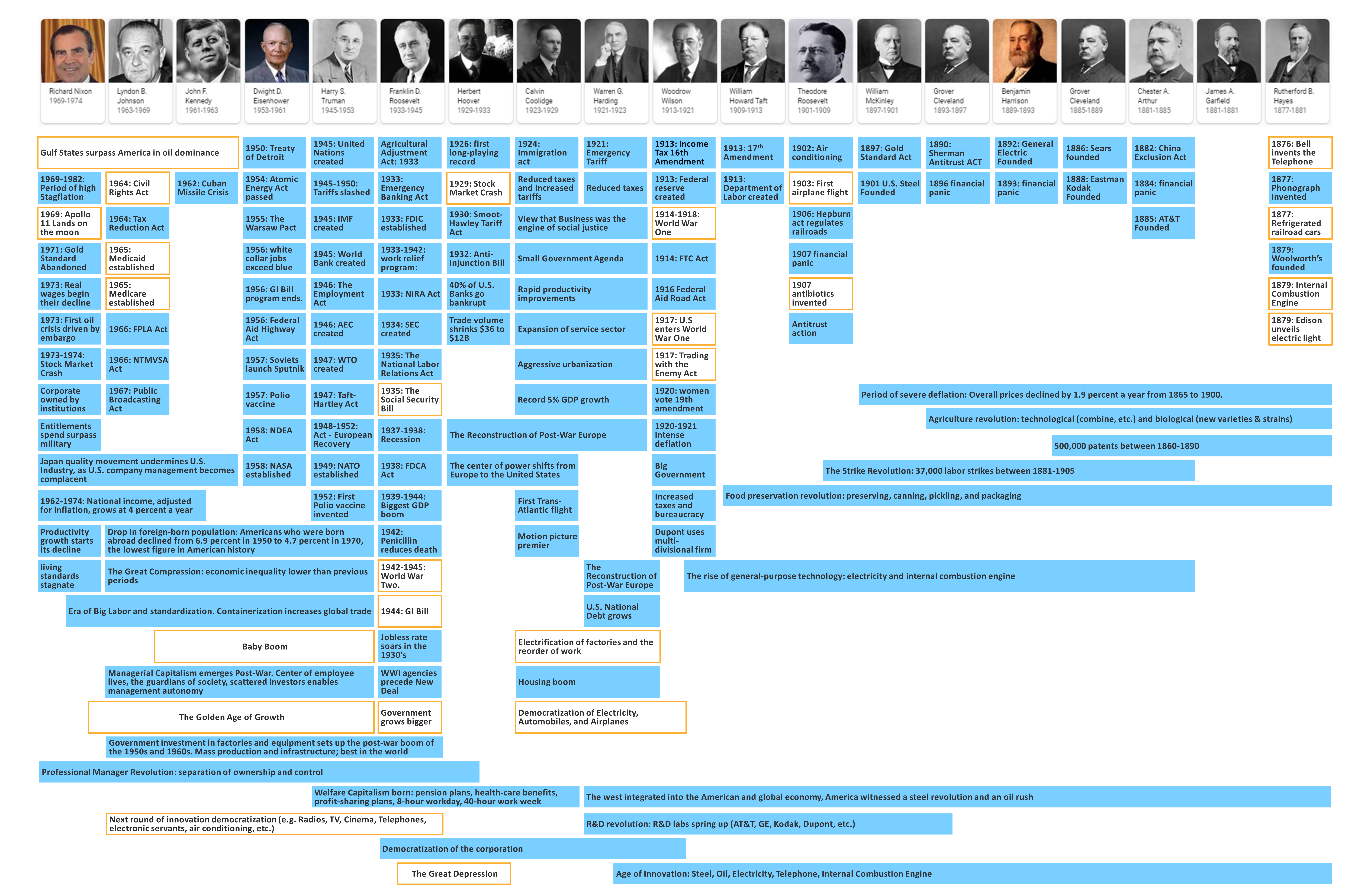
[…] A visual representation of American history – four catalysts drove a special century: Breath-t… […]
LikeLike
[…] several domains, the world has experienced a Tipping Point. As I described in a recent post on Learning from History, the point in history that experienced the most convergence occurred in the late 19th and […]
LikeLike
[…] we have Learned from History, general purpose technologies have driven massive change. First, fire and language tipped the world […]
LikeLike
[…] of our Lessons from History was the presence of catalysts that drove actions that ultimately shaped our future. The major […]
LikeLike
[…] explore these themes, I launched a Poll focused on catalysts. A look at history is very instructive, as several dynamics from that period have the potential to emerge once again […]
LikeLike
[…] multiple domains to take action. Much like the Domain Convergence that occurred during our most Transformative Period in History, convergence is required if we are to take the correct path towards human […]
LikeLike
[…] really like this quote from Winston Churchill. In a previous post on Learning from History, I was trying to say the same thing. One of the key learnings in looking back to our most […]
LikeLike
[…] advancements and scenarios is a full-time job. I have spent the better part of one year focused on History – as I look for evidence of similar periods in the past. That work has been very instructive. […]
LikeLike
[…] The Economist’s Hour. I find every journey to the past instructive, and my hope is we can Learn from History. This book chronicles the role of the Economist, their foray into political waters, and their […]
LikeLike
[…] by China. Another book that instructs from a historical context – providing possible Guidance as we look forward. A great look into why communism and socialism failed, how they are linked, and […]
LikeLike
[…] great advantages. He provides the code to understanding the future, which is hidden in the Lessons of History. Those that follow my work know that I am a big believer in this type of Convergence. Mr. Baldwin […]
LikeLike
[…] variable to consider as we gaze into the future. Let’s hope we’ve learned some Lessons from History. Are we on the brink of a second Great […]
LikeLike
[…] to apply historical reasoning to the future. I have invested considerable time in understanding the Cycles of History and how they help us better understand the future. As Future Thinking becomes an increasingly […]
LikeLike
[…] progression that the global community failed to manage. A social and economic upheaval that History has shown us before. But this time, the combination of biotechnology and information technology can […]
LikeLike
[…] However, global thinkers are asked to provide their views in times of crisis, and a perspective on a post-pandemic society is no exception. This recent Article provides a view from twelve different global thinkers, and while relying on the opinions of individuals informs us, history provides a lens that may be very instructive. In The Fourth Turning, the author describes the cycles of history, where each piece of the cycle is approximately 20 years in duration – adding up to a long life of 80 years. The book illuminates the past, explains the present, and reimagines the future. It offers an utterly persuasive prophecy about how the past will predict the future. Considering the headwinds that we face as a society; the book predicted a crisis that reshapes the social order prior to 2030 – much like it has throughout history. So before I summarize the predictions in the article, I want to look back one hundred years to see if there is something to be Learned from History. […]
LikeLike
[…] However, global thinkers are asked to provide their views in times of crisis, and a perspective on a post-pandemic society is no exception. This recent Article provides a view from twelve different global thinkers, and while relying on the opinions of individuals informs us, history provides a lens that may be very instructive. In The Fourth Turning, the author describes the cycles of history, where each piece of the cycle is approximately 20 years in duration – adding up to a long life of 80 years. The book illuminates the past, explains the present, and reimagines the future. It offers an utterly persuasive prophecy about how the past will predict the future. Considering the headwinds that we face as a society; the book predicted a crisis that reshapes the social order prior to 2030 – much like it has throughout history. So before I summarize the predictions in the article, I want to look back one hundred years to see if there is something to be Learned from History. […]
LikeLike
[…] article really resonated with me, as I am a firm believer in Learning from History. Something that I believe we are failing miserably at. I highly recommend the full […]
LikeLike
[…] launched this Poll on the catalysts that drive human action. As I mentioned back then, one of our Lessons from History was the presence of catalysts that drove actions that ultimately shaped our future. The major […]
LikeLike
[…] For those of us alive today, our core beliefs, the way we live, and our notion of work are rooted in the way it has been for the last 250 years. To us, it has always been this way. When a transformative era emerges, we struggle to imagine a different way of doing things – even when the emerging future is begging us to think differently. One great example lies in the future of work. As we struggle to envision a world where work is no longer required, we fail to realize that History is very Instructive. […]
LikeLike
[…] explore these themes, I launched a Poll focused on catalysts. A look at history is very instructive, as several dynamics from the past have the potential to emerge once again […]
LikeLike
[…] History is therefore indeed instructive. The authors do a great job of weaving history into their perspective, and in troubling ways, as every leading civilization has followed this path to collapse. This is what we face as a society. We will continue in our efforts to force an antiquated organizing system on top of a new system of production. Will Catalysts emerge to reverse this historical response? Can we appreciate our man-made constructs for what they are – variables not constants? For a deeper look into these questions, I highly recommend the book. I’ll close with this from the authors: […]
LikeLike
[…] (AI), viewing rapid advancements in AI as the sputnik moment of our times. Realizing we can Learn a Great Deal from History, Mr. Kanaan effectively applies it to our current situation. The book does a great job of […]
LikeLike
[…] (AI), viewing rapid advancements in AI as the sputnik moment of our times. Realizing we can Learn a Great Deal from History, Mr. Kanaan effectively applies it to our current situation. The book does a great job of […]
LikeLike
[…] presence – or we might mimic the world of the 1950s and 1960s. It is not the only example of History informing the […]
LikeLike
[…] Development. We may be in a better position to do so now then we have in quite some time. In fact, History tells us that the last time we experienced a period of great human development spanned the century […]
LikeLike
[…] article leverages one of my favorite approaches to understanding the future – Learning from History. We travel through the early nineteenth century and the factory-driven blue collar worker […]
LikeLike
[…] Conversations about work take many forms these days. Is remote work here to stay? What will a hybrid work model look like? Will we need to work in the future? In the short term, the pandemic has driven a focus on different models of working. In the long term, the polarized discussion centers on the impact of automation. That discussion is explored in incredible detail in a recent book titled Work: A Deep History, from the Stone Age to the Age of Robots. Anthropologist and author James Suzman sets out to answer several questions. He does so by looking at the history of work and the lessons we can learn. […]
LikeLike
[…] Learning from History […]
LikeLike
[…] post of this multi-post series I explored convergence. While convergence shaped our current world, History tell us it was the presence of catalysts that drove human action. An overwhelming amount of […]
LikeLike
[…] phenomenon emerged now and why do people expect it to drive structural change? Once again, history may provide an […]
LikeLike
[…] is critical as we look towards the future. Readers of my Blog know that I believe we have a lot to learn from history. In his analysis of this 140-year period, Mr. DeLong shows us how the events of earlier periods […]
LikeLike
Great bblog
LikeLike
[…] Wave have each underscored the critical need for human action. But as I described in a post on the Lessons from History, it takes catalysts to drive actions that ultimately shape our future. A combination of […]
LikeLike
[…] readers of my Blog know, I find this look backward to see forward approach extremely insightful. Understanding points of failure – in this case within […]
LikeLike
[…] again, history is very instructive. In this recent book, Robert D. Kaplan delves into the complexities of the […]
LikeLike
[…] of societies weave together to create the fabric of our collective past. Here again, history is very instructive. Robert D. Kaplan delves into the complexities of the Greater Middle East, […]
LikeLike
[…] or poorly regulated technological augmentation could deepen inequality. Such concerns are valid. History shows we often react too slowly. Yet that doesn’t imply an inevitable dystopia. We see early […]
LikeLike