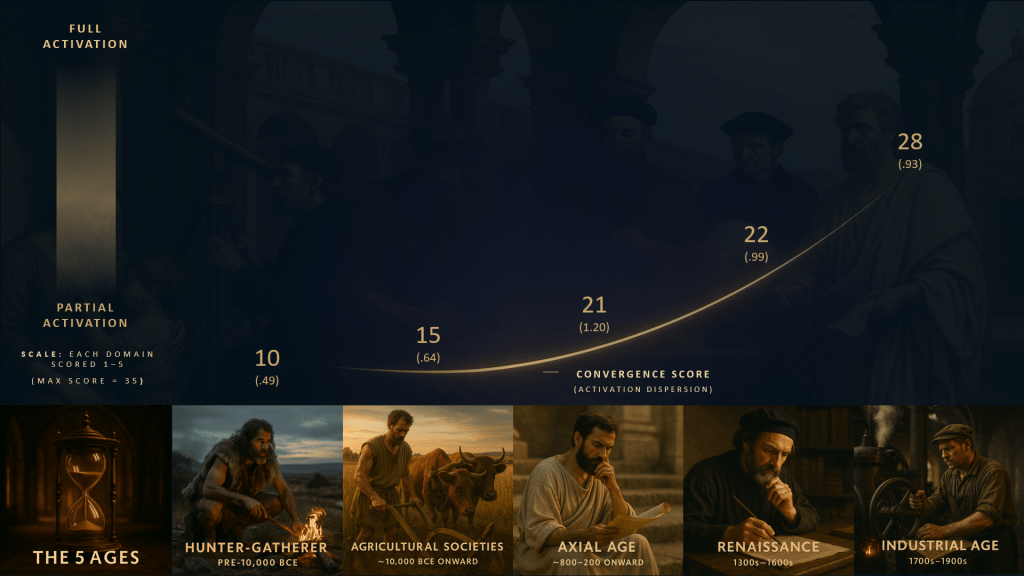
Over the first seven posts, we explored the seven domains that shape civilization, the forces that move within them, the thresholds that mark major transitions, and the drivers that push systems toward those turning points. We also built two gauges that help make those movements visible. TSDS shows how much energy sits across the seven domains. AD shows how that energy is arranged. Together, they help us see the internal structure of an age: how active its domains were, how evenly that activity spread, and how tightly the system was coupled. With that groundwork in place, we can now use the gauges to trace the long arc of history and examine how pressure accumulated across major ages of civilization.
The table below brings the gauges and the ages together. It uses the same seven domains that anchor this entire series. These domains remain constant across history because they represent the broad areas of human activity that have always shaped collective life: science, technology, society, geopolitics, economics, philosophy, and the environment. What changes across ages is not the domains themselves, but how active they become and how they relate to one another.
Domain Activation by Age

The Bio-Intelligence column captures a pattern emerging in the present day. It is included for continuity, but this post focuses only on the five completed ages. To read this table clearly, a few foundational points matter.
How TSDS Works
TSDS is the sum of activation across the seven domains. Each domain is scored from 1 to 5. The lowest possible TSDS is 7. The highest possible TSDS is 35. A high TSDS does not mean an age was more advanced. It means more domains were active shapers of life. As civilization became more complex, more domains activated, and TSDS rose accordingly.
How AD Works
AD measures how evenly activation is spread across the domains. A low AD means the domains sit at similar levels. A high AD means one or two domains pull far ahead of the others. The meaning of low AD changes over time. Early in history, low AD reflects broad uniformity. Later in history, low AD reflects synchronization. The number itself is less important than what it says about the shape of the system.
Why the Late-Stage Signature Matters
Every age evolves internally. Early in an age, one or two domains may dominate. Later in the age, others accelerate, closing gaps or creating new ones. The late-stage signature reveals the configuration that became most visible as each age approached transition, when pressure was strongest and the internal relationships were clearest.
Why These Numbers Look the Way They Do
The activation levels are relative. A score of 4 in the Renaissance does not match a score of 4 in the Industrial Age. Each score reflects how much a domain shaped the internal structure of its own age. This avoids imposing modern expectations on ancient civilizations and keeps the focus on structural patterns rather than absolute capability. With that background in place, we can turn to the ages themselves.
TSDS and AD describe the internal structure of an age, but structure alone does not produce transition. Transitions occur when the configuration of an age runs into constraints it can no longer absorb. In early history, those constraints were external — climate, geography, and survival limits. Later, they became internal — institutional rigidity, moral tension, technological acceleration, and environmental feedback.
Low activation does not imply low sensitivity. Early systems were simple, but they were also tightly constrained, with little slack. Small shifts in constraints could therefore force large reorganizations. As activation increased across history, constraints migrated from nature into social systems, technologies, and networks. Each age resolved one set of constraints while quietly constructing the next. TSDS shows how much energy accumulated. AD shows how that energy was arranged. Constraints determine when that arrangement could no longer hold.
The Hunter–Gatherer Age
By the late Hunter–Gatherer period, the system settled into a uniform pattern of modest activity across domains. The TSDS of 10 reflects a world where only a few domains played significant roles in everyday life. AD sits at 0.49, showing that the domains moved at similar levels. Life was shaped almost entirely by the environment and small-scale social organization. Pressure accumulated slowly. Changes did not travel far, and nothing in the system pushed other domains into rapid motion.
The system was stable but tightly constrained by immediacy. Survival depended on unpredictable environmental cycles, leaving little room for surplus, planning, or scale. When climate patterns stabilized, that constraint shifted. Even modest increases in predictability made settlement and coordination viable, forcing a transition not because activation was high, but because the rules of survival had changed.
The Agricultural Age
By the late Agricultural Age, TSDS rises to 15 as more domains begin to influence daily life. Economics and society anchor the early period, and later in the age, geopolitics and philosophy expand. AD increases to 0.64, reflecting the growing unevenness between domains as some intensify while others develop more slowly. The system becomes richer and more layered, but still moves at a pace defined by local and regional constraints. Pressure spreads farther than before, but remains gradual.
The Agricultural system resolved survival constraints by producing stability and surplus, but it introduced a new limitation: meaning. As societies grew more stratified and institutions hardened, material order outpaced moral coherence. This gap became the dominant constraint of the age, setting the conditions for philosophy and ethics to reorganize social life in the Axial transition.
The Axial Age
The Axial Age produces one of the clearest signatures in the table. TSDS rises to 21, showing a meaningful increase in overall activation. But the defining feature is AD, which peaks at 1.20. This is the most uneven pattern in history. Early Axial life is driven by a surge in philosophy, which accelerates far ahead of science, technology, economics, and geopolitics. Later in the period, other domains begin catching up, but the disparity remains large. The system stretches in multiple directions, and pressure surfaces in unpredictable ways. Transformation becomes a defining experience.
The Axial Age expanded moral and philosophical frameworks faster than material systems could support them. Ethics, governance, and meaning advanced, but technological and scientific capacity lagged. Over time, this imbalance became constraining. Ideas accumulated without sufficient means of expression or experimentation, creating pressure for renewed inquiry and practical application — the spark that reignited science and experimentation in the Renaissance.
The Renaissance
By the late Renaissance, TSDS nudges upward again to 22. The more important shift appears in AD, which falls to 0.99. Multiple domains begin to move more closely together. Early in the Renaissance, society, science, and philosophy reignite inquiry and experimentation. Later in the period, technology, economics, and geopolitics accelerate, narrowing the gaps between domains. The system becomes more connected and more responsive. Pressure spreads more smoothly because several domains now reinforce one another.
The Axial Age expanded moral and philosophical frameworks faster than material systems could support them. Ethics, governance, and meaning advanced, but technological and scientific capacity lagged. Over time, this imbalance became constraining. Ideas accumulated without sufficient means of expression or experimentation, creating pressure for renewed inquiry and practical application — the spark that reignited science and experimentation in the Renaissance.
The Industrial Age
The late Industrial Age shows one of the highest levels of activation in the entire table. TSDS reaches 28, reflecting a world where nearly all domains are strongly active. At the same time, AD falls to 0.93. Early in the Industrial Age, technology and economics break away from the others, creating sharp unevenness. Later in the age, science, society, philosophy, and geopolitics catch up. The system tightens. Changes in one domain quickly affect the rest. Pressure accelerates because the system holds less slack than in earlier ages.
The Renaissance reduced ideational imbalance by reconnecting knowledge, inquiry, and experimentation, but it remained constrained by scale. Production, energy, and mobility were still limited by human and animal power. As scientific understanding matured, this energy constraint became decisive. The Industrial transition occurred when technology broke that boundary, reorganizing the system around acceleration and mechanical scale.
Structural Patterns Across the Ages
Three patterns appear consistently across the long arc of history.
- TSDS rises steadily as civilizations grow more complex and more domains become active contributors to daily life.
- AD rises, peaks in the Axial Age, and then falls as domains begin moving in closer alignment.
- The system evolves from uniform modest activation to uneven surges to synchronized acceleration.
The following table summarizes these shifts.
TSDS and AD Across the Ages
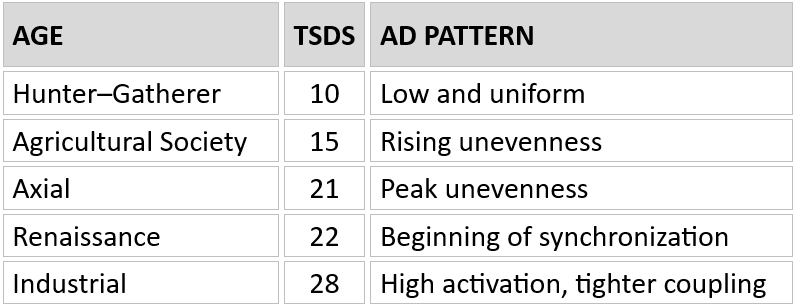
Across these ages, the system becomes denser and more interdependent. Early ages change slowly because activation is modest and evenly distributed. Middle ages change unevenly because one or two domains surge while others lag. Later ages change rapidly because multiple domains accelerate together. As activation rises and alignment tightens, pressure spreads faster and reaches farther. The assumptions that held earlier ages together no longer match the pace or shape of the system.
In the next post, we turn to the moments when these internal pressures became visible turning points. By examining how TSDS and AD shifted as each age approached its threshold, we can see why some transitions unfolded gradually while others arrived with force, and why civilizations repeatedly reorganized themselves as their domains converged.
THE SERIES TO DATE
- When Systems Turn Over
- Why Everything Feels Like It’s Changing At Once
- How Big Shifts Unfold — And Where We Are Now
- Why No Single Force Changes The World
- The Three Drivers That Push Civilizations Across Thresholds
- Reading The Pulse Of A Civilization In Motion
- How The Gauges Were Built: Making Systemic Pressure Legible
 Inside the Next Transition
Leave a comment