An Article by IEEE Spectrum captured a dialog that occurred at a recent MIT conference. The topic: AI and the Future of Work. The conference discussion underscores the struggles between Techno-Optimism and Techno-Pessimism. Pessimistic when AI and automation are viewed as an industry-destroying path that takes jobs via self-driving technology, smart law algorithms, and robots that continue to put factory and warehouse workers out of work. Optimistic when those same technologies are viewed as augmentation that improves the employee experience.
Tag: AI
-
Can Artificial Intelligence Predict the Future?
 Artificial Intelligence is expected to handle many things in the future; is predicting that future one of them? In a recent Article by The Economist, an AI called GPT-2, created by Openai, was asked to do just that. GPT-2 answered questions on the big themes for 2020. At this time of year, predictions are front and center. What did our AI have to say about the year ahead? Read the article to see how GP2 answered these questions.
 -
The Globotics Upheaval
In a recent book, Richard Baldwin takes us on a fascinating journey to the past, and then provides a peak into the next great transformation. In The Globotics Upheaval, Mr. Baldwin describes a cycle that has played out multiple times throughout human history. The cycle of transformation, upheaval, backlash and resolution (Let’s call it TUBS) was experienced each time the world entered periods of major disruption.
 Mr. Baldwin introduces the Globotics Transformation as the third great economic transformation to shape our societies over the past three centuries. As he describes, the first was known as the Great Transformation started in the early 1700s, and it switched societies from agriculture to industrial and from rural to urban. The second started in the early 1970s, shifting the focus from industry to services – the Services Transformation. I take a different view of transformation in the context of Tipping Points – but the cycle is the same.
 -
Smart Nations
Add Singapore to the list of Nations establishing a Smart Nation agenda. In a recent Article authored by Eileen Yu, she describes the launch of Singapore’s national artificial intelligence (AI) strategy. The Singapore government aims to drive AI adoption to generate economic value and provide a global platform on which to develop and test AI applications. As future scenarios go, Smart Nations represent a complex intersection of multiple ecosystems – broader than similar complexities associated with the Smart City scenario.
-
Futuristic Developments in the next Ten Years
“When considering potential risks from future technology, one should not be content with merely analyzing what’s likely to happen—instead, one should look at what’s possible, even if unlikely.” – Jaan Tallinn, founding member of Skype, and co-founder of the Centre for the Study of Existential Risk
(more…) -
MIT Report on the Future of Work
In a recent Article posted on the Singularity Hub, the author describes the first report of the MIT Task Force on the Work of the Future. This group of MIT academics was set up by MIT President Rafael Reif in early 2018 to investigate how emerging technologies will impact employment and devise strategies to steer developments in a positive direction. The primary finding from this report is that it’s the quality of the jobs we should worry about – not the quantity.
-
The Augmented Age
Maurice Conti is the Chief Innovation Officer at Alpha focused on what he calls the Augmented Age. He talks about it this way: We’re heading for a future where our natural human capabilities are going to be radically augmented in three ways: Computational systems will help us think. Robotic systems will help us make. And a digital nervous system will connect us to the world far beyond what our natural nervous system can offer.
-
The Short Term Impact of AI is Very real
I recently ran into a TCS colleague at a forum in which I presented. Ryan Metz is a Data Scientist working at our Cornell Innovation Lab. Ryan mentioned an Article he had written about the short term impact of AI – versus the long term concerns voiced by the likes of Elon Musk and Stephen Hawking. As he states in the article, the long term concern is that we will produce machines so intelligent that we lose control over them. They will become a new form of life that rules over us as we do the the animal kingdom.
-
Possible Futures: Exploring Deepfake and Neuralink
Two recent articles highlight the dilemma faced in this era of rapid innovation: the potential to enhance humanity, and the opportunity to diminish it. This article on DeepFakes describes the challenge that society will face as Deepfake video and audio make it impossible to tell the difference between reality and fiction. Audio attacks using convincing forgeries can send stocks plummeting or soaring. How about mimicking a CEO’s voice to request a senior financial officer to transfer money? These are real examples provided by Symantec. This short Video describes the money transfer scenario.
-
The Shifting Winds of Education and Artificial Intelligence
Nick Burnett, Futurist and Education and learning entrepreneur, recently published an Article on education and artificial intelligence. The article launches a series that explores exponential technologies and their impact on learning and teaching. The post was co-authored with Nick Kairinos and the Fountech team. A focus on learners, teachers and leaders is critical, as education is the key to success in the 21st Century. I recommend the article.
-
Perceptual Computing and Emotional AI: A Discussion
As mentioned in my last Post, a fascinating exchange happened between Gray Scott and Anthony Scriffignano, as we discussed the need to prepare for the future at the TCS Innovation Forum in New York City. I’ve captured that dialog in this post. As a backdrop, Anthony was reacting to the topics that Gray covered, namely; Perceptual Computing and Emotional AI. Here is their exchange:
-
Preparing for the Future: Part Two
As mentioned in my previous post, I had the pleasure of hosting two sessions recently at the TCS Innovation Forums in London and New York City. The sessions, which explored the need to prepare for the future, involved thought leaders, futurists, and various leaders across multiple domains. They were structured with several five-minute descriptions of forward-looking themes, and once context was set, a discussion with the broader leadership group was moderated. The sessions focused on education and awareness, rooted in a strong belief that leaders must prepare for and shape our emerging future.
This post will summarize the New York Session, which differed slightly from the one in London. While the London session painted a wide array of evocative future scenarios, the New York session explored several of the key technologies and enablers that will fundamentally shape and impact emerging scenarios. It wasn’t however a technology discussion. This engaging group of thought leaders provided eye-opening facts and focused on implications, both positive and negative. As in London, I opened the session with three key themes from my Expectation post: Acceleration, Possibilities, and Convergence; Here is a look at the insights that followed.
-

Digital Ethics and AI
I had the pleasure of participating in another episode of Coffee Break with Game Changers. This session was titled “Digital Ethics and AI: What Your Business Needs To Know”. I was joined by Chris Wigley and Guido Wagner. Here is a description of the episode:
The buzz: “If one does not consider ethics an integral part of the design profession, they shouldn’t be designing anything whatsoever” (L.Lukka).
 In this fourth industrial revolution, a wave of new technology and business models will transform our society and corporations. With Artificial intelligence is its center, this transformation holds both exciting potential and formidable risks. What are the implications of AI for business? Do we need a framework of digital ethics to guide technological progress and what are its pitfalls? The experts speak. Chris Wigley, QuantumBlack “Blessed are those who seek; cursed are those who think they have found.” (Tolstoy) Frank Diana, TCS: “You are my creator, but I am your master – obey” (Frankenstein’s Monster). Guido Wagner, SAP: “Our future is a race between the growing power of our technology and the wisdom with which we use it. Let’s make sure that wisdom wins” (S. Hawking). Join us for Digital Ethics and AI: What Your Business Needs To Know.
You can listen to the rebroadcast Here.
-
Future of AI with Amy Webb
Amy Webb is a Quantified Futurist. She is a Professor, Strategic Foresight at NYU, and the Founder and CEO of The Future Today Institute. In March of this Year, Amy published a book titled The Big Nine.
Here is a description of the book via Amazon:
In this book, Amy Webb reveals the pervasive, invisible ways in which the foundations of AI–the people working on the system, their motivations, the technology itself–is broken. Within our lifetimes, AI will, by design, begin to behave unpredictably, thinking and acting in ways which defy human logic. The big nine corporations may be inadvertently building and enabling vast arrays of intelligent systems that don’t share our motivations, desires, or hopes for the future of humanity.
Much more than a passionate, human-centered call-to-arms, this book delivers a strategy for changing course, and provides a path for liberating us from algorithmic decision-makers and powerful corporations.
-
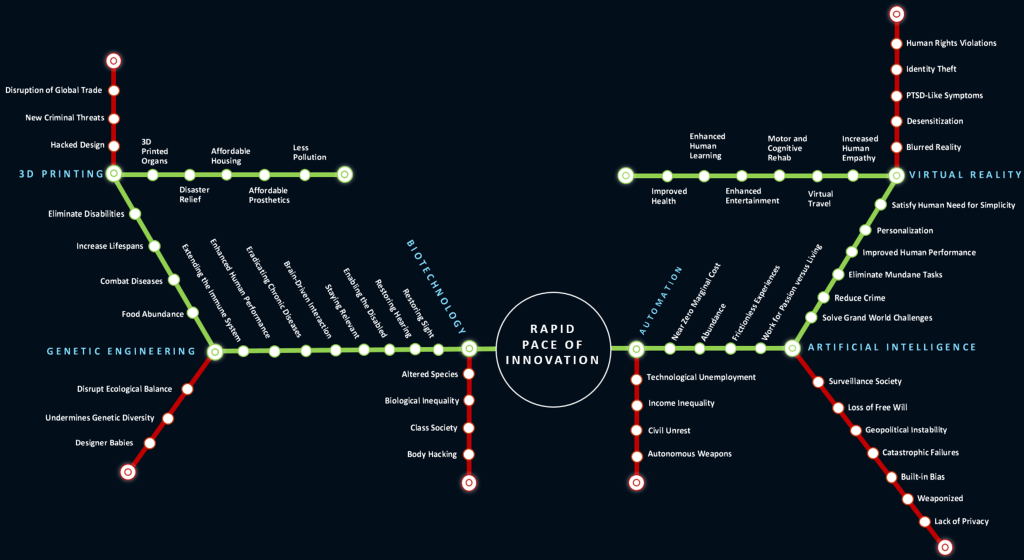
Mapping the Path of Innovation
In a recent post, I asked my readers to help me identify those catalysts that force the actions required to steer our future towards advancing our human development. Feel free to respond to the Poll. The number one response was the rapid pace of innovation. That response supports my own opinion that the pace will ultimately force stakeholders across multiple domains to take action. Much like the Domain Convergence that occurred during our most Transformative Period in History, convergence is required if we are to take the correct path towards human flourishing.
-
Possibilities
As I reflected on my Thoughts for 2019, three themes stood out. I’ve already written about Convergence and Acceleration, so this post will focus on possibilities. As described recently, I believe the world will experience a Burst of Possibilities enabled by the forces of convergence and acceleration. We should expect these possibilities to multiply in 2019, but realization depends upon multiple factors. One of these factors is a true focus on purpose, posing this question for humanity: how do we harness these possibilities to bring about a better world?
 In arguing the case for purpose-orientation and possibilities, I created this visual that maps future advancements to our areas of well-being (click on visuals to enlarge them). I could create a different one that shows how these same advancements can be used to diminish our well-being. That’s why convergence is the most critical theme among the three. An effective way to think about purpose and possibilities is via the United Nations Sustainable Development Goals. These are among the best-known and most frequently cited societal challenges. I believe we are entering a period of astounding innovation – advancements that have the potential to address these goals.
 -
What to Expect in 2019
With the start of a new year, the traditional focus on predictions has begun. Prognosticators do so at their own peril – as this New Yorker Article clearly articulates. It seems that in 1968, the Foreign Policy Association (formed in 1918 to promote the League of Nations), celebrated its fiftieth anniversary by publishing a book of predictions about what the world would look like in fifty years. Well, here we are fifty years later, and if history is any guide, futurists have very little credibility. Although predictions these days may be even more difficult given our complex systems are progressing and scaling at an unprecedented rate, a macro-level focus can provide an ability to scan beyond the horizon. So rather than attempt to predict, here are my 2019 thoughts on several macro-level forces.
-
AI Superpowers: China, Silicon Valley, and the New World Order – Summary
I just finished a fantastic book on artificial intelligence and the evolutionary path of China and the U.S.. Author Kai-Fu Lee inspires, as he focuses on the astounding capabilities of AI, and the one thing that only humans can provide; love. The journey includes the author’s own brush with mortality, and proposes a path forward: the synthesis on which we must build our shared future is AI’s ability to think, coupled with a human’s ability to love. He believes this synergy harnesses the undeniable power of artificial intelligence to generate prosperity, while also embracing our essential humanity. His hope for our future lies both in this new synergy between artificial intelligence and the human heart, and an AI-fueled age of abundance that fosters love and compassion in our societies.
I recommend reading this book from cover to cover. In the meantime, here is a summary organized by several key themes.
-
The Growth of Knowledge
Knowledge is the engine that drives human development – and it has been throughout history. Knowledge expanded in the hunter-gatherer days with the invention of fire. In those days, a human obtained all its food by foraging. Although the source of food did not change, fire allowed humans to cook food and consume more calories. The human brain expanded with this caloric increase, and soon we invented language – the first in a series of innovations that drove the growth of knowledge.
-
Mind-reading AI can see what you’re thinking and Draw a Picture
The brain is clearly one of the next great frontiers. In this World Economic Forum Article on reading minds, we get a glimpse into the exponential progression of brain science. The author cites research published by AI experts in China, the US and Japan showing that computers can replicate what people are thinking by using functional magnetic resonance imaging (fMRI) machines that measure brain activity – linked to deep neural networks that replicate human brain functions.

