
Every society invents new ways to organize power. Each system begins as an answer to the limits of the one before it – and eventually becomes the next problem to solve. As our world grows more interconnected, the frameworks that once defined legitimacy and belonging are starting to crack. Something new is forming in the spaces between.
Political order has always evolved in response to complexity. Each form of governance arises to solve the constraints of its predecessor. When a way of organizing people can no longer keep pace with the scale of human activity, it gives way to something new. The story of humanity is, in many ways, the story of how we have learned to govern at increasing levels of scale – from kinship to code.
Tribes — Belonging Through Kinship
The earliest political order was intimate and human. Tribes governed through shared ancestry, story, and survival. Authority was personal, drawn from proximity and trust. Belonging came through blood and narrative, and decisions were rooted in relationships rather than institutions. This intimacy was both strength and limit. Order existed only within reach of the firelight.
Empires — Order Through Hierarchy
As populations expanded, kinship alone could not sustain coherence. Empires arose to manage scale – centralizing power, codifying law, and enforcing order through armies, religion, and bureaucracy. For the first time, strangers could be governed. The empire extended authority beyond personal ties, creating vast systems of control. But in doing so, it replaced belonging with obedience.
City-States — Belonging Through Civic Identity
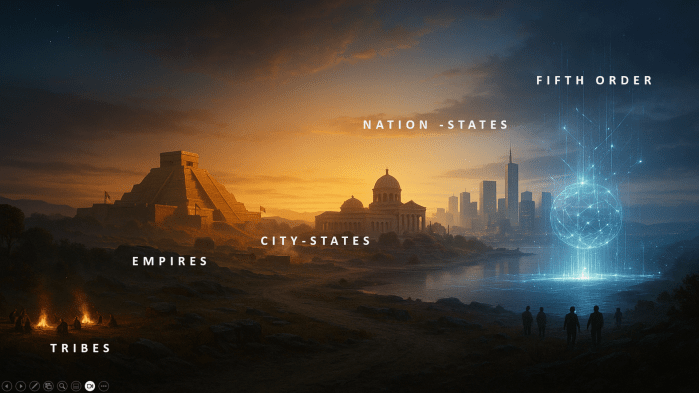
Empires eventually became too rigid to adapt. A new idea took hold: that governance could emerge from participation rather than subordination. The city-state was small enough for voice to matter and large enough to innovate. In places like Athens, Venice, and Florence, citizens built governance on shared ideals, trade, and culture. Civic identity replaced lineage as the foundation of belonging. It was the birth of the public – and the beginning of political imagination as a human project.
Nation-States — Legitimacy Through Sovereignty
The nation-state scaled the civic experiment to entire populations. Citizenship replaced city walls. Law replaced lineage. Identity became national rather than local. For centuries, this model delivered extraordinary progress. It industrialized economies, standardized education, and united millions under shared symbols and laws. But the conditions that made the nation-state powerful – borders, bureaucracy, and control – now limit its reach. In a world shaped by global networks, markets, and digital flows, sovereignty has become porous. Power is no longer confined to geography.
The Emerging Fifth Order
A new political order is forming – one that blends human governance with digital coordination. Its shape is not yet defined, but several trajectories are emerging.
AI as Governance. Algorithms are beginning to manage systems once reserved for human oversight – from logistics and energy to health and policy modeling. Governance could become adaptive and predictive, but also opaque and unaccountable. Authority may shift from consent to optimization.
Technology Companies as the New States. Global platforms regulate speech, commerce, and identity at planetary scale. They govern attention and data – the defining resources of our age. Power is migrating from public institutions to private networks that operate beyond national law.
Networked City-States. Major cities are re-emerging as autonomous centers of culture, economics, and policy. Linked by digital networks and AI coordination, they may form a planetary mesh – a return to city-level sovereignty, but with global reach.
Value-Based Federations. As shared purpose replaces shared territory, communities may organize around missions rather than geography – climate action, data ethics, health longevity. Belonging could shift from map to meaning.
The Pattern Beneath the Pattern
Every political order carries a paradox. Tribes united through belonging but excluded the unfamiliar. Empires achieved scale but erased individuality. City-states empowered citizens but fractured easily. Nation-states built legitimacy but now strain under interdependence. The next order will face its own contradiction: balancing intelligence and agency. As decision systems become adaptive and self-correcting, how will humans retain voice, consent, and moral responsibility?
From Shared Blood to Shared Intelligence
The long arc of governance can be read as a journey of belonging – shared blood, centralized rule, civic participation, national identity, and now digital belonging. The Fifth Order may not be a single model at all, but a distributed architecture: part algorithm, part city, part collective consciousness. It may govern less through territory and more through coordination – the flow of data, values, and shared purpose.
As before, the challenge will not be building systems that function, but ensuring they remain human. The next political order may not be ruled by kings, parliaments, or presidents. It may be guided by the intelligences we create – and by the values we choose to embed within them.
Closing Reflection
Across time, political orders have shifted whenever complexity outgrew control. That threshold has arrived again. The question is not whether governance will evolve, but whether our next design for power will still remember what it means to belong.
Discover more from Reimagining the Future
Subscribe to get the latest posts sent to your email.
 Reimagining the Future
thank you for this historical reflection on governing.
The nation state is ending and I believe the opportunity for self-governing communities and bio regionalism based upon sustainability are critical and emerging-
The centralization of wealth, technology will increase individualism and our challenge is values of care and the need to be local…using technology for international relationships.
The transition from one epoch to another is also about time .
rich feldman richarfeldman60@gmail.com
LikeLiked by 1 person