In his eight post in the series, Marshall Kirkpatrick focuses on the intersection between artificial intelligence and blockchain. By way of reminder, Marshall launched a 30 day series that explores the intersection between AI and the various innovation components on my emerging futures visual.
Tag: Artificial Intelligence
-
Artificial Intelligence Intersects with Genomics
In his seventh post in the series, Marshall Kirkpatrick focuses on the intersection between artificial intelligence and genomics. By way of reminder, Marshall launched a 30 day series that explores the intersection between AI and the various innovation components on my emerging futures visual.
-
Artificial Intelligence Intersects with Renewable Energy
In his sixth post in the series, Marshall Kirkpatrick focuses on the intersection between artificial intelligence and renewable energy. By way of reminder, Marshall launched a 30 day series that explores the intersection between AI and the various innovation components on my emerging futures visual.
-
Artificial Intelligence Intersects with Mobile and Cloud
In his fourth post in the series, Marshall Kirkpatrick focuses on the intersection between artificial intelligence and Mobile, and in the fifth he focuses on cloud. By way of reminder, Marshall launched a 30 day series that explores the intersection between AI and the various innovation components on my emerging futures visual.
-
Artificial Intelligence Intersects with Fintech
In his third post in the series, Marshall Kirkpatrick focuses on the intersection between artificial intelligence and Fintech. By way of reminder, Marshall launched a 30 day series that explores the intersection between AI and various future scenarios anchored by my emerging futures visual.
-
Artificial Intelligence Intersects with 3D Printing
In his second post in the series, Marshall Kirkpatrick focuses on the intersection between artificial intelligence and 3D Printing. By way of reminder, Marshall launched a 30 day series that explores the intersection between AI and various future scenarios anchored by my emerging futures visual.
-
Artificial Intelligence and Future Scenarios
I had the pleasure of talking to Marshall Kirkpatrick recently about his work at Little Bird and a new series on artificial intelligence that he just launched. Marshall has leveraged my emerging futures visual in the past, and is using it to steer the direction of his series. The first article focuses on How Artificial Intelligence Could Change the Future of Food.
-
Blockchain, Artificial Intelligence, Renewable Energy and More
The airwaves are filled with talk of exponential technologies like Blockchain, Artificial Intelligence, Robotics, Renewable Energy and more. In addition, societal factors that influence or are influenced by technology are getting more attention. So what’s the buzz?
(more…) -
Technology and Ethics
Some in the Futurist community are focused on technology and ethics. Gerd Leonhard has been particularly vocal on the topic. I’ve dedicated a section of my keynote to what I believe will be a growing dialog. I use this slide to pose a question to the audience:
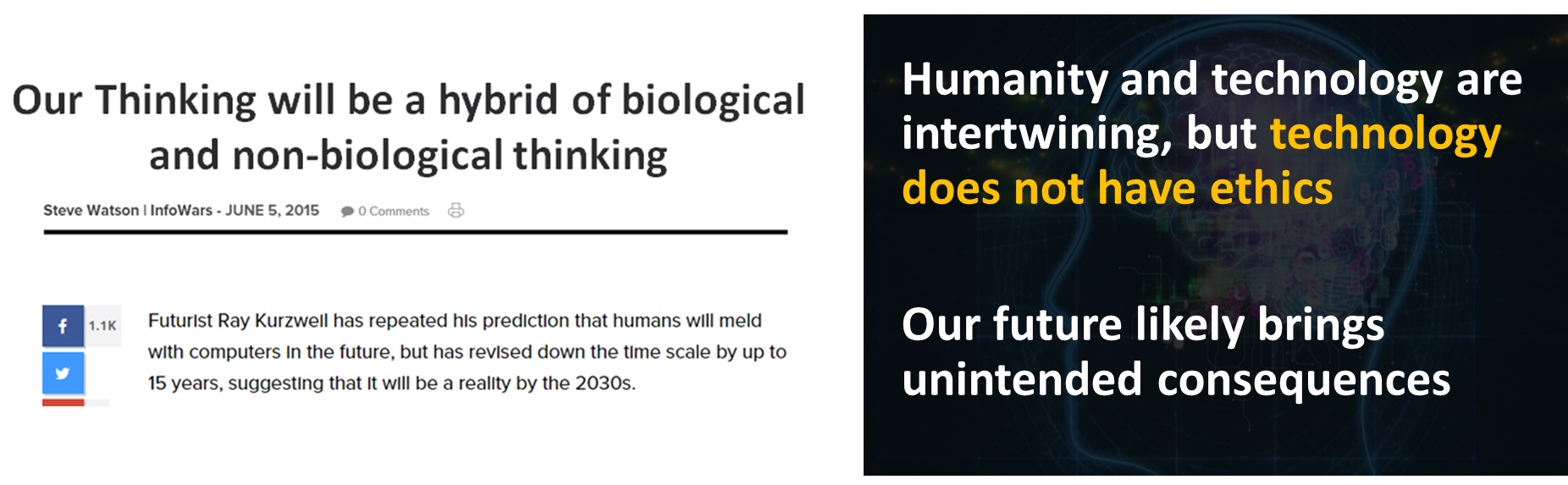
The example provided above comes from Ray Kurzweil, famous Futurist, Inventor and author. In an appearance at last years Exponential Finance conference, Kurzweil said this:
“Our thinking will be a hybrid of biological and non-biological thinking. We’re going to gradually merge and enhance ourselves. In my view, that’s the nature of being human – we transcend our limitations. We’ll be able to extend (our limitations) and think in the cloud. We’re going to put gateways to the cloud in our brains.”
-
The Modern Workforce: Four Crucial Shifts
Here is the summary of a recent article I wrote for the Insurance Innovation Reporter. Please visit their site to see the full Article.
Accelerating advancements in science and technology have set the foundation for massive shifts in the decades ahead, yet we continue to operate on a platform meant for a different time. This platform has hit a productivity wall, and a new emerging platform has changed the expectations of those we engage with. As they advance, these shifts will challenge our long held beliefs and intuition, while changing long standing business models across industries. In the face of this, organizations must unlearn what they know and embrace new ways of thinking. This is especially important in our approach to the workforce and the evolution of our management paradigm. How we lead the modern workforce will require change, and it starts with four crucial shifts: embrace a new way of working, move towards a collaborative management paradigm, value human characteristics, and plug into the emerging platform.
-
Technology, Social Change, and Future Scenarios
If we are to Think about the Future in a way that helps us thrive in that future, we must excel at connecting dots. I developed the Future Scenarios visual in an attempt to help visualize the dots, as well as the various intersections that amplify the impact of those dots. In parallel with this scenario view, I have looked at various aspects of social change that both influence and impact these scenarios – and vice versa – but until now, those views were separate. Convergence is occurring not just across the technology and future scenario curves, but also the various aspects of social change. So in the interest of maximizing future thinking impact, I have combined the two views and will describe a connecting the dots scenario. First, the new future scenario visual:

-
World Economic Forum – Deep Shift
A must read on six mega-trends, their tipping points and societal impacts. I recommend this for anyone with interest in where the world is heading, and/or tasked with future thinking in the context of strategy. I commend the World Economic Forum for their efforts here, as education is likely to spur action. The six mega-trends are:
- People and the internet
- Computing, communications and storage everywhere
- The Internet of Things
- Artificial intelligence (AI) and big data
- The sharing economy and distributed trust
- The digitization of matter
Here is a tipping point timeline from the report:
Many leaders are struggling with the sheer number of future scenarios and some indication of when the tipping point may arrive. This material provides critical input into the scenario and response analysis process. Enjoy the read.
-
Anticipating 2025 – Part Three: Redesigning Artificial Intelligence
Part three of Anticipating 2025 will summarize the third section of the book. This section focused on redesigning artificial intelligence, with a look at six important questions and the exploration of human-machine mergers. The six questions explored in this section are:
- Can we create a human-level artificial intelligence?
- If so, when?
- Will human-level artificial intelligence lead to super-intelligence?
- If super-intelligence arrives, will we like it?
- Can we upload our minds to computers?
- Can we de-risk the arrival of super-intelligence?
Like the first two sections, this section forces us to look at disruption through a different lens. Granted, the path forward is highly speculative, and even the most optimistic scenarios are likely years away from having transformative implications. Nonetheless, it does force us to broaden our lens beyond traditional views. For example, I’ve focused on the automation of knowledge work and all its ramifications, while the authors (Calum Chace, Martin Dinov, and Elias Rut) focus on creating super-intelligence by uploading our minds to computers. They explore a human-machine merger that they see as the enabler of super-intelligence benefits realization. This merger in the author’s view is the only way to avoid creating our successor. So yeah, that’s a little more impactful than automating knowledge work.
-
Anticipating 2025 – Part Two: The Future of Medicine
Part two of Anticipating 2025 will summarize the second section of the book. This section focused on three broad topics:
- Will advancing technology make doctors unemployed?
- The future of medicine and the convergence of nanotechnology and biology
- Rejuvenation Biotechnology program
It is fascinating to view this section through a disruptive and transformative lens. The acceleration of scientific advancement intensifies the degree and speed of change, thus positioning the type of paradigm shift that we have not seen since the steam engine. As this recent Forbes article points out, even The Acceleration is Accelerating.
The first topics author is Maneesh Juneja, Digital Health Futurist, and Founder of the Health 2.0 London Chapter. In the opening discussion, the author focuses on technology advancement and the future role of doctors. He describes a backward healthcare system that focuses on treatment versus prevention, and the difficulties of solving this problem when there is no profit in prevention. In researching systems from the past, the author looked at ancient China, where it is said that doctors only received payment while their patients stayed healthy. The author then explores the technologies projected to change the practice of medicine:


