In a recent Article, author Bernard Marr describes the five most important job skills of the future. A conversation that is tightly linked to the role of education, and a topic I have explored in Several Posts. Mr. Marr states that the pace of change is being driven by several factors. He paints a picture of an interconnected world that allows us to work remotely and with people from different cultures as easily as if they were in the office next door. The Healthy Extension of Life allows us to work longer, creating an age-diverse workforce. Combined with science fiction becoming reality, machines suddenly augment our skills and free us up to focus on higher-level activities.
Author: Frank Diana
-
The Global Fertility Crisis
Bloomberg BusinessWeek recently posted an article describing the Global Fertility Crisis. As we look at the forces likely to shape our future, we spend a lot of time and media cycles analyzing the exponential progression of science and technology.
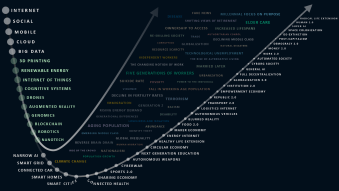 This powerful force is having a profound impact on society. But the opposite is also true: society is influencing the path of innovation. Societal Factors play as big a role in establishing the path of our emerging future. I placed societal factors in the middle of the visual I use to connect an overwhelming number of dots. The two curves that surround them are the science and technology foundation; and the future scenarios that it spawns. Societal tension happens in both directions; out towards the curves, and in from the curves.
 -
The Next 50 Years of Digital Life
Dr. Micah Altman – Director of Research, Center for Research in Equitable and Open Scholarship (CREOS) at MIT – recently made me aware of a Survey that probed several questions about the future of our Digital world. The survey was conducted by Elon University and the Pew Research Internet and Technology Project to imagine social and technological evolution over the next 50 years. The respondents were technologists, scholars, practitioners, strategic thinkers and others.
-
The Future of Farming
The global population is projected to reach 9.7 billion in 2050 – up from 7.6 Billion today. This population growth along with city expansions are having major consequences, driving a lack of growing space and food in many parts of the world. Add to this the concerns of extreme weather events that will disrupt food production, and you have a scenario that forces us to find creative solutions. According to various statistics, 795 million people don’t have enough food; and keeping pace with population growth requires a focused effort on realizing food abundance.
-
Reimagining the Future: Revised
Our world certainly has a way of moving quickly. Keeping pace with a myriad of advancements and scenarios is a full-time job. I have spent the better part of one year focused on History – as I look for evidence of similar periods in the past. That work has been very instructive. The results of that analysis – along with an ever changing view of the future – have been incorporated into the latest version of my presentation. You can view or download the current version Here.
-
Futuristic Developments in the next Ten Years
“When considering potential risks from future technology, one should not be content with merely analyzing what’s likely to happen—instead, one should look at what’s possible, even if unlikely.” – Jaan Tallinn, founding member of Skype, and co-founder of the Centre for the Study of Existential Risk
(more…) -
The Highest Skilled Workers Reside in Switzerland – Why?
A recent Article on education reveals that Switzerland has the most highly skilled workers in the world. In an era where job growth is likely to tilt towards high skilled jobs, Switzerland is doing something right. At the heart of our skilling challenges lies an education paradigm and system that were built in and for a different era. I have spent considerable time on the need for a shift in the Learning Paradigm. Has Switzerland made the shift?
-
Which U.S. State Generates the most Wind Energy?
Although we spend a lot of cycles debating climate change, some have placed economic development above ideology. You wouldn’t expect a state tied economically and in the American imagination to oil, gas and coal, to lead the U.S. in wind power generation. Less restrictive zoning, taxation systems that encourage building, and robust transmission lines can enable this type of progress.
-
Target Transforms by taking a Long Term View
A recent Article describes how Target transformed from a Retailer with stores in disrepair and leaders that struggled to adapt to changing consumer behavior, to a company that is thriving. Their first quarter results for 2019 beat analysts’ expectations, the store’s private-label lines are exploding, and the stock price is trading at an all-time high.
Target CEO Brian Cornel made a huge announcement in March of 2017 that it planned to invest over $7 billion in a turnaround strategy – Wall Street was not impressed, as Target suffered its largest stock plunge in almost a decade on the day of the announcement. But Mr. Cornel took a page out of Jeff Bezos book and pushed forward on a plan that included:
-

A Deep Dive with Kevin Benedict
 I had the pleasure of joining Kevin Benedict on RegalixTv for a conversation about the Future. This 20 minute conversation focused on making sense of this fast changing world of ours, identifying those things that require our attention today, rehearsing the future, and more. Click the visual to view this short video discussion.
 -
Wages are flatlining around the world
The World Economic Forum focused on wages in a recent Article that described a new Report from Hays, the world’s largest specialist recruiter. They highlight another year of change ranging from the tensions rising over trade relations between the US and China; to the uncertainty around Britain leaving the European Union; to the increasing levels of scrutiny against ’Big Tech’ and the ensuing debate surrounding privacy and content.
The IMF forecast a slowdown in global real GDP growth due in large part to the fear of the unknown. The Global Skills Index developed by Hays tracks the trends facing the global labor market. Here are some of the key findings:
-
Society 5.0
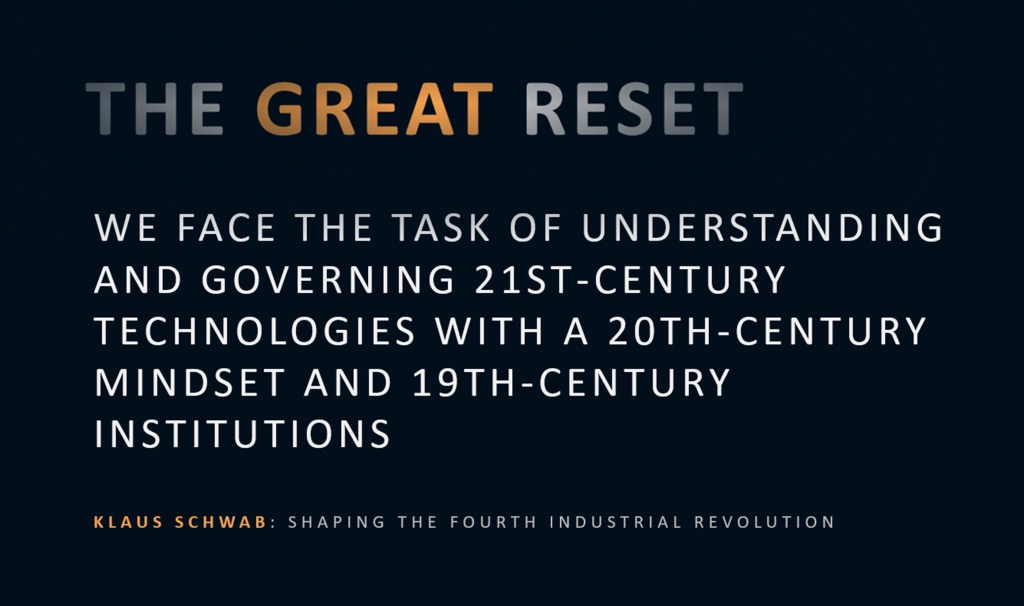
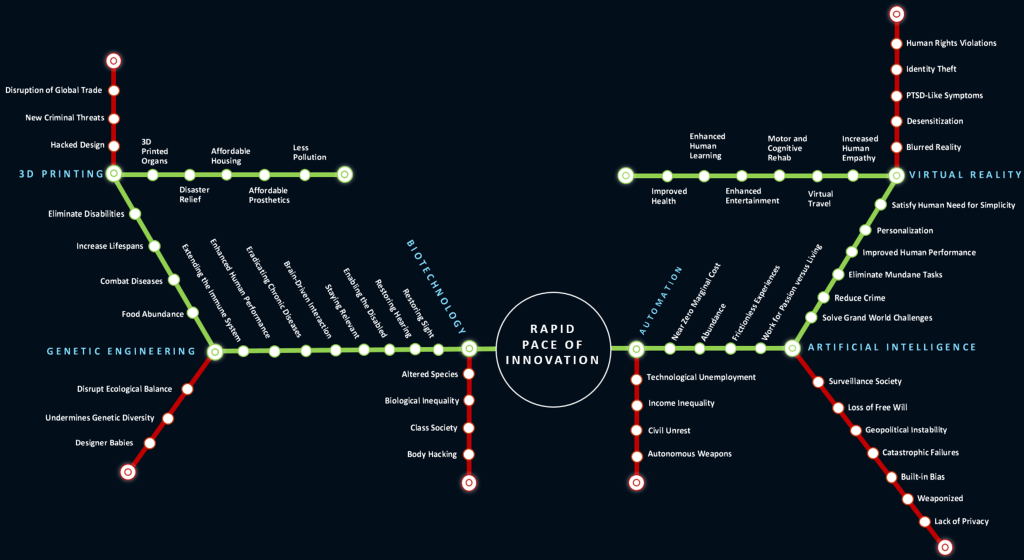
I found a very refreshing Article today describing Japan’s vision for the fifth iteration of society. Our hunter-gatherer days represent the first iteration, with agriculture coming in as number two and the industrial and information revolutions rounding out the next two. I’ve written about the Tipping Points in human history – and this vision of a future society is aligned with my point of view on the next tipping point. With each tip, we have experienced Unintended Consequences. Big visions such as these would be wise to ensure a balancing of the Opposing forces of Innovation.
-
Ray Kurzweil Predicts: Disease, Reality, and Brain Interaction
Ray Kurzwiel has always been very good at predicting; which will make some of his recent predictions scary for some and fascinating for others. That’s the general reaction when people are exposed to some of what Futurists see coming. Out of the 147 predictions he made in his various books, only 3 turned out to be totally wrong. With that knowledge in hand, this recent Article describes some of Ray’s recent predictions. Scary, fascinating, or some combination of the two? Here is a look at three of his recent predictions:
-
Paralyzed Man Walks in Brain-Controlled Exoskeleton
This recent Article highlights the progress made in brain science, our focus on solving grand world challenges, and the critical need to continue this advancement. The article describes how a paralyzed man using only his brain signals was able to operate, maneuver, and walk in a whole-body robotic exoskeleton. This press release provides more details. The findings could advance efforts to help paralyzed patients drive computers using brain signals alone; “perhaps starting with driving wheelchairs using brain activity instead of joysticks and progressing to developing an exoskeleton for increased mobility,” says Stephan Chabardes, neurosurgeon from the CHU of Grenoble-Alpes, France.
-
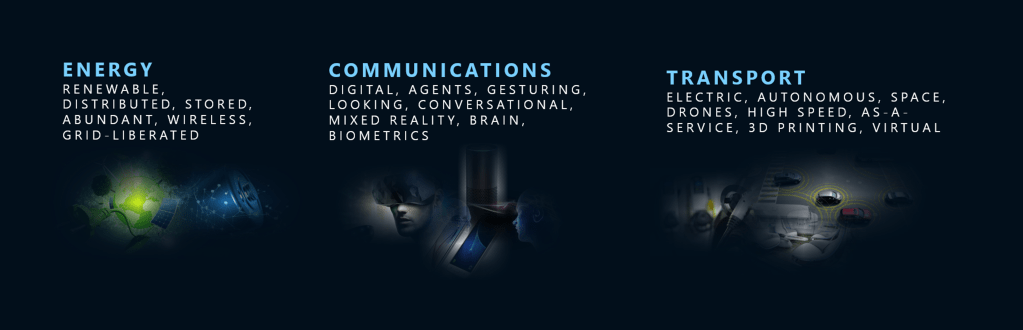
The Shifting Energy Paradigm
Our energy platform has not changed since the early days of the second industrial revolution. Energy is one of the three foundational pillars of our society – with communication and transport representing the other two. Collectively, they create a general purpose technology platform that enables our society. Although we talk a lot about a Fourth Industrial Revolution, in reality, there was never a third shift in this foundational platform.
-
Trends that could change everything in the next decade
CCS Insight delivered a set of future predictions at its annual future-gazing event in London on Thursday 3 October. A longer than usual time frame was the focus, stretching to 2030. A total of 90 predictions were released. I include some interesting ones below.
PREDICTIONS
By 2021, algorithmic and anti-bias data auditors emerge to tackle “pale, male and stale” artificial intelligence.
-
Automation to Destroy 200,000 Banking Jobs
A recent Article states that automation will result in the biggest reduction in headcount across the U.S. banking industry in its history, with an estimated 200,000 job cuts over the next decade – this according to Wells Fargo & Co.
-
UPS gets FAA clearance to roll out a fleet of delivery drones
For the first time, the Federal Aviation Administration (FAA) has given broad permission to create a fleet of drones to deliver packages with very few limitations on Tuesday – the first time it’s given such broad permission to a delivery company. The delivery program is described in this Article.
Listen to UPS Chairman and CEO describe the Drone Airline that UPS is now going to build out.
Just another example of how the Mobility Ecosystem is evolving rapidly, and the stakeholders within the ecosystem continue to shift. Who will be the dominant players in the ecosystem? One thing is certain: as mobility experiences are altered, traditional companies and their role within the ecosystem will shift – or their roles will be diminished.
-
The Education Ecosystem
I had a call a while back with education entrepreneur Nick Burnett. Nick shares my passion for rethinking a learning paradigm that was built in a different era. In this world of rapid change, where information is abundant and the shelf-life of skills is short, learning is central to our quest for improved well-being.
During the first revolution, it was education that finally shifted the plight of the working class. In the early days of mass production, it was the introduction of high school that allowed workers to meet the skill set demands of new roles on assembly lines and in the office. This time around, the challenge is greater. The speed dimension promises to complicate the re-skilling requirements of an automated future. It will indeed take an education ecosystem to meet the challenge. In his latest article, Nick focuses on this education ecosystem – well worth the quick read.
-
MIT Report on the Future of Work
In a recent Article posted on the Singularity Hub, the author describes the first report of the MIT Task Force on the Work of the Future. This group of MIT academics was set up by MIT President Rafael Reif in early 2018 to investigate how emerging technologies will impact employment and devise strategies to steer developments in a positive direction. The primary finding from this report is that it’s the quality of the jobs we should worry about – not the quantity.


