
Winston Churchill’s famous words – “History will be kind to me, for I intend to write it myself” – are not simply a reflection of confidence or political legacy. They represent a profound truth: that those who step forward to shape the future ultimately influence how history remembers the past.
(more…)Tag: History
-
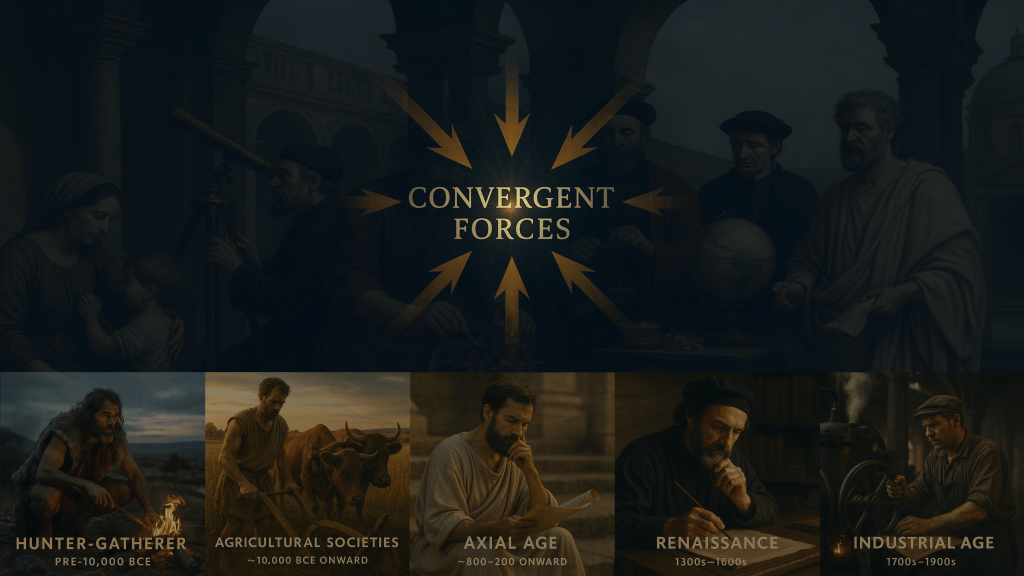
From Campfires To Code: The Systemic Shifts That Shaped Humanity
Human history has been anything but linear. While centuries can pass with relative stability, there are rare moments where everything changes—moments where converging forces across domains give rise to entirely new paradigms. These are not just periods of change. They are systemic transitions that reshape how we live, work, relate, and make sense of the world.
(more…) -

The Return Of The Polymath: Thinking Systemically In An Age Of Complexity
In times of profound change, the ability to connect dots across disciplines becomes essential. As the world faces converging forces across science, technology, society, economics, geopolitics, the environment, and philosophy, the polymath reemerges – not as a relic of the past but as a necessity for navigating the future.
Last year, I explored the polymath phenomenon and how our evolving world may be giving rise to a new kind of intelligence – polyintelligence. That post traced the lives of polymaths like da Vinci, Goethe, and others who shaped eras of discovery and disruption. If you haven’t read it, I encourage you to revisit that foundation here: Genius Across the Ages.
What we are experiencing today is not simply another technological cycle – it is a systemic shift. To make sense of that shift, we must look to history, and the eras where polymathic thinking played a central role in societal advancement.
(more…) -
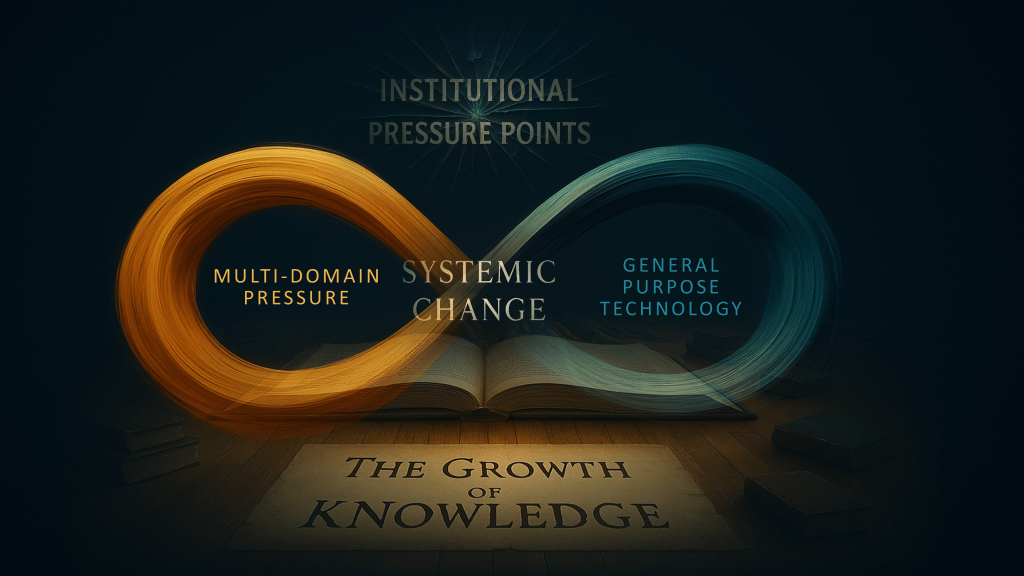
When Systems Shift: The Rare Alignment Driving Change Today
History is filled with moments of disruption and reform. But true systemic change – when the very foundations of society are redefined – has been rare. These periods of profound transition are not triggered by short-term trends. They emerge when multiple deep forces move in tandem, setting in motion the restructuring of the societal platform itself.
(more…) -
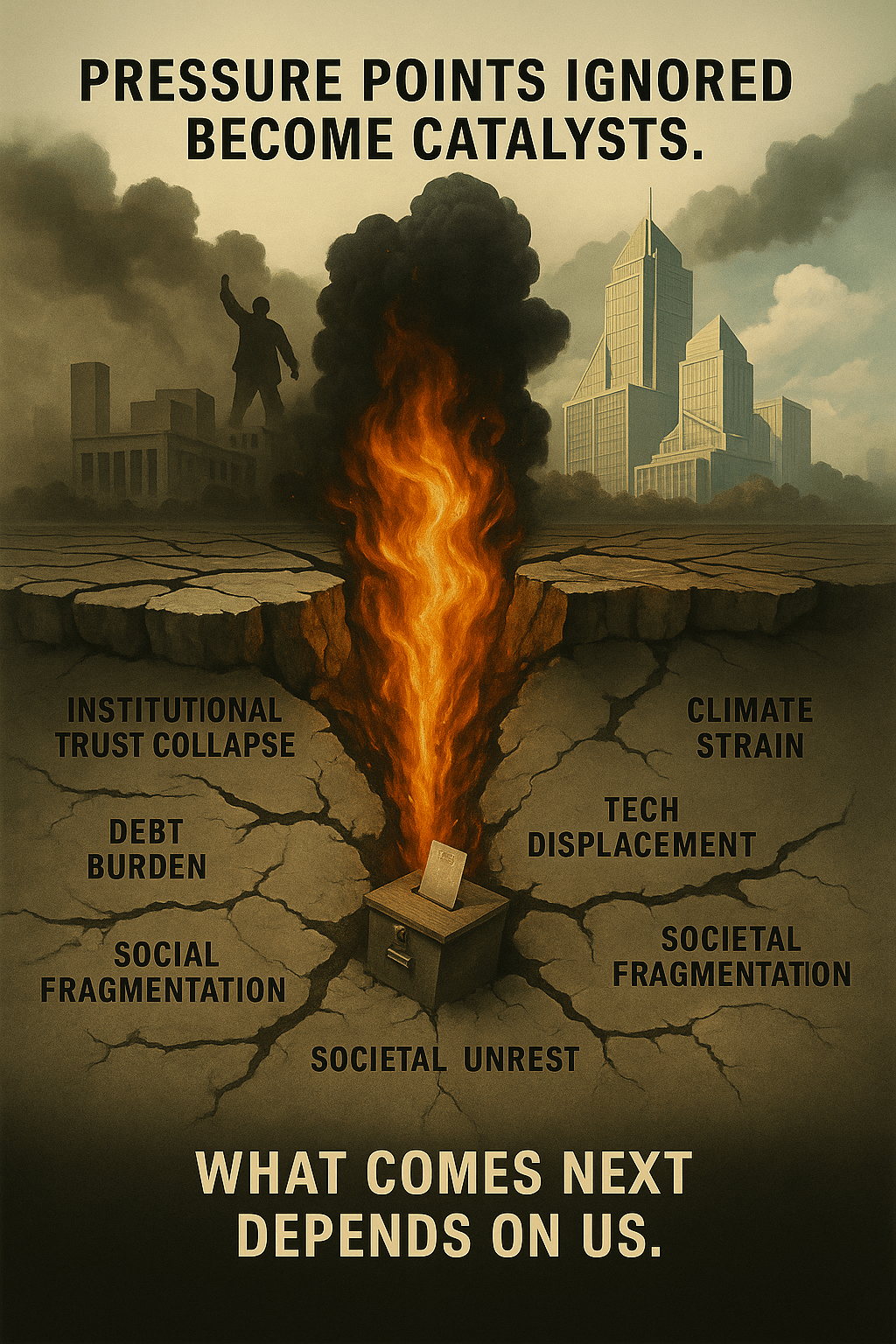
Pressure Points And Catalysts: Shaping Our World
I introduced the notion of pressure points and catalysts in an earlier post. Here are the results of my analysis.
Introduction
The trajectory of human civilization is not merely a linear progression but a complex interplay of forces that build, converge, and occasionally erupt into periods of profound transformation. Understanding these dynamics requires a framework centered on Pressure Points and Catalysts – concepts crucial to comprehending how global systems evolve and redefine themselves.
(more…) -

Building Possibility Chains: Mapping Disruption Across A Converging World
As I’ve explored in Post One and Post Two of this series, history doesn’t move in straight lines. It moves in cycles of buildup and release – of pressure and systemic change. Across time, humanity has navigated moments when systems fray, institutions falter, and norms break down. These moments are rarely surprises. They’re preceded by converging signs – warning lights blinking across domains that something foundational is under strain. We are in such a moment now.
(more…) -
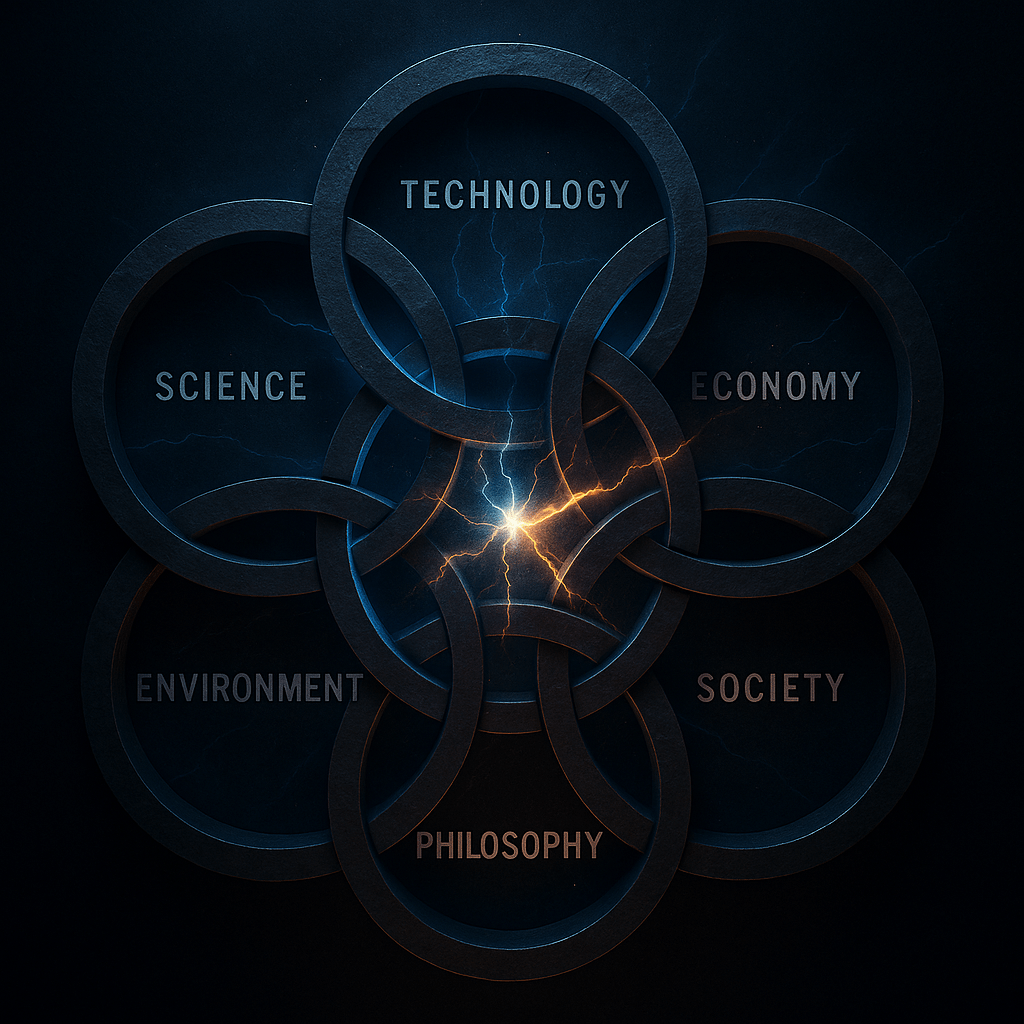
When All Domains Move At Once – Understanding The Convergent Instability Of Our Time
In the first post of this series, I explored the expanding possibility space – the widening range of plausible futures shaped by more than 1,700 convergent forces unfolding across time and across domains. That post introduced the structural lens for understanding how pressure builds, how pathways emerge, and how catalysts may eventually reshape the system. This post focuses on what makes that possibility space so expansive in the first place: the simultaneous instability across seven foundational domains. Science, technology, economy, society, geopolitics, philosophy, and environment are not shifting sequentially or in isolation. They are all in motion, at the same time, and in constant interaction.
(more…) -

A World Of Expanding Possibilities – And Accelerating Pressure
The world feels unfamiliar – more volatile, more complex, and harder to navigate than at any point in recent memory. That sense is not misplaced. It reflects the reality of a system under strain.
Across seven domains – science, technology, society, geopolitics, economy, philosophy, and environment – more than 1,700 convergent forces have been identified and mapped between 2025 and 2030, with the list continuing to grow. These forces are directional, accelerating, and deeply entangled. Together, they are expanding the possibility space – the set of plausible futures – faster than most institutions can observe, let alone act.
(more…) -

Introducing the Next Phase: Pressure Points, Catalysts, and the Forces That Shape Them
History doesn’t move in straight lines. It moves in cycles of buildup and release – of pressure and transformation. Across time, humanity has navigated moments when systems fray, institutions falter, and norms break down. These moments are rarely surprises. They are preceded by converging signs – warning lights blinking across domains that something foundational is under strain.
(more…) -

The Fastest Tech Transition In History: How Businesses And Governments Can Lead Or Lag
Historically, the diffusion of transformative technologies has been constrained by institutional inertia, workforce adaptation, and the challenge of transferring tacit, hands-on expertise. As a result, decades often separated invention from widespread adoption. Today, however, powerful General Purpose Technologies – artificial intelligence, quantum computing, and synthetic biology – may defy that pattern, diffusing faster than ever. What makes this era different, and how should businesses and governments respond?
(more…) -
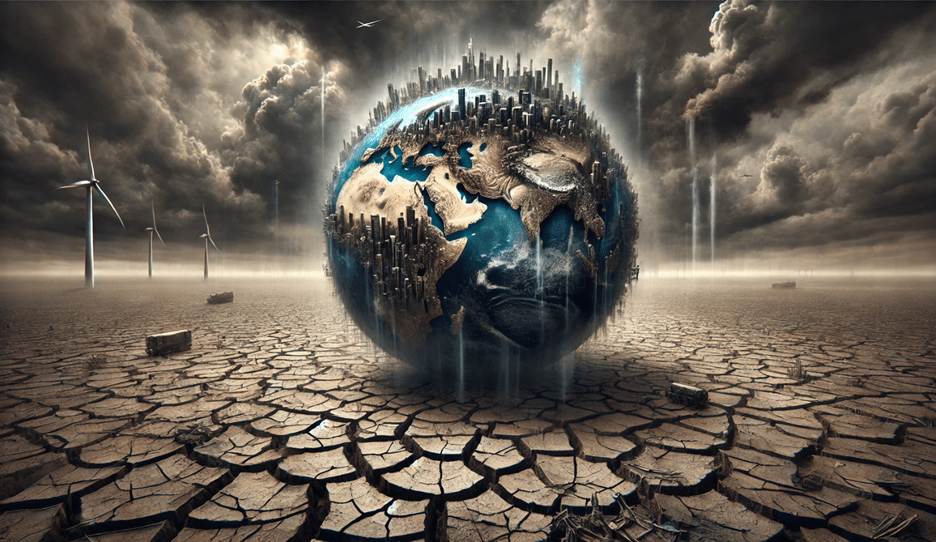
Navigating A World Of Permanent Crisis: A Review Of Robert D. Kaplan’s Waste Land
Robert D. Kaplan’s latest book, Waste Land: A World in Permanent Crisis, presents an unsettling yet necessary exploration into our current global predicament. True to Kaplan’s distinguished career, this book expertly connects historical contexts with today’s increasingly complex reality, a practice that resonates deeply with my own work on examining historical lessons to better understand our evolving future.
(more…) -
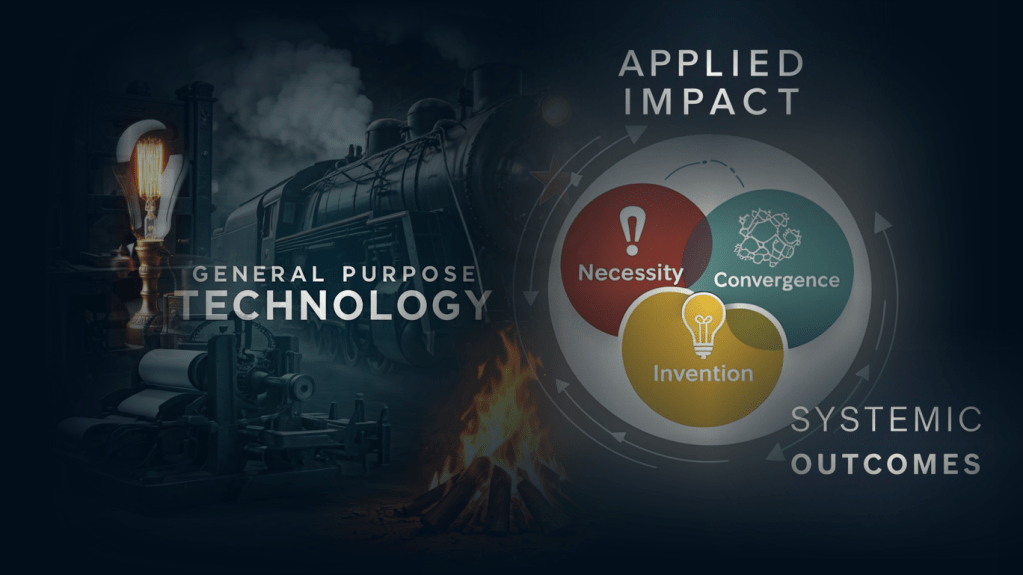
When General-Purpose Technologies Intersect With Necessity, Invention, And Convergence
History teaches us that transformative technologies do not emerge in isolation, nor do they reshape the world overnight. Instead, they follow a discernible pattern – an evolutionary journey that unfolds in response to human needs. Two phenomena help us understand this journey: the Evolutionary Phases of General-Purpose Technologies (GPTs) and the role of necessity, invention, and convergence (NIC). When viewed together, they provide a powerful lens for understanding not just how technologies evolve, but why they emerge and when they reach their full potential.
(more…) -

The Fragile Future: Why Stability Is More Uncertain Than Ever
History does not repeat, but it often rhymes. As I read Robert D. Kaplan’s Waste Land: A World in Permanent Crisis, I was struck by his argument that the 20th and early 21st centuries have been especially bloody because the stabilizing force of monarchy has vanished. He suggests that despite our moral progress in areas like human rights and the environment, the world remains tightly wound, vulnerable to clashing interests and aggressive authoritarian states. He draws an analogy to Weimar Germany – a moment of fragile democracy, economic strain, and rising nationalism that ultimately collapsed into war.
(more…) -

The Eurasian Century – Navigating Global Convergence
I recently finished reading The Eurasian Century: Hot Wars, Cold Wars, and the Making of the Modern World by Hal Brands, a sweeping historical analysis that illuminates Eurasia’s enduring centrality in global geopolitics. The author convincingly demonstrates how Eurasia’s vast resources, immense population, and strategic location have continuously positioned it as the crucible of global power struggles – from the ideological confrontations of the twentieth century to today’s emerging geopolitical tensions. His narrative offers profound lessons for leaders navigating an increasingly interconnected and uncertain global landscape.
(more…) -
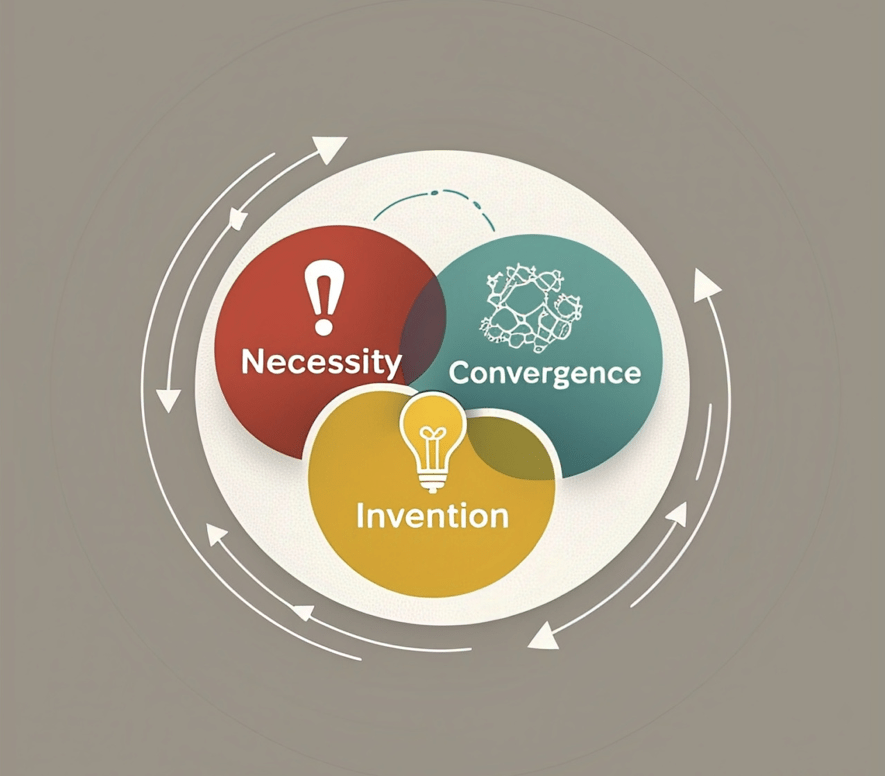
Meeting Today’s Grand Challenges – The Next Wave of Convergence
Throughout this four-part series, we’ve seen how necessity sparks invention – and together, they transform our society in profound ways. Today, our world faces an array of urgent challenges, from climate change and demographic shifts to economic and geopolitical instability, cybersecurity threats, and healthcare crises. These pressures are igniting a fresh wave of convergence, where inventive and innovative responses to pressing needs are poised to reshape our future. As we enter this transformative era, the cycle of necessity and invention reminds us that bold, purpose-driven invention and innovation is our best path forward.
(more…) -
The Converging Forces Of Progress: Necessity, Invention, And Systemic Outcomes
What if the very inventions that propel humanity forward also sow the seeds of our greatest challenges? History shows that progress is rarely a straight line. Instead, it moves in cycles: necessity sparks invention, and inventions converge to reshape society. From the steam engine’s role in the Industrial Revolution to the internet’s impact on globalization, each wave of transformation has brought profound change – economic shifts, new social structures, and unintended consequences. These disruptions, from rising inequalities to environmental crises, often take decades to address. As we stand on the brink of the next great convergence – whether in AI, biotechnology, humanoid robots, cyber, climate or health – we must ask – how can we harness innovation to create a more equitable and sustainable future?
(more…) -
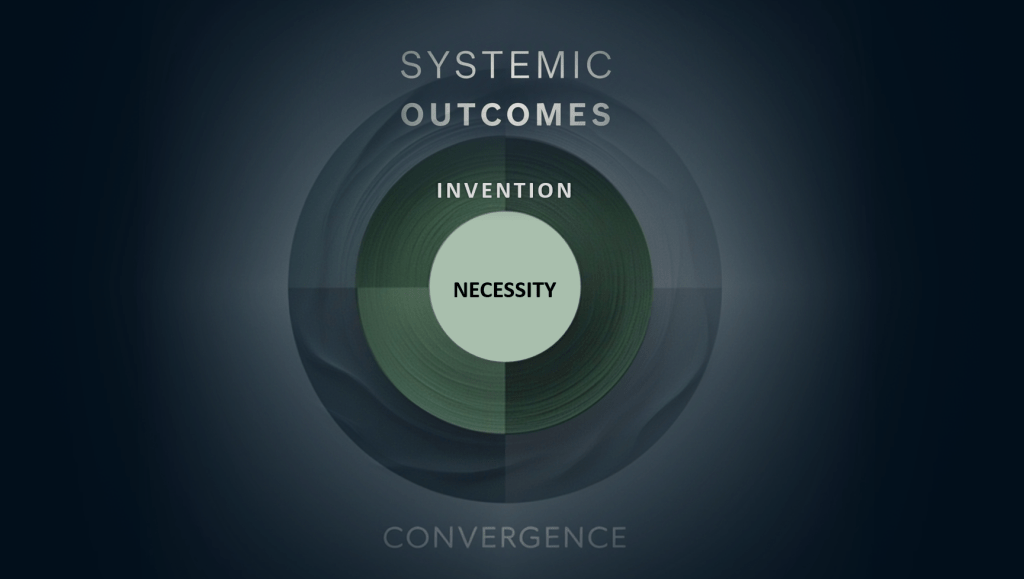
The Necessity-Invention-Convergence Framework
The Necessity-Invention-Convergence Framework provides a structured way to analyze the forces that drive human progress. At its core, necessity serves as the fundamental driver of change, arising from pressing challenges, constraints, or demands. Whether economic, social, environmental, or geopolitical, necessity compels action and forces innovation. Throughout history, this dynamic has played out in transformative ways. The Industrial Revolution was fueled by labor shortages and an increasing demand for goods, just as the Digital Revolution emerged in response to the need for faster, decentralized communication. Today, the global energy transition is being shaped by the necessity of addressing climate change and resource limitations.
(more…) -
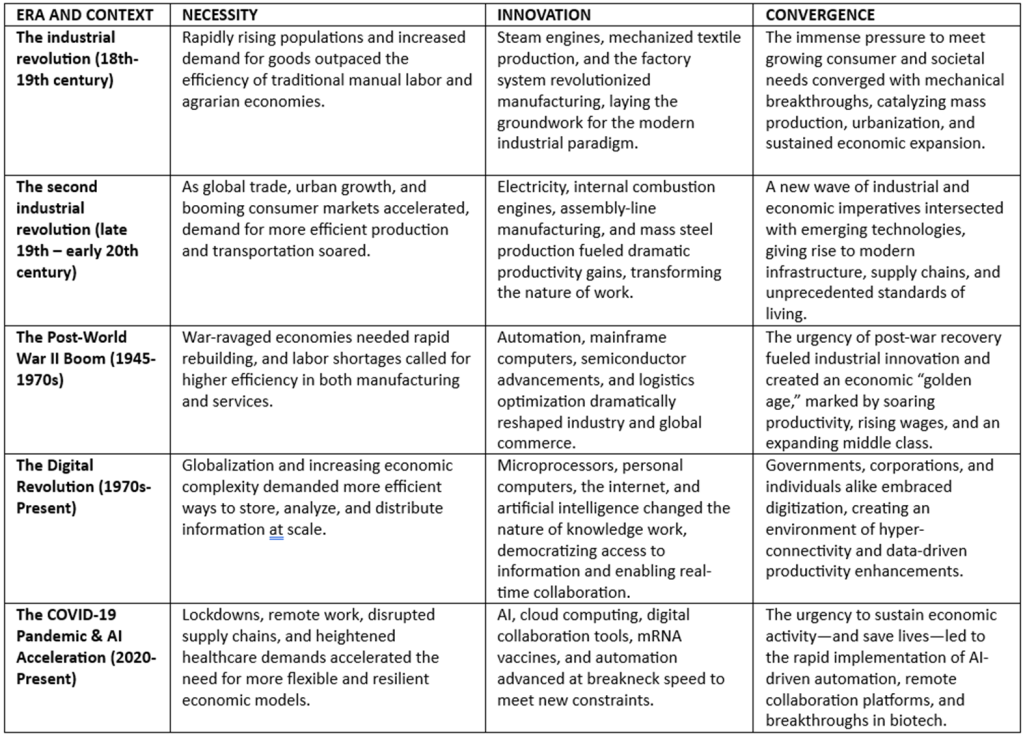
The Great Convergence: When Necessity Meets Invention and Innovation
History has shown that when necessity, invention and innovation converge, the result is transformative change. From the steam engine to artificial intelligence, periods of economic, societal, and technological strain have consistently pushed invention innovation to new heights. These inflection points – where high-pressure needs meet breakthrough ideas – can drive unprecedented leaps in productivity, reshaping industries, economies, and even entire civilizations.
(more…) -
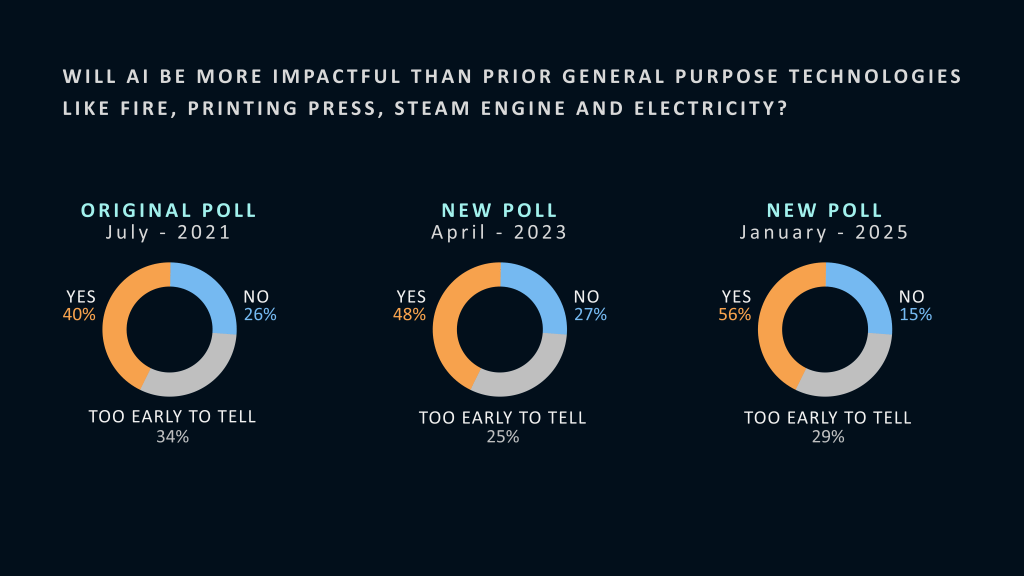
The Evolution Of AI Perception: From Skepticism To Conviction
In 2021, I conducted a poll to gauge public sentiment on the transformative potential of artificial intelligence. I posed a bold question: Will AI be more impactful than prior general-purpose technologies like fire, the printing press, the steam engine, and electricity? Respondents had three choices: Yes, No, and Too Early to Tell. The results reflected a world still grappling with AI’s potential—40% answered Yes, 26% No, and 34% felt it was Too Early to Tell.
(more…) -

Rehearsing The Future: Navigating Complexity With Mimi Brooks
In an age of accelerating change and complexity, leadership requires more than traditional planning – it demands a mindset of rehearsal. This principle framed my recent conversation with Mimi Brooks, CEO of Logical Design Solutions, on her Bold Agendas podcast. Our discussion spanned the evolving role of ecosystems, the dual edges of innovation, and the critical importance of adaptability and resilience. Together, we unpacked strategies for thriving in an unpredictable world and explored the transformational shifts leaders must embrace to navigate 2025 and beyond.
(more…)

